Pivotal stage:
The primary endpoint was the percentage of patients with 20% or greater reduction in diurnal IOP after 2 years of follow-up

Sponsored by Alcon
556 Patients
•
38 centers
9 countries
A phase 3 clinical trial that compared Hydrus® Microstent plus cataract surgery to cataract surgery alone, split into two phases:
The primary endpoint was the percentage of patients with 20% or greater reduction in diurnal IOP after 2 years of follow-up
Patients were continuously followed for an additional 3 years to monitor safety and to assess predefined efficacy endpoints
Enrolled patients with mild-to-moderate primary open-angle glaucoma on one to four medications.
Patients were randomized 2:1 to Hydrus® Microstent placement (Hydrus + CS; n = 369) or cataract surgery alone (CS alone; n = 187)

The mean reduction in washed-out diurnal IOP at 2 years was -7.5 ±4.1 mm Hg and -5.3 ±3.9 mm Hg in the Hydrus® + CS group and the CS alone group, respectively (difference = -2.2 mm Hg; P < .001)2
The mean number of medications was reduced from 1.7 ±0.9 to 0.3 ±0.8 in the Hydrus® + CS group and from 1.7 ±0.9 to 0.7 ±0.9 in the CS alone group
At 2-years of follow-up, 78% and 48% of eyes were on zero medications in the Hydrus® + CS group and the CS alone group, respectively2

Five-year follow-up was completed in 80% of patients in the Hydrus® + CS group and in 71.7% in the CS alone group3
The change in IOP versus before surgery was -8.3 ±3.8 mm Hg in the Hydrus® + CS group and -6.5 ±4.0 mm Hg in the CS alone group3
The rate of Secondary Surgical Interventions (SSIs) was lower in the Hydrus® + CS group (2.4%; n = 9/369) compared to the CS alone group (5.3%; n = 10/187)—a greater than 50% relative reduction3*
*Secondary Surgical Interventions (SSI) include trabeculectomy, tube shunt, gel stent, ECP/TSCP, non-penetrating; (9/369 Hydrus Microstent +cataract surgery and 10/187 cataract surgery); vs. cataract surgery alone: 2.4% in Hydrus + cataract surgery vs. 5.3% in cataract surgery only.

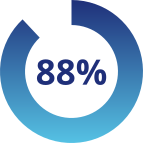
of patients on 1 medication at baseline remained medication-free at 2 years3
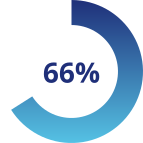
Among Hydrus Microstent patients on 1 prior medication, 66.1% remained medication-free for 5 years.
Patients previously on 1 medication: Hydrus Microstent + cataract surgery (n=308 patients) vs. cataract surgery alone (n=134 patients); 41.1% of the cataract surgery-alone patients remained drop-free.

in the Hydrus® + CS group

in the CS alone group
Among Hydrus Microstent patients on 1 prior medication, the rate of incisional SSls was 1.8% for Hydrus Microstent + cataract surgery and 4.1% for cataract surgery alone at 5 years.

Comparable rates of serious adverse events after 5 years of follow-up: 3.5% in the Hydrus® + CS group (n = 13/369) and 4.3% in the CS alone group (n = 8/187)5
In the majority of eyes with PAS (30/42 or 71.4%), peripheral anterior synechiae were focal or <1 clock hour in size, there was no adverse impact to IOP or visual acuity, and there were no sequelae observed in eyes with device obstruction
*n=369 eyes receiving Hydrus Microstent + cataract surgery, n=187 eyes receiving cataract surgery alone (results not reported for this endpoint).PAS observation based on gonioscopic appearance, not IOP.


At 3 months postoperatively, Hydrus® had an initial postoperative spike in endothelial cell loss versus cataract surgery alone5

After this point, the rate of change in endothelial cell density was stable and followed the same trajectory as the cataract surgery only group, with no difference in the rate of postoperative endothelial cell loss5

No patients demonstrated any clinically significant sequelae such as corneal edema or corneal decompensation5

POAG = primary open angle glaucoma

Baseline as well as 2-and 5-year global visual field metric data were comparable between groups2,8*
*n=352 eyes receiving Hydrus Microstent + cataract surgery, n=165 eyes receiving cataract surgery alone.
MD worsening by ≥ 2.5 dB was defined as an adverse event. Safety outcomes were similar between groups.1,2
Baseline sensitivities (estimated via a separate analysis) were similar between groups after cataract surgery7
Approximately 6 VF measurements over 4.9 years were used for each group
The rate of progression was -0.49 dB/year in the CS alone group vs. -0.26 dB/year in the Hydrus® + CS group7
DIOP=diurnal intraocular pressure; IOP=intraocular pressure.
1. HYDRUS® Microstent [instructions for use]. Irvine, CA: Alcon Vision LLC; September 2021 (United States).
2. Samuelson TW, Chang DF, Marquis R, et al; HORIZON Investigators. A schlemm canal microstent for intraocular pressure reduction in primary open-angle glaucoma and cataract: The HORIZON Study. Ophthalmology. 2019;126(1):29-37.
3. Ahmed IIK, De Francesco T, Rhee D, et al; HORIZON Investigators. Long-term outcomes from the HORIZON Randomized Trial for a schlemm's canal microstent in combination cataract and glaucoma surgery. Ophthalmology. 2022;129(7):742-751.
4. Alcon Data on File, 2024. REF-24145.
5. Alcon Data in File, 2021. REF-15037
6. Alcon Data on file, 2023. REF-22437.
7. Montesano G, Ometto G, Ahmed IIK, et al. Five-year visual field outcomes of the HORIZON trial. Am J Ophthalmol. 2023 Jul;251:143-155.
INDICATIONS FOR USE: The Hydrus® Microstent is intended for the reduction of intraocular pressure (IOP) in patients with primary open angle glaucoma (POAG) as a standalone treatment or in conjunction with cataract surgery.
CONTRAINDICATIONS: The Hydrus® Microstent is contraindicated under the following circumstances or conditions: (1) In eyes with angle closure glaucoma; (2) In eyes with secondary glaucoma such as neovascular glaucoma or uveitic glaucoma; (3) Patients with known nickel allergy; (4) Pediatric patients less than 18 years of age.
WARNINGS: Clear media for adequate visualization is required. Conditions such as corneal haze, corneal opacity or other conditions may inhibit gonioscopic view of the intended implant location. Gonioscopy should be performed prior to surgery to exclude congenital anomalies of the angle, peripheral anterior synechiae (PAS), angle closure, rubeosis and any other angle abnormalities that could lead to improper placement of the stent and pose a hazard.
PRECAUTIONS: The surgeon should monitor the patient postoperatively for proper maintenance of intraocular pressure. The safety and effectiveness of the Hydrus® Microstent has not been established as an alternative to the primary treatment of glaucoma with medications, in patients 21 years or younger, eyes with significant prior trauma, eyes with abnormal anterior segment, eyes with chronic inflammation, eyes with glaucoma associated with vascular disorders, eyes with uveitic glaucoma, eyes with other secondary open angle glaucoma, or eyes that have undergone argon laser trabeculoplasty (ALT). The safety and effectiveness of use of more than a single Hydrus® Microstent or with other metallic implants has not been established.
ADVERSE EVENTS: The most common intra-operative and post-operative device-related ocular adverse events reported include transient hyphema; peripheral anterior synechiae without device obstruction; partial or complete device obstruction; non-persistent anterior uveitis/ iritis; subconjunctival hemorrhage; and device malposition.
MRI INFORMATION: The Hydrus® Microstent is MR-Conditional meaning that the device is safe for use in a specified MR environment under specified conditions. Please refer to product direction for use for list of indications, contraindications and warnings.
©2026 Alcon Inc. 02/26 US-HDM-2600002