


What influence did Morton Grant, MD, have on your professional life?
I was privileged to be at the Massachusetts Eye and Ear Infirmary when Drs. Grant, Cogan, Kuwabara, and Knoshita were actively interacting with the ophthalmology residents along with many private practitioners in the community such as Drs. Gundersen, Chandler, Sloan, Hutchinson, Simmons, and Schepens. My active mentors were also my very special fellow residents, including Drs. Brubaker, Worthen, Petersen, Frederick, Pruett, and Thoft. Glaucoma fellows Bruce Shields, Robert Bellows, and Douglas Anderson arrived and found space at Dr. Grant’s table for coffee and an active discussion of cases. I was inspired, motivated, and personally challenged by their collective excellence and understanding of ophthalmology and glaucoma, which was far ahead of mine.
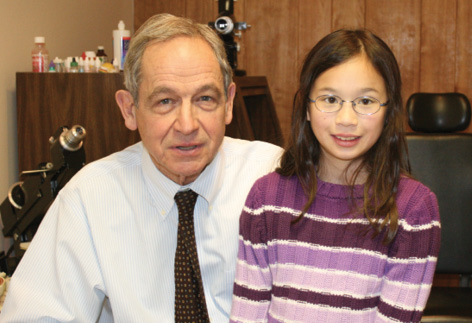
Dr. Walton with a patient after glaucoma surgery.
I had chosen the medical profession, because it offered me the opportunity to care for children through the challenge of individual development and work. Dr. Grant recognized my interest very early and encouraged me to pursue the care of children with glaucoma. He actively taught me examination skills and assisted me on the majority of my resident surgeries. Dr. Grant had assisted Dr. Chandler for many years with the surgeries on infants with glaucoma in Boston, and after my training, they very generously directed this responsibility to me. On a personal level, Dr. Grant’s integrity, humility, and generosity were indelibly adopted as a goal by all of us privileged to be his students.
What led you from your training as a pediatrician to your work in ophthalmology?
Fast Facts
• Surgeon in ophthalmology at Massachusetts Eye and Ear Infirmary in Boston, 1990 to present
• Clinical professor of ophthalmology at Harvard Medical School in Boston, 2004 to present
• Pediatrician at Massachusetts General Hospital in Boston, 2010 to present
• President of the Chandler Grant Society, 2007 to 2009
• President of the Children’s Glaucoma Foundation, 1999 to present
• Recipient of the American Academy of Ophthalmology’s Senior Achievement Award, 2009
I like to think that I have in a small way successfully incorporated ophthalmology into my care of children and being a pediatrician. I have had some success in recognizing and interpreting systemic conditions in patients who have been sent for ophthalmic concerns, and I am very pleased when I can help children who have been sent with puzzling clinical findings by their family pediatricians. I also find house calls to be an indispensable opportunity to closely observe children after glaucoma surgery and to respond promptly when called for my patients who are not doing well for other reasons.
What is known about the mechanism of aphakic glaucoma, and what remains to be determined?
Glaucoma has always complicated early congenital cataract surgery. Fifty years ago, pupillary-block secondary glaucoma was the most frequent mechanism. With the placement of an iridectomy followed for the past 40 years by the use of aspiration and vitrectomy instruments, the filtration angles are typically open after infantile lensectomy procedures. It has been repeatedly demonstrated that the significant risk of secondary glaucoma in young infants has persisted after lensectomy procedures. The release and persistence of lens cells in the aqueous fluid may put the trabecular meshwork at significant risk related to the effect of offending cytokines. In addition, I suspect that epithelial-mesenchymal transition plays an active role and is responsible for fibrosis of the trabecular meshwork and the marked gonioscopic abnormalities that are seen in patients soon after their lens surgery.
What is your secret for calming an infant or small child so that you may measure his or her IOP?
Whatever it is, I wish it were always there to assist me! It is helpful for the child and parents to know that you are going to measure the pressure and be successful no matter how long it takes to accomplish this. To perform the examination with the child held upright by the parent is very basic. Distraction is a great aid, of course, from preoccupation with feeding to the delight of an unfamiliar toy. I think that it is very important that the child and parent believe that you care for them and will not hurt the child. A lot of meaningful hugs and lollipops after successful tonometry may help prepare the patient and parents for the next examination.
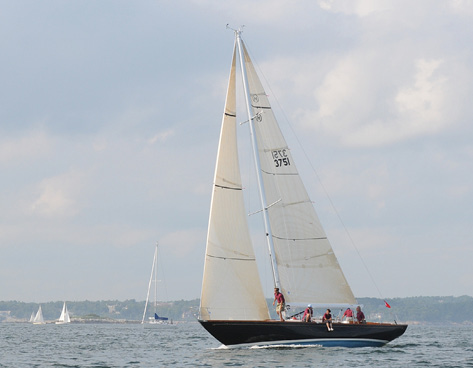
Dr. Walton sailing Black Magic in Marblehead.
What do you enjoy the most about sailing?
I enjoy the technical challenge of making my older boat continue to be very competitive and the companionship of my sons and friends, who crew and tolerate my competitive starts and suggestions for trim changes. Marblehead is a beautiful sailing community on the North Shore near Boston, where I go to enjoy its deep water and good winds. Sailing began for me on a New Jersey island, where Robison Harley, MD, PhD, taught me how to race boats and to believe that I might become a meaningful pediatric ophthalmologist with the suggestion that I come every week to observe his surgery. By the end of the third summer, we won more races, and incredibly, he also assisted with my first lensectomy before I returned to school.
