


Running an efficient glaucoma clinic starts with your scheduling template and trickles down to the appropriate allocation of staff and facility resources. Identify a staff person to be responsible for reviewing scheduling and chart notes in advance to anticipate the testing requirements or other needs of each patient. The mix of new and established patients should be linked to the predictable flow of each type of visit. Evaluations should be adequately spread out to allow for additional testing or a little extra time to be spent as needed. The management and coordination of types of visits are the keys to success.
PROCESS FOR NEW PATIENTS
New patients must complete preliminary paperwork and/or have documentation from a referring doctor to identify their condition or the preliminary indicators for treatment. Having baseline information will help your staff predict what needs to happen and will allow them to inform the patient of what to expect at his or her first visit. This is a perfect opportunity to invite patients to enroll and submit their history and intake forms electronically prior to their visit if your practice has a functional patient portal. If not, be sure that the patient history and intake forms are accessible on your practice's website; appointment schedulers should ask new patients to download the forms and complete them at home. Whenever possible, have patients submit their forms to the practice in advance, perhaps via a specific dedicated fax line. New patients who refer themselves may need a full battery of tests and should be advised that their initial evaluation could take a significant amount of time.
A scribe or clinical support staff member should preload preliminary information into the patient's record. If the data are not entered in advance, they tend to be entered by the technician, which is not an effective use of his or her time.
PLAN FOR TESTING
Be prepared to meet imaging and other testing needs by having dedicated staff resources available, especially for visual field testing. For example, if a patient has not had a visual field test in the past 6 months, staff should be available for perimetry other than the technician(s) who must keep on top of the patient workups so that you, the physician, remain on schedule. Because most of the other tests such as routine optical coherence tomography and confocal scanning laser ophthalmoscopy do not take as much time as visual field testing, the technicians can usually perform these tests as part of a short visit without compromising workflow.
Your facility should also have adequate space and equipment to run testing simultaneously with the clinic schedule without disrupting the delicate balance. If not, patients will become unhappy with waiting times.
CREATING A SCHEDULE TEMPLATE
The ideal number of patients and types of visit will vary by physician. Creating an efficient schedule template includes limiting glaucoma evaluations to a realistic number per day (Table). In most glaucoma practices, three evaluations per half-day will maintain an efficient flow of patients. Most other types of appointments are similar in the amount of time they take.
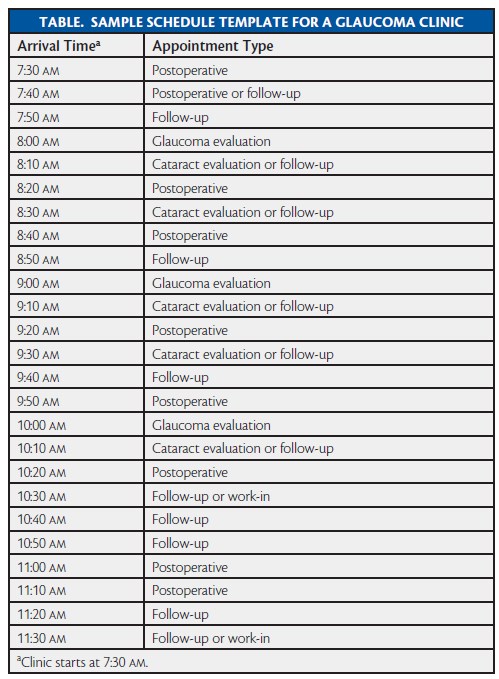
In a glaucoma clinic, refractions usually are not required, and the emphasis is on monitoring IOP. Each visit usually requires a complete review of medications, and a typical maximum is six patient visits per hour. This volume allows adequate time for workups.
On an hourly basis, then, a reasonable template might comprise one glaucoma evaluation, then three or four glaucoma rechecks, followed by two to three postoperative visits. Six patients per hour is a manageable schedule with a little wiggle room for the unexpected.
ACCOMMODATING URGENT APPOINTMENTS
Maintaining a waiting list can help preserve full schedules. Glaucoma clinics will always have patients who need to be seen on short notice. Plan some time for these visits, and advise scheduling staff. Consider allowing some extra time at the end of a morning or afternoon clinic schedule to avoid increasing waiting times for existing patients.
FUTURE SCHEDULING
Ideally, your clinic has a checkout person who can schedule the return visits. The patient's record should indicate what testing will be necessary prior to or at the time of the next visit. He or she should be advised of the need for testing and offered the opportunity to schedule it separately to avoid longer appointment times. The patient's next visit should be based on his or her preference for waiting time and ability to schedule multiple visits. Many times, however, it is more efficient for both the clinic and for patients if the testing occurs in advance, because then, it can be planned around less busy clinic times. If a patient prefers to combine testing with the visit on the same day, then these activities should be scheduled separately to avoid workflow problems.
ADAPTABILITY
Schedules are dynamic and never totally predictable. Every template can fall apart. Eventually, a staff member will call in sick, a visit will not go as planned, equipment will break down, or something else will go awry. Cross-training efforts can help avoid some scheduling pitfalls. In other words, staff members from other departments learn to perform simple testing and basic workup functions to help keep patient flow on track.
That said, taking the time to plan and prepare while constantly evaluating and adapting workflow will help your glaucoma clinic run smoothly most of the time.
Candace S. Simerson is the president and chief operating officer of Minnesota Eye Consultants in Bloomington. Ms. Simerson may be reached at (952) 567-6100; cssimerson@mneye.com.
