


Do you doubt that your electronic medical record (EMR) system can help you manage glaucoma patients? Your skepticism is not unreasonable, considering the past performance of the EMR industry. The best platforms available today help eye doctors organize and summarize patient data in a format that is more efficient than thumbing through paper charts, but these systems do not really help doctors process large amounts of complex data—at least not yet.
NASCENT TECHNOLOGY
Twenty years ago, could people have anticipated using a cell phone as you do now? Could they have imagined GPS maps that provide directions, social media, or the myriad other apps that you now access routinely with that tiny device?
EMR systems today are much like that cell phone of 20 years ago. Almost every user tends to think of the former as an electronic version of the paper chart—an administrative tool at best. Many have grudgingly adopted EMR systems simply to garner Meaningful Use incentive payments and avoid future penalties. If you continue to think of EMRs as a tool that just records information, you will forever have a cell phone that makes phone calls and nothing more.
INFORMATION AND IMAGINATION
Think for a moment about the enormous amount of data that you must process to manage a typical patient with glaucoma. As you work through your 10-minute encounter, you analyze demographic and historical information as well as a plethora of examination and diagnostic test data, not just for the current encounter but also from numerous prior encounters. Unlike other disease processes that can be managed by focusing only on the current examination, glaucoma requires a longitudinal analysis of multiple data points over time.
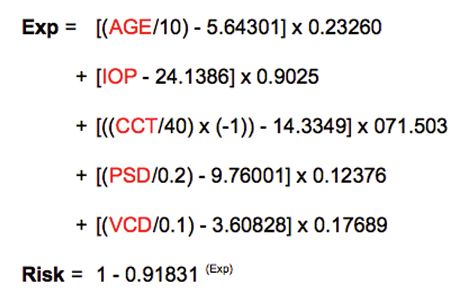
Figure. The OHTS 5-year glaucoma risk calculator is based on this mathematical model that incorporates the patient's age, IOP, central corneal thickness (CCT), pattern standard deviation (PSD), and vertical cup-to-disc ratio (VCD). Abbreviation: EXP, exponent.
Now, consider the fact that your EMR system is an accessible repository of discrete data elements that have been collected on each patient over multiple prior encounters. Every data element that you need to analyze is potentially available in the EMR database. More importantly, computers are incredibly efficient processors of information. How can that potential be transformed into a tool that actually helps you take better care of patients? Charles Kettering, one of the most prolific inventors in American history, once said, “Our imagination is the only limit to what we can hope to have in the future.” All that is required for an EMR system to generate meaningful information for the management of glaucoma patients is imagination in the form of thoughtful, intelligent programming.
INFORMATION-DRIVEN GLAUCOMA MANAGEMENT
Consider a glaucoma suspect who has several risk factors for glaucoma. How would you quantitate his or her risk? At present, the best guidance you have is the 5-year glaucoma risk calculator based on data obtained from the Ocular Hypertension Treatment Study (OHTS).1,2 It assesses only five data elements to determine a patient's risk of developing glaucoma over the next 5 years (Figure). What if your EMR system were programmed to consider all of the factors that are known to be associated with a higher risk of glaucoma?
Now, consider the patient with advanced glaucoma whom you have been managing for several years. You should not simply ask, “Has this patient's disease progressed since the last adjustment in treatment?” The more relevant question is, “What is the risk that this patient's glaucoma will progress in the future if I don't change the treatment regimen?” How will you make that assessment for your patient? Can you quantify that risk for your patient? You likely have a host of incredibly powerful diagnostic tools at your disposal. How will you make the most of the mountains of data that these tools generate? What if your EMR system had instant access to all of the data from millions of patient encounters over many years? Could it help you make critical decisions?
Intelligent programming is beginning to address these questions. For the first time in history, cloud-based EMR systems have the ability to analyze every data element from your patient's record and process that in light of normative data from millions of other patient encounters. All that is needed are smart EMR systems that have been programmed to use this technology to its fullest potential on behalf of patients.
CONCLUSION
The first cell phones were not called smartphones. That transformation took time and imagination. Some EMR systems are evolving in the same manner and will likely focus initially on the clinical issue best suited for this type of analysis: glaucoma management. n
Kyle Smith, MD, is the founder of Integrity Digital Solutions, a company that produces and markets an ophthalmology-specific cloud-based EMR product. Dr. Smith may be reached at ksmith@integrityemr.com.
1. Glaucoma 5-year risk estimator. Washington University in St. Louis School of Medicine website. http://ohts.wustl.edu/risk/formula.html. Accessed April 21, 2015.
2. Gordon MO, Beiser JA, Brandt JD, et al. The Ocular Hypertension Treatment Study: baseline factors that predict the onset of primary open-angle glaucoma. Arch Ophthalmol. 2002;120(6):714-720.
