


The role of imaging in glaucoma started with simple disc photography, which made it possible to record and compare qualitative changes in the optic nerve over time. Photography alone relies on subjective analysis, however, so clinicians can miss early changes in the optic nerve head (ONH). Advances have been made in producing stereoscopic images using flicker photography, which, when employed, improves interobserver agreement on neuroretinal rim width.1
Digital evaluation in the form of optical coherence tomography (OCT) is now the most widely adopted modality for the diagnosis and management of glaucoma. Analysis of the retinal nerve fiber layer (RNFL) by spectral domain OCT (SD-OCT) is an effective tool for discriminating healthy from glaucomatous eyes.2 SD-OCT analyzes the ONH, RNFL, and ganglion cell complex, and the technology objectively measures the development and progression of glaucomatous damage in combination with the traditional clinical examination. SD-OCT has rapidly emerged as the imaging modality of choice in ophthalmology for detecting early changes in the anatomy of glaucomatous eyes. Multiple studies have shown that structural changes produced by glaucoma can be precursors to functional change detected by visual field testing.3,4 In a recent study, OCT evaluation of the RNFL detected damage in approximately one-third of patients 5 years prior to the appearance of visual changes on standard perimetry testing.5
The importance of this diagnostic tool will continue to grow.
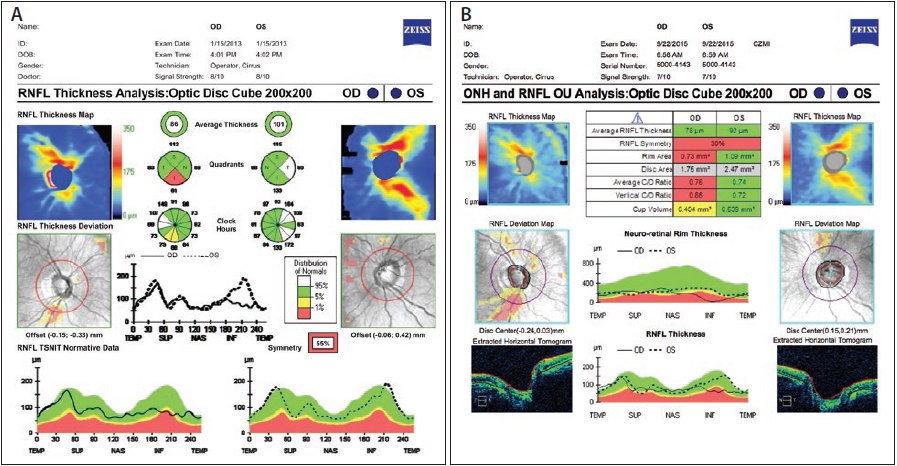
Figure 1. An example of a Cirrus SD-OCT ONH and RNFL analysis with early inferior changes (A). The same patient 2 years later demonstrates progressive inferior RNFL thinning (B).
ESTABLISHED USE OF OCT IN GLAUCOMA
The current generation of SD-OCT devices can identify the center of the optic disc and measure multiple parameters, including the disc area, rim area, vertical and horizontal rim thickness, and cup-to-disc ratios. The ability of the algorithms to identify the termination of Bruch membrane has greatly improved the accuracy, automation, and usefulness of the results, even for eyes with tilted or oblique discs. These data have been shown to be as accurate as RNFL analysis for the detection of early glaucoma.2
In addition to the ONH and RNFL, SD-OCT analysis of the ganglion cell-inner plexiform layer (GC-IPL) thickness has now been shown to have excellent reproducibility and reliability in the detection of glaucoma.6 Ganglion cell analysis maps are useful in detecting early glaucoma (Figure 1 and 2). Caution is warranted, however, because RNFL defects in the superior hemifield can be missed, and myopic eyes that are otherwise healthy can falsely appear to be glaucomatous.7 Multiple studies have now shown which OCT parameters are most useful for detecting glaucoma, including rim area and vertical cup-to-disc ratio, average peripapillary RNFL, inferior peripapillary RNFL, and the minimum GC-IPL thickness. In 2014, Shin et al demonstrated that the type of initial optic disc damage determines which OCT parameter is optimal for detecting early disease.8
NEW DIRECTIONS FOR OCT USE
Early time-delayed OCT was capable of 400 A-scans per second with a resolution of 10 µm. The SD-OCT generation introduced in 2006 drastically increased the capture speed to between 26,000 and 40,000 A-scans per second and improved the resolution to between 3.9 and 5 µm. New commercial OCT devices are able to capture 70,000 A-scans per second and achieve a resolution near 3 µm, enhancing discrimination of the various layers of the retina. Current-generation instruments are similar in their ability to detect glaucoma by analysis of the RNFL. Fixing the specificity of glaucoma detection using global thickness of the RNFL to 95% obtains sensitivities of 68.5% for the Spectralis (Heidelberg Engineering), 65.6% for the Cirrus (Carl Zeiss Meditec), and 62.1% for the RTVue (Optovue).9 In addition to improving diagnostic capabilities, advances in SD-OCT have permitted new study of the anatomical and physiologic changes that occur in the glaucomatous eye.
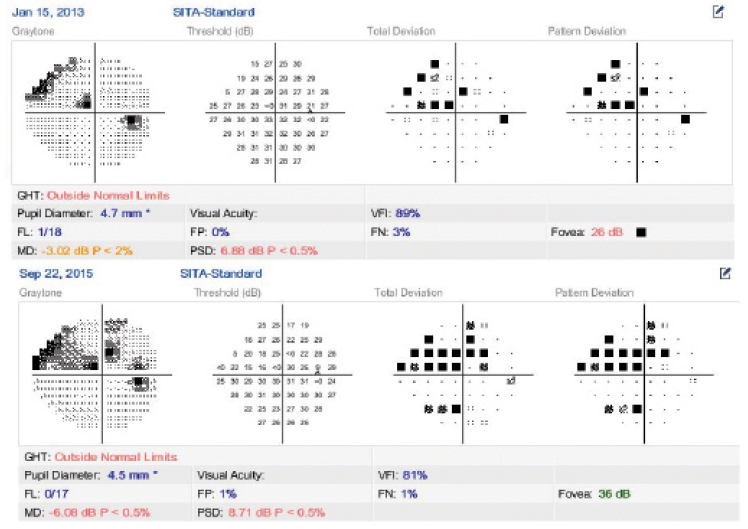
Figure 2. Humphrey visual field test (Carl Zeiss Meditec) of the patient seen in Figure 1. Correlating functional changes in a superior arcuate defect pattern are consistent with the SD-OCT changes over the same 2-year period.
Recently introduced, swept-source OCT uses a short cavity swept laser with a tunable wavelength of operation and a scanning rate of up to 100,000 A-scans per second. The faster acquisition allows for a wide-angle, high-quality image of the posterior pole and capture of the optic nerve and macula in a single scan. In early studies, swept-source OCT has performed similarly to SD-OCT for RNFL analysis and for discrimination between healthy and glaucomatous eyes. It is unclear if the wider field currently offers any advantages, but swept-source OCT may be less susceptible to artifacts and centering errors.10
CLINICAL AND ANATOMICAL CORRELATES
The value of SD-OCT for investigating physiologic changes in glaucoma is of growing interest. The lamina cribrosa (LC) has long been considered a primary site of axonal injury in glaucoma. Bowing of the LC may damage the axons passing through the lamina pores or lead to ischemic insult. SD-OCT permits in vivo analysis of the LC, and multiple studies have shown displacement and thinning in glaucomatous eyes.11,12 There is also evidence that LC displacement occurs prior to any detectable damage to the optic nerve.13 Recently, OCT imaging of the LC has shown that a faster rate of RNFL thinning is associated with a larger LC depth and smaller LC thickness.14
OCT angiography was recently developed using high-speed OCT systems. OCT angiography provides a quantitative measure of local circulation in the optic nerve by split-spectrum amplitude-decorrelation angiography (SSADA). By showing significant differences between the disc flow index of healthy and glaucomatous eyes, SSADA has demonstrated preliminary validation of its diagnostic utility. In the past, fluorescein angiography has been used to evaluate optic disc flow, but this technique requires the invasive injection of dye and its potential side effects. SSADA avoids many of the technical disadvantages of other noninvasive methods, and its high reproducibility is promising.15 If found reliable in large studies and as high-speed OCT devices become readily available, OCT angiography could represent another modality for monitoring glaucoma and elucidating the physiology leading to the disease.
CONCLUSION
OCT has an important role in glaucoma management, and development of this powerful diagnostic tool will continue. At the same time, this technology is expanding clinicians' understanding of the physiology of glaucoma, and it constitutes a promising area of active research. n

Scott Butikofer, MD, is an ophthalmology resident at the University of Missouri Kansas City Ophthalmology in Kansas City, Missouri. He acknowledged no financial interest in the products or companies mentioned herein. Dr. Butikofer may be reached at (360) 550-8268; scottbutikofer@gmail.com.

Rohit Krishna, MD, is an associate professor of ophthalmology and director of glaucoma at the University of Missouri, Kansas City Kansas City School of Medicine. He acknowledged no financial interest in the products or companies mentioned herein.

Kevin Pikey, DO, is an assistant professor of ophthalmology and codirector of the Glaucoma Service at the University of Missouri-Kansas City School of Medicine and Eye Foundation of Kansas City. He is in practice as a glaucoma specialist with Sabates Eye Centers in Kansas City, Missouri. He acknowledged no financial interest in the products or companies mentioned herein.
1. Morgan JE, Sheen NJ, North RV, et al. Digital imaging of the optic nerve head: monoscopic and stereoscopic analysis. Br J Ophthalmol. 2005;89(7):879-884.
2. Strouthidis NG, Scott A, Peter NM, Garway-Heath DF. Optic disc and visual field progression in ocular hypertensive subjects: detection rates, specificity, and agreement. Invest Ophthalmol Vis Sci. 2006;47(7):2904-2910.
3. Wollstein G, Schuman JS, Price LL, et al. Optical coherence tomography longitudinal evaluation of retinal nerve fiber layer thickness in glaucoma. Arch Ophthalmol. 2005;123(4):464-470.
4. Kuang TM, Zhang C, Zangwill LM, et al. Estimating the lead time gained by optical coherence tomography in detecting glaucoma before development of visual field defects. Ophthalmology. 2015;122(10):2002-2009.
5. Mwanza JC, Oakley JD, Budenz DL, Anderson DR; Cirrus Optical Coherence Tomography Normative Database Study Group. Ability of Cirrus HD-OCT optic nerve head parameters to discriminate normal from glaucomatous eyes. Ophthalmology. 2011;118(2):241-248.
6. Mwanza JC, Budenz DL, Godfrey DG, et al. Diagnostic performance of optical coherence tomography ganglion cell-inner plexiform layer thickness measurements in early glaucoma. Ophthalmology. 2014;121(4):849-854.
7. Hwang YH, Jeong YC, Kim HK, Sohn YH. Macular ganglion cell analysis for early detection of glaucoma. Ophthalmology. 2014;121(8):1508-1515.
8. Shin HY, Park HY, Jung Y, et al. Glaucoma diagnostic accuracy of optical coherence tomography parameters in early glaucoma with different types of optic disc damage. Ophthalmology. 2014;121(10):1990-1907.
9. Leite MT, Rao HL, Zangwill LM, et al. Comparison of the diagnostic accuracies of the Spectralis, Cirrus, and RTVue optical coherence tomography devices in glaucoma. Ophthalmology. 2011;118(7):1334-1339.
10. Yang Z, Tatham AJ, Weinreb RN, et al. Diagnostic ability of macular ganglion cell inner plexiform layer measurements in glaucoma using swept source and spectral domain optical coherence tomography. PLoS One. 2015;10(5):e0125957.
11. Furlanetto RL, Park SC, Damle UJ, et al. Posterior displacement of the lamina cribrosa in glaucoma: in vivo interindividual and intereye comparisons. Invest Ophthalmol Vis Sci. 2013;54(7):4836-4842.
12. Inoue R, Hangai M, Kotera Y, et al. Three-dimensional high-speed optical coherence tomography imaging of lamina cribrosa in glaucoma. Ophthalmology. 2009;116(2):214-222.
13. Strouthidis NG, Fortune B, Yang H, et al. Longitudinal change detected by spectral domain optical coherence tomography in the optic nerve head and peripapillary retina in experimental glaucoma. Invest Ophthalmol Vis Sci. 2011;52(3):1206-1219.
14. Lee EJ, Kim TW, Kim M, Kim H. Influence of lamina cribrosa thickness and depth on the rate of progressive retinal nerve fiber layer thinning. Ophthalmology. 2015;122(4):721-729.
15. Jia Y, Wei E, Wang X, et al. Optical coherence tomography angiography of optic disc perfusion in glaucoma. Ophthalmology. 2014;121(7):1322-1332.
