


CASE PRESENTATION
A 25-year-old phakic Hispanic man was referred to our hospital for the management of a perforated corneal ulcer. He had received this diagnosis 10 days earlier at another hospital but was unable to follow the recommended treatment plan. Upon presentation at our facility, the patient was noted to have a perforated central corneal ulcer and a very shallow anterior chamber. The patient denied contact lens use, any trauma, or any autoimmune diseases. Cultures of the ulcer were negative. An autoimmune workup was completed, and it was unremarkable. The cause of the initial ulcer was unable to be identified.
The patient underwent emergency penetrating keratoplasty (PKP). The pathology report showed a perforated ulcer with marked acute stromal keratitis. Postoperatively, the patient received a prescription for prednisolone acetate 1% (Pred Forte; Allergan) every 2 hours.
His postoperative recovery went well. Ten months after the PKP, the patient’s visual acuity was 20/40. Unfortunately, the IOP rose progressively despite tapering the steroid to once-daily dosing and adding maximally tolerated pressure-lowering medical therapy, including a topical prostaglandin inhibitor, a b-blocker, an a-agonist, and oral acetazolamide 500 mg twice daily. The patient’s maximum IOP reached 56 mm Hg. On gonioscopy, the angles in all quadrants were open to the ciliary body band. The optic disc rims appeared full and symmetric in both eyes. The peripapillary retinal nerve fiber layer was normal in both eyes on both a 24-2 Humphrey visual field test (Carl Zeiss Meditec) and optical coherence tomography.
HOW WOULD YOU PROCEED?
• Would you place a glaucoma drainage device (GDD) in the anterior chamber or in the posterior chamber and perform a concurrent pars plana vitrectomy and lens extraction?
• Would you perform a trabeculectomy with an antimetabolite?
• Would you consider the Trabectome (NeoMedix), gonioscopy-assisted transluminal trabeculotomy, or canaloplasty?
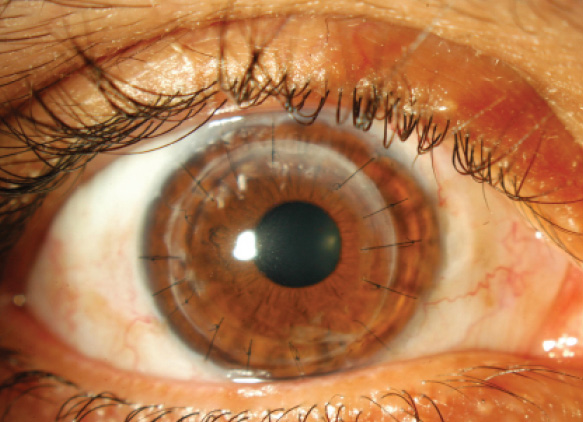
Figure 1. A slit-lamp photograph of a clear corneal graft in the patient 2.5 months postoperatively.
SURGICAL COURSE
The patient underwent a fornix-based trabeculectomy with mitomycin C (MMC). Special attention was paid to minimizing the use of cautery and avoiding the application of MMC to the cornea. Copious irrigation followed removal of the MMC sponges. Three 10–0 nylon sutures (Ethicon) were placed on the flap to control the flow, and the conjunctiva was closed with 8–0 Vicryl wing sutures (Ethicon).
OUTCOME
On the first postoperative day, the patient’s IOP measured 17 mm Hg. The bleb was low, vascular, and Seidel negative. The patient began administering prednisolone acetate 1% every 2 hours and ofloxacin four times daily. During postoperative week 1, the patient’s UCVA was 20/80, and the IOP was 54 mm Hg. Laser suture lysis of one out of three was performed, and the bleb was massaged at the limbus. After manipulation, the pressure decreased to 10 mm Hg. By the second postoperative week, the UCVA was 20/60, the IOP had spiked again to 50 mm Hg, and the bleb appeared flat with slight conjunctival retraction at the limbus. We immediately performed laser suture lysis, after which the IOP dropped to 6 mm Hg, and the bleb rose. The bleb became Seidel positive at the limbus, with a slow leak that was likely secondary to conjunctival manipulation with the suture lysis lens. We placed a 16-mm bandage contact lens and started the patient on atropine once daily. He was instructed to decrease the prednisolone acetate to four times daily.

Figure 2. The patient has a diffuse elevated bleb with minimal vascularity 2.5 months postoperatively.
The bandage contact lens was removed 4 weeks postoperatively. The UCVA was 20/30-2, and the IOP was 11 mm Hg. A diffuse, avascular, Seidel-negative bleb formed. Atropine was discontinued.
At the patient’s most recent visit (2.5 months after surgery), the UCVA remained stable at 20/30-2 with a clear corneal graft (Figure 1). A diffusely elevated bleb with minimal vascularity was present (Figure 2). The patient’s IOP was 10 mm Hg on no glaucoma medications. He was instructed to continue the prednisolone acetate four times daily with a plan to slowly taper the drug after 3 months.
DISCUSSION
Glaucoma after PKP was originally described by Irvine and Kaufman in 1969.1 Its incidence varies from 9% to 31% in the early postoperative period and from 18% to 35% in the late postoperative period.1-5 The incidence of ocular hypertension (OHT) has also been reported to occur in two waves, one at 70.3 ±15.8 days postoperatively with a mean duration of 15.6 days. Half of these patients presented a second wave at 212.2 ±46.8 days postoperatively with a mean duration of 18.1 days.2 Risk factors contributing to OHT and glaucoma after PKP include preexisting glaucoma, combined surgical procedures, corneal perforation, previous PKP, steroid response, suturing technique, and the diameter of the graft.1-5 In addition, the change in anterior chamber angle structure is suspected to be related to the incidence of glaucoma after PKP.6 The diagnosis of glaucoma after PKP is made based on IOP, optic disc changes, thinning of the retinal nerve fiber layer, and progressive visual field changes. By this definition, our patient had persistent OHT or preperimetric glaucoma.
In a prospective series of 678 patients who underwent PKP, 12.4% required glaucoma treatment, of whom 18% required surgical management.7 Our patient’s IOP was elevated and trending upward on maximal medication; surgical intervention was unavoidable. Better IOP control is not only important in terms of glaucoma but also the cornea. A major cause of graft failure is poorly controlled IOP, which can compromise graft endothelial function.8
The best surgical management of glaucoma after PKP is not clearly defined. Several studies have suggested that conventional trabeculectomy has a high failure rate.7-11 Given the young age of our patient, we anticipated a robust Tenon fibrotic response, so we deemed an adjunctive antimetabolite to be necessary. In one study, patients who underwent concomitant trabeculectomy with MMC and PKP showed a graft survival rate of 85% 1 year postoperatively and 60% at 2 years postoperatively, but the cumulative probability of adequate IOP control was only 50% at 2 years.11 The incidence of failure was associated with additional concurrent procedures.
The use of a GDD after PKP was first reported by Kirkness.12 GDDs appeared to control glaucoma in a high percentage of patients in a published series, but unfortunately, they were associated with a high incidence of graft failure (range, 10%-51%).11-15 The lowest corneal graft survival rate was noted when a GDD was implanted after PKP compared with concurrent surgery or PKP following GDD.14 Graft survival may also be influenced by the location of the GDD’s tube. In a retrospective study of 72 eyes, the corneal graft was clear in 48% of the eyes with an anterior chamber tube versus 83% of the eyes with a pars plana tube at year 1. In this study, however, only 18 eyes (25%) had an anterior chamber tube.16 Studies by Sidoti et al17 and Ritterband et al18 found a 2-year corneal survival rate from 41% to 59% in patients with a pars plana GDD after PKP. In another study of 28 eyes of combined anterior chamber GDD implantation and PKP, 96% of the corneas were clear at year 1, and 54% remained clear at year 5.19 Given the lack of well-controlled, prospective, randomized trials, it is difficult to compare the rates of corneal graft survival in patients with a pars plana versus anterior chamber tube. Existing studies do not clearly demonstrate an advantage in terms of corneal graft survival in eyes with a pars plana tube versus an anterior chamber tube.
To add to the complexity, in a retrospective case series comparing trabeculectomy with MMC, GDD, and cyclophotocoagulation in eyes with intractable glaucoma after PKP, Ayyala et al concluded that there were no differences among the three groups with respect to IOP control and graft failure.8 As the authors pointed out, however, potential selection bias was inherent to the retrospective study design.
CONCLUSION
How to manage glaucoma after PKP is a complicated issue with no clear answer. The procedure must be individualized to the patient, taking into account his or her age, the extent of glaucomatous damage, and the status of the lens. Our patient was young and phakic with no previous history of glaucoma or OHT prior to his PKP; his nerve and visual field test results were essentially normal. His UCVA after the PKP was excellent, and we focused mostly on maintaining the clarity of his graft and his vision. A GDD placed in the anterior chamber potentially carries a higher risk to the corneal graft. A pars plana tube, which would be our preferred technique in a pseudophakic patient, requires vitrectomy and a concurrent clear lens extraction. In general, we prefer trabeculectomy with MMC in phakic eyes with corneal transplants due to the lower risk of graft failure compared with tube shunt surgery. n

Luna Xu, MD, is a senior ophthalmology resident at the New York Eye and Ear Infirmary of Mount Sinai. She acknowledged no financial interest in the products or companies mentioned herein. Dr. Xu may be reached at luxu@nyee.edu.

Noga Harizman, MD, is the director of the Glaucoma Clinic and an assistant professor of ophthalmology at the New York Eye and Ear Infirmary of Mount Sinai. She acknowledged no financial interest in the products or companies mentioned herein. Dr. Harizman may be reached at nharizman@nyee.edu.

Tak Yee Tania Tai, MD, is an assistant professor of ophthalmology at the New York Eye and Ear Infirmary of Mount Sinai. She acknowledged no financial interest in the products or companies mentioned herein.
Dr. Tai may be reached at ttai@nyee.edu.
1. Irvine AR, Kaufman HE. Intraocular pressure following penetrating keratoplasty. Am J Ophthalmol. 1969;68:835-844.
2. Orucoglu F, Blumenthal EZ, Frucht-Pery J, et al. Risk factors and incidence of ocular hypertension after penetrating keratoplasty. J Glaucoma. 2014;23(9):599-605.
3. Panos GD, Song X, Seitz B, Gatzioufas Z. Risk factors and incidence of ocular hypertension after penetrating keratoplasty. J Glaucoma.2014;23(9):662.
4. Foulks GN. Glaucoma associated with penetrating keratoplasty. Ophthalmology. 1987;94:871-884.
5. Chien AM, Schmidt, Cohen EJ, et al. Glaucoma in the immediate postoperative period after penetrating keratoplasty. Am J Ophthalmol. 1993;115:711-714.
6. Olson RJ, Kaufman HE. A mathematical description of causative factors and prevention of elevated intraocular pressure after keratoplasty. Invest Ophthalmol Vis Sci. 1977;16:1085-1092.
7. Al-Mohaimeed M, Al-Shahwan S, Al-Torbak A, Wagoner MD. Escalation of glaucoma therapy after penetrating keratoplasty. Ophthalmology. 2007;114:2281-2286.
8. Ayyala RS, Pieroth L, Vinals AF, et al. Comparison of mitomycin C trabeculectomy, glaucoma drainage device implantation, and laser neodymium: YAG cyclophotocoagulation in the management of intractable glaucoma after penetrating keratoplasty. Ophthalmology. 1998;105:1550-1556.
9. Insler MS, Cooper HD, Kastl PR, Caldwell DR. Penetrating keratoplasty with trabeculectomy. Am J Ophthalmol. 1985;100:593-595.
10. Gilvarry AM, Kirkness CM, Steele AD, et al. The management of post-keratoplasty glaucoma by trabeculectomy. Eye. 1989;3:713-718.
11. WuDunn D, Alfonso E, Palmberg PF. Combined penetrating keratoplasty and trabeculectomy with mitomycin C. Ophthalmology. 1999;106:396-400.
12. Kirkness CM. Penetrating keratoplasty, glaucoma and silicone drainage tubing. Dev Ophthalmol. 1987;14:161-165.
13. Kirkness CM, Ling Y, Rice NS. The use of silicon drainage tubing to control post-keratoplasty glaucoma. Eye. 1988;2:583-590.
14. Rapuano CJ, Schmidt CM, Cohen EJ, et al. Results of alloplastic tube shunt procedures before, during, or after penetrating keratoplasty. Cornea. 1995;14:26-32.
15. Alvarenga LS, Mannis MJ, Brandt JD, et al. The long-term results of keratoplasty in eyes with a glaucoma drainage device. Am J Ophthalmol. 2004;138:200-205.
16. Arroyave CP, Scott IU, Fantes FE, et al. Corneal graft survival and intraocular pressure control after penetrating keratoplasty and glaucoma drainage device implantation. Ophthalmology.2001;108(11):1978-1985.
17. Sidoti PA, Mosny AY, Ritterband DC, Seedor JA. Pars plana tube insertion of glaucoma drainage implants and penetrating keratoplasty in patients with coexisting glaucoma and corneal disease. Ophthalmology. 2001;108(6):1050-1058.
18. Ritterband DC, Shapiro D, Trubnik V, et al. Penetrating keratoplasty with pars plana glaucoma drainage devices. Cornea. 2007;26(9):1060-1066.
19. Knape RM, Szymarek TN, Tuli SS, et al. Five-year outcomes of eyes with glaucoma drainage device and penetrating keratoplasty. J Glaucoma. 2012;21(9):608-614.
