


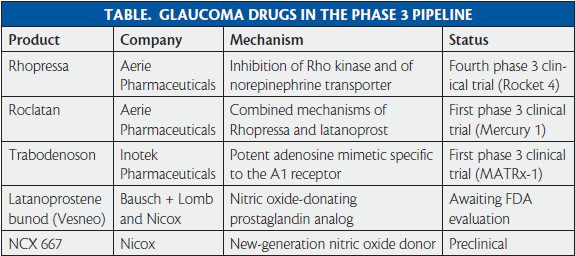
From the mid-1990s to the mid-2000s, the number of antiglaucoma medication classes greatly expanded, giving clinicians five major classes from which to choose: prostaglandin analogues, b-blockers, selective a2-adrenergic agonists, carbonic anhydrase inhibitors, and miotics. The last is rarely used for long-term management. Looking into the phase 3 pipeline today suggests that clinicians may be on the verge of another exciting era of new medications that act directly on the tissue of pathology, the trabecular meshwork (Table). These agents in development include Rho kinase (ROCK) inhibitors (Rhopressa and Roclatan; Aerie Pharmaceuticals), adenosine agonists like trabodenoson (Inotek Pharmaceuticals), and nitric oxide (NO) donors such as latanoprostene bunod (Vesneo; Bausch + Lomb and Nicox) and NCX 667 (Nicox). If these agents make it to market, eye care providers could have important new options for the millions of patients affected by glaucoma.
ROCK INHIBITORS
Rhopressa (AR-13324) shows great potential for lowering IOP by three cooperative mechanisms. The first two act via ROCK inhibition both to increase aqueous humor outflow through the trabecular meshwork and reduce episcleral venous pressure, as demonstrated in normotensive primate eyes.1 The third mechanism of norepinephrine transporter inhibition, which decreases the total amount of fluid produced, was shown in a rabbit study.2 Rhopressa offers unique yet complementary therapy to the market-leading prostaglandin analogues, which primarily increase uveoscleral outflow.
Compared with latanoprost, Rhopressa was less effective at reducing IOP by 1 mm Hg and was associated with a higher incidence of ocular hyperemia at both concentrations (0.01% or 0.02%). That said, 0.02% Rhopressa decreased IOP from the controls by 5.7 mm Hg after 28 days of treatment in the phase 2b clinical trial.3 In Rocket 2, a phase 3 registration trial, Rhopressa demonstrated superiority to timolol at multiple time points, and showed noninferiority throughout the study, with a primary endpoint of patients with an IOP of 20 to 25 mm Hg.4
Rhopressa successfully achieved the primary efficacy endpoint in the second phase 3 trial of Rocket 2. With once-daily administration, the most common side effect was hyperemia, which was mild in 83% of patients taking the drops. For twice-daily administration, side effects were slightly more common, but the IOP-lowering effects were also more pronounced. An additional, fourth phase 3 registration trial, Rocket 4, commenced as planned in September of this year, and Aerie expects to file a new drug application with the FDA in 2016.5,6
Aerie is also developing Roclatan, a fixed combination of Rhopressa and latanoprost that works through the combined mechanisms of the respective drugs to decrease IOP. With Rhopressa’s three mechanisms of action plus the known mechanism of latanoprost, Roclatan would use many of the known means of lowering IOP in a single drop.7
Roclatan recently achieved its primary efficacy endpoint in a phase 2b clinical study that demonstrated the agent’s superiority over latanoprost alone. The study had 297 patients, and Roclatan decreased mean diurnal IOP from 25.1 to 16.5 mm Hg (34%). This is about 2 mm Hg more than the reduction in IOP seen after treatment with latanoprost alone.8 At every time point in the study, Roclatan significantly exceeded latanoprost’s efficacy. Because latanoprost is one of the most efficacious glaucoma drugs worldwide, the availability of Roclatan could be a huge step forward in glaucoma treatment.9 The agent demonstrated no systemic side effects, similar to Rhopressa, and caused only mild hyperemia in about 40% of patients. Aerie initiated its first phase 3 registration trial of Roclatan this September and anticipates conducting two additional trials in 2016.10
ADENOSINE AGONISTS
Adenosine agonists are another promising class of medication. Of the four adenosine receptors found in the human trabecular meshwork, three of them (A1, A2A, A3) lower IOP when activated, but one of these (A3) also has the potential to cause an increase in IOP.11 Manipulation of these receptors is a promising, novel mechanism for glaucoma treatment. Inotek’s A1 mimetic, trabodenoson, demonstrated positive end-of-phase 2 results in its most recent clinical trial. In the study of 144 patients, the drug decreased IOP by 7 mm Hg after 28 days compared to the placebo with no detectable systemic side effects and less hyperemia than the currently used prostaglandin analogues.12 In addition, this drug’s IOP-lowering effects persisted for 24 hours following the final dose, which makes it an excellent candidate as a once-daily drop. Inotek initiated the first phase 3 trial of trabodenoson this year, with completion anticipated in late 2016.13
Although Inotek’s trabodenoson is by far the most up-and-coming adenosine agonist, there are several others in the pipeline.14 Acucela and Otsuka Pharmaceuticals are currently deciding the next steps on their A2A agonist, OPA-6566, with which they conducted a phase 1/2 clinical trial in 2012. The drug increases aqueous humor outflow via the conventional pathway of the trabecular meshwork and Schlemm canal rather than the uveoscleral pathway used by prostaglandin analogues.15 Santen Pharmaceuticals also has a selective A2A agonist, ATL313, that has significantly decreased IOP in vivo, but the company has not released any recent updates on further development of this drug.14,16
nitric oxide donors
Another potential treatment involves the modulation of ocular NO levels. NO has been shown to play a role in IOP regulation and to have neuroprotective qualities.17-20 Nicox and Bausch + Lomb have demonstrated the potential of NO in glaucoma treatment with latanoprostene bunod, an NO-donating prostaglandin F2-analog. In two phase 3 clinical trials, the drug was more effective at lowering IOP than timolol and only had to be administered once daily.21 Latanoprostene bunod is currently under review by the FDA (expected decision date of July 2016), and it could be one of the first of a new class of NO-donating drugs.22
A second drug, NCX 667, is an NO donor in a class of “new-generation” NO donors. It has been shown to decrease IOP in both rabbits and cynomolgus monkeys with glaucoma. Still in the preclinical stage, this class of drugs is meant to be able to deliver the effects of NO without the side effects and dosing limitations of the parent drug.23,24
CONCLUSION
This is an exciting time in glaucoma. Treatments are changing, new ideas are emerging, and clinicians’ and scientists’ knowledge of the disease itself is growing. It is to be hoped that some of the drugs described herein soon become a part of physicians’ arsenal against glaucoma. n

Douglas J. Rhee, MD, is chair, Department of Ophthalmology and Visual Sciences, and director, University Hospitals Case Medical Center Eye Institute, in Cleveland, Ohio. Dr. Rhee has received research grants from Allergan, Glaukos, Ivantis, and Merck. He has stock holdings in Aerie Pharmaceuticals and is an ad hoc consultant to Alcon. Dr. Rhee may be reached at (216) 844-3601, dougrhee@aol.com.

Emily Ahadizadeh, BS, is a second-year medical student at Case Western Reserve University School of Medicine in Cleveland, Ohio. She acknowledged no financial interest in the products or companies mentioned herein. Ms. Ahadizadeh may be reached at ena9@case.edu.
1. Wang RF, Williamson JE, Kopczynski C, Serle JB. Effect of 0.04% AR-13324, a ROCK, and norepinephrine transporter inhibitor, on aqueous humor dynamics in normotensive monkey eyes. J Glaucoma. 2015;24(1):51-54.
2. Kiel JW, Kopczynski CC. Effect of AR-13324 on episcleral venous pressure in Dutch belted rabbits. J Ocul Pharmacol Ther. 2015;31(3):146-151.
3. Bacharach J, Dubiner HB, Levy B, et al. Double-masked, randomized, dose–response study of AR-13324 versus latanoprost in patients with elevated intraocular pressure. Ophthalmology. 2015;122(2):302-307.
4. Aerie Pharmaceuticals reports initial Rhopressa phase 3 efficacy results. Aerie Pharmaceuticals. April 23, 2015. http://investors.aeriepharma.com/releasedetail.cfm?releaseid=917999. Accessed September 15, 2015.
5. Aerie Pharmaceuticals reports positive Rhopressa phase 3 efficacy results. Aerie Pharmaceuticals. September 16, 2015. http://investors.aeriepharma.com/releasedetail.cfm?ReleaseID=931967. Accessed September 17, 2015.
6. Aerie Pharmaceuticals Initiates Fourth Phase 3 Clinical Trial of Rhopressa. Aerie Pharmaceuticals. September 24, 2015. http://investors.aeriepharma.com/releasedetail.cfm?ReleaseID=932929. Accessed October 31, 2015.
7. Lim KS, Nau CB, O’Byrne MM, et al. Mechanism of action of bimatoprost, latanoprost, and travoprost in healthy subjects: a crossover study. Ophthalmology. 2008;115(5):790-795.
8. Aerie Pharmaceuticals reports Roclatan phase 2b results achieve all clinical endpoints. Aerie Pharmaceuticals. June 25, 2015. http://investors.aeriepharma.com/releasedetail.cfm?releaseid=856396. Accessed September 17, 2015.
9. Orme M, Collins S, Dakin H, et al. Mixed treatment comparison and meta-regression of the efficacy and safety of prostaglandin analogues and comparators for primary open-angle glaucoma and ocular hypertension. Curr Med Res Opin. 2010;26:511.
10. Aerie Pharmaceuticals initiates first phase 3 registration trial of Roclatan. Aerie Pharmaceuticals. September 21, 2015. http://investors.aeriepharma.com/releasedetail.cfm?ReleaseID=932323. Accessed November 8, 2015.
11. Tian B, Gabelt BT, Crosson CE, Kaufman PL. Effects of adenosine agonists on intraocular pressure and aqueous humor dynamics in cynomolgus monkeys. Exp Eye Res. 1997; 64(6):979-989.
12. Inotek Pharmaceuticals presents positive data of trabodenoson in glaucoma. Reuters. November 8, 2012. http://www.reuters.com/article/2012/11/08/idUS199801+08-Nov-2012+BW20121108. Accessed September 17, 2015.
13. Inotek Pharmaceuticals initiates dosing of MATRx-1, the first pivotal Phase 3 clinical trial of trabodenoson, a novel treatment for glaucoma. October 16, 2015. http://bit.ly/1HD2Ezg. Accessed November 8, 2015.
14. Chen J, Runyan SA, Robinson MR. Novel ocular antihypertensive compounds in clinical trials. Clin Ophthal. 2011;5:667-677.
15. Acucela and Otsuka Pharmaceuticals announce the initiation of a phase 1/2 clinical trial for OPA-6566 in patients with open-angle glaucoma or ocular hypertension. Acucela Pharmaceuticals. September 13, 2011. http://www.acucela.com/Read-About-Us/Press-Releases/Acucela-and-Otsuka-Pharmaceutical-Announce-the-(1). Accessed September 17, 2015.
16. Clinical Data, Inc. licenses adenosine A2A agonist to Santen for development of ophthalmic treatments. Santen Pharmaceuticals. April 30, 2010.http://www.santen.com/en/news/20100430.pdf. Accessed September 17, 2015.
17. Buys ES, Ko YC, Alt C, et al. Soluble guanylate cyclase alpha1-deficient mice: a novel murine model for primary open angle glaucoma. PLoS One. 2013;8:e60156.
18. Heyne GW, Kiland JA, Kaufman PL, Gabelt BT. Effect of nitric oxide on anterior segment physiology in monkeys. Invest Ophthalmol Vis Sci. 2013;54:5103-5110.
19. Stamer WD, Lei Y, Boussommier-Calleja A, et al. eNOS, a pressure-dependent regulator of intraocular pressure. Invest Ophthalmol Vis Sci. 2011;52:9438-9444.
20. Zurakowski D, Vorwerk CK, Gorla M, et al. Nitrate therapy may retard glaucomatous optic neuropathy, perhaps through modulation of glutamate receptors. Vision Res. 1998;38:1489-1494.
21. Baush + Lomb and Nicox’s glaucoma candidate Vesneo (latanoprostene bunod) meets primary endpoint in Phase 3 studies. Nicox Pharmaceuticals. September 25, 2014. http://bit.ly/1NFaZZH. Accessed November 8, 2015.
22. Bausch + Lomb and Nicox announce FDA acceptance of new drug application for novel glaucoma candidate Vesneo (latanoprostene bunod). Nicox Pharmaceuticals. September 22, 2015. http://bit.ly/1OzTkUQ. Accessed November 8, 2015.
23. Bastia E, Impagnatiello F, Almirante N, et al. NCX 667, a novel nitric oxide (NO) donor lowers intraocular pressure (IOP) in ocular normotensive and hypertensive eyes of rabbits and non-human primates. Invest Ophthalmol Vis Sci. 2015;56(7):1999. http://iovs.arvojournals.org/article.aspx?articleid=2331748&resultClick=1. Accessed November 9, 2015.
24. Promising preclinical data on new compounds for glaucoma presented at ARVO by Nicox. Nicox Pharmaceuticals. May 11, 2015. http://bit.ly/1Y09acK. Accessed November 8, 2015.
