



There are many business models of clinical practice, just as there are many different ways that physicians practice1,2: solo, group, single specialty, multispecialty, multisubspecialty with or without academic affiliation, or hospital or academic employment. The right situation for you may be out there, or you may already be in it. When I finished my fellowship in 1993, I joined one of the oldest group practices in the country, which was established as the Alliance Eye & Ear Clinic in 1895. It has evolved into a multisubspecialty ophthalmology group practice with specialties in glaucoma, cornea, pediatrics, plastics, retina, and low vision. My colleagues and I all have voluntary faculty positions with a local medical school/residency program as well as teaching preceptorships with optometry externs and residents through Ohio State University. We have a blended shared and productivity-based compensation model that has been in place for over 10 years and works well for us.
What works best for you? This article presents the pros and cons of different group models. A number of key elements differentiate the types of practice, which may be self-employed or hospital-employed; academic or nonacademic (clinical/research/mix); solo or group; and single-specialty group, multispecialty group, or multisubspecialty group. The pros and cons presented herein are my opinion and may therefore differ from the viewpoints of others (Table). Moreover, this discussion of business models is not comprehensive.
At a Glance
• Ophthalmologists practice under a variety of business models, each with its pros and cons.
• Most ophthalmologists are in private group practice.
• Choosing the best business model for you requires determining which factors are most important to you such as decision-making autonomy, income potential, financial risk, research, teaching, and flexibility.
SOLO PRACTICE
Solo practitioners have complete autonomy over their practices and, as such, have complete liability for their practices. In many cases, these physicians can change and adapt easily, but they may become isolated from other practitioners and academic pursuits. Income potential can be high, and there are opportunities for ancillary income from optical shops, real estate, and surgery centers.
PRIVATE GROUP PRACTICE
Most ophthalmologists practice under this model. To a large extent, these doctors have autonomy in their decisions, but as in a marriage, they must make some compromises when it comes to income, purchasing, practice administration, and scheduling. Groups have the advantage of patient care coverage for vacations. Financial risk and reward are usually shared and can change over time, especially in cases of great disparity in revenue among doctors. Income potential can be very high, and there are opportunities for ancillary income from optical shops, real estate, and surgery centers. Succession planning and retirement can be difficult if the practice is not in a desirable location. There are some politics in practice, especially in large groups, which may cause friction. Again, as in a marriage, it is necessary for partners to work together toward solutions to problems.
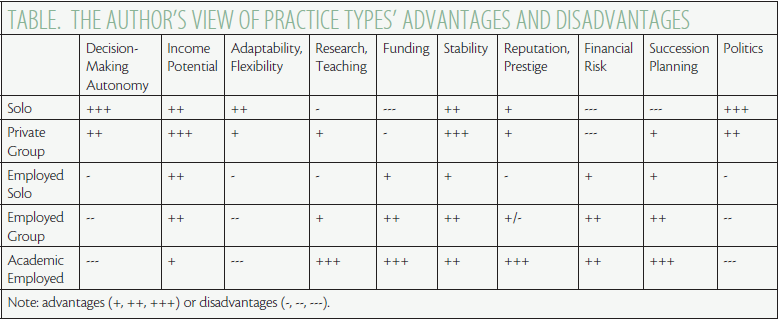
There are academic opportunities in private practice, and usually, these are pursued outside the clinical practice. Teaching and research are possible, as are contributions to the scientific knowledge base. Additionally, you may be able to participate in clinical studies for the pharmaceutical and surgical industries and to publish articles. This can generate significant revenue but requires considerable time in addition to clinical practice.
SINGLE SUBSPECIALTY VERSUS MULTISUBSPECIALTY GROUPS
Single-subspecialty groups are common among retina practices. Glaucoma groups are also common but are usually limited to urban areas. Single-subspecialty groups have advantages with regard to coverage issues, referral patterns, recruitment, and succession planning. Access to colleagues makes obtaining second opinions easy. Patient care is fairly predictable and consistent among different physicians, making workups, procedures, equipment, coding, and billing uniform across the practice. Physician compensation can be straightforward in these situations, especially if all doctors have similar collections.
In small multisubspecialty groups like mine, it is sometimes difficult to support certain subspecialties like retinal surgery and neuro-ophthalmology due to volume constraints. In groups of more than eight to 10 physicians, all specialties can be represented. In the latter scenario, you have the luxury of multiple in-house referrals from your partners, with easy access to patients’ records. Technical staff as well as coding, billing, and business personnel, however, face the challenge of handling all subspecialties, not just one. Moreover, the cost of equipment can be high in these practices, because multiple specialties may require different specialized and expensive devices. Income distribution can be difficult in these groups as well, because there may be great disparity in collections, with extremely high earners like refractive and cataract surgeons as well as relatively low earners like pediatric ophthalmologists.
EMPLOYED PHYSICIANS
In my area and around the United States, there has been a trend in which hospitals buy medical practices and employ the physicians.3 This strategy is most common in primary care, but it has now reached ophthalmology practices as well. Mostly group practices are involved and may represent a way for hospitals to control market shares of captive patients with cross-referrals to other hospital-owned practices, hospital-based testing, and surgery facilities. The staff at these offices typically comprises hospital employees, and all administrative functions of the practice are handled by the hospital.
This may be a very good situation for doctors entering into practice or nearing retirement. Compensation may be generous, but it is typically not as high as in private practice. The trade-off is that you usually will not need to do any administrative tasks, just show up and see patients. If compensation is based on collections, the hospital billing and coding personnel may not be familiar with all of the nuances of ophthalmology coding. It will be important to make sure that they are competent enough to accurately capture all of your revenue. In my town, some of these primary care practices have been like revolving doors, with physicians coming and going within a few months or years—a complaint I hear from my patients.
ACADEMIC PRACTICE
Traditional academic practices are university based and affiliated with residency training programs.4 Physicians usually see tertiary subspecialty referrals and perform basic scientific and clinical research. These practices and their staff are expected to exemplify the pinnacle of patient care. Usually, a chairperson oversees all aspects of the program, which may include the clinical practice. Typically, all physicians are faculty members and university employees, and they may be purely clinical or have a mix of clinical and research responsibilities. Most of the physicians are involved in teaching and training at the university. Like hospital-employed physicians, they typically refer patients to other doctors within the system, and all testing and procedures are performed at the university.
Today, however, physicians may also have private single- and multisubspecialty groups within the auspices of the university that operate separately and independently.5 These groups can have ownership of their practices as well as opticals and surgery centers. This setup may be the best of both worlds if you seek the intellectual stimulation of academia with the benefits of private practice.
CONCLUSION
The best practice situation for you will not be optimal for everyone. You need to find your niche. Determine which factors are most important to you before selecting your opportunity. If nothing out there suits you, make up a new paradigm that does! n
1. Young Physicians and Residents Clinical Committee. Finding the right job. ASCRS white paper. http://bit.ly/1Rbxjgj. Published March 2006. Accessed January 4, 2016.
2. Masters P. Types of practices. http://bit.ly/1RZRPjH. American College of Physicians website. Accessed January 4, 2016.
3. Mertz G. Hospital employment vs. private practice: pros and cons. Physicians Practice website. http://bit.ly/1Ov9L3q. Published June 2, 2013. Accessed January 4, 2016.
4. Day K. Big decisions, part 2: private practice or academics? American Academy of Ophthalmology website. http://bit.ly/1RbxF6v. Published April 1, 2009. Accessed January 4, 2016.
5. Day K. Big decisions, part 3: combining academics and private practice. American Academy of Ophthalmology website. http://bit.ly/1JppVel. Published May 1, 2009. Accessed January 4, 2016.
Richard A. Lehrer, MD
• director of glaucoma services & president, Ohio Eye Alliance in Alliance, Ohio
• assistant clinical professor of ophthalmology, Northeast Ohio Medical University
• (330) 823-1680; rlehrer@ohioeye.com; Twitter @RichLehrer
