


In his video, Yuri McKee, MD, a well-known and skilled surgeon, demonstrates stab incision glaucoma surgery (SIGS), which he has been performing for a few years now. This technique is a modified guarded filtration procedure that has been adopted by surgeons in multiple countries around the world as an easy and less traumatic technique than trabeculectomy. It gives good results while maintaining a definite economic advantage over many of the current micoinvasive glaucoma surgical devices. Compared with conventional trabeculectomy, SIGS provides a maximized area of virgin conjunctiva, induces less conjunctival scarring, allows a controlled posteriorly directed leak, and creates a diffuse bleb while keeping most subconjunctival drainage channels intact.
— Soosan Jacob, MS, FRCS, DNB, section editor
 This video presents my first case of SIGS, a surgical procedure I learned from Soosan Jacob, MS, FRCS, DNB. I edited the video as little as possible to show the events of the surgery in real time.
SIGS is a simple surgical approach to trabeculectomy that limits the formation of scar tissue that is usually associated with filtering surgery. The corneal tunnel that is created is generally self-sealing. I use a Kelly punch to create a calibrated leak by removing the posterior corneal lip of the incision back to the trabecular meshwork. I find that the resistance to outflow by the Tenon layer and conjunctiva limit the amount of hypotony in the postoperative period.
Watch It Now
Dr. McKee performs the SIGS procedure.
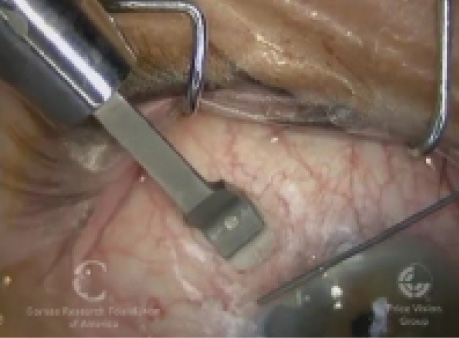
As demonstrated in my video, SIGS takes only a few minutes to complete and requires just one suture in the conjunctiva. No special instruments or implants are required, and the use of disposable surgical instruments keeps costs down. The resulting low, broad bleb can often be missed without careful inspection. The IOP-lowering effects have been reliable and long lasting in my patients.
I have found this approach to trabeculectomy to be as good as any technique that I have previously employed. I place mitomycin C in the scleral tunnel before entering the anterior chamber. I recommend an iridotomy if the pupil peaks toward the sclerotomy to avoid failure of the fistula by iris plugging. It is important that the conjunctiva be mobile enough for the conjunctival incision to be displaced posteriorly from the scleral incision. I pull the conjunctiva forward during the initial entry so that this incision falls posteriorly away from the scleral incision at the conclusion of surgery.
I look forward to learning the results of a large series of Dr. Jacob’s patients who underwent SIGS with long-term follow-up. n
Section Editor Soosan Jacob, MS, FRCS, DNB
• senior consultant ophthalmologist at Dr. Agarwal’s Eye Hospital, Chennai, India
• dr_soosanj@hotmail.com
Section Editor Jonathan S. Myers, MD
• associate attending surgeon on the Glaucoma Service and director of the Glaucoma Fellowship at Wills Eye Hospital, Philadelphia
Yuri McKee, MD
• corneal and refractive surgeon at Swagel Wootton Hiatt Eye Center, Mesa, Arizona
• mckeeonline@mac.com
