



Cyclodialysis clefts are often challenging. They occasionally close with pupillary dilation alone, and they sometimes respond to an argon laser or cryotherapy when combined with dilation1 or gas tamponade.2 Oftentimes, though, surgical intervention is required.3
AT A GLANCE
• Surgical intervention is often required to treat cyclodialysis clefts.
• Patients frequently experience ups and downs in their treatment and may require multiple surgeries.
• Glaucoma surgeons, already skilled in creating flaps and delicate suturing, are well suited to handle clefts.
MANAGING A SMALL CLEFT
Small clefts may be closed with internal or external surgical approaches. The latter are typical for phakic patients. The ophthalmologist creates a large, full-thickness scleral flap, carefully sutures the ciliary body to the posterior margin, and then closes the flap.4 This approach is effective, but the unroofing and suturing of the ciliary body require a delicate touch.
In pseudophakic patients, an ab interno approach is often effective. A paracentesis 180° away from the cleft allows passage of the straight needles of a double-armed 10–O Prolene suture (Ethicon) through the pupil, behind the iris, through the ciliary body, and out of the sclera, with or without a scleral flap (the conjunctiva needs to have been opened).5 The two needles are spaced 1 to 2 mm apart, and as they are tightened externally, the suture pulls up against the ciliary body internally, closing that area of the cleft. This process is repeated to close larger cleft areas.
The surgeon passes the suture behind the iris more by judgment than by direct visualization, which can be disconcerting for novices. The long, straight needles should be handled with care, because interference outside the eye (eg, the lid speculum) can lead to dynamic motions within the eye. If the needle is left partly through the sclera after insertion through the ciliary body, the surgeon may use a gonioscopy lens to visualize the angle and confirm that the needle placement is not too far anterior or posterior.
MANAGING A LARGE CLEFT
Large clefts can be more complicated to repair, as seen in an Eyetube video from Shane Havens, MD, and M. Reza Razeghinejad, MD, of the Truhlsen Eye Institute at the University of Nebraska Medical Center, Omaha. They demonstrate an elegant use of a capsular tension ring with two-point scleral fixation to close a very large (270°) longstanding cleft in an eye with hypotony maculopathy. The doctors’ technique is based on the work of Yuen and colleagues.6 The surgery is well presented and clearly shown.
Watch it Now
Shane Havens, MD, and M. Reza Razeghinejad, MD, share the case of a 47-year-old man with a longstanding 270° cleft and hypotony maculopathy.
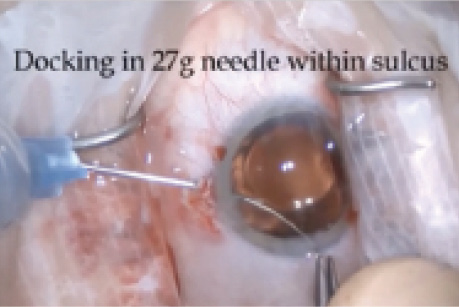
According to the video, the patient returned the next day with vomiting and an IOP of 48 mm Hg, as is often the case when a cleft closes. With medication and presumably the resumption of trabecular meshwork function, the patient’s IOP and vision improved dramatically, only to drop again a few months later because of a small residual cleft. After its closure with a traditional external approach, the patient’s vision returned to 20/40 and the IOP to 10 mm Hg.
HIDDEN CLEFTS
A rollercoaster course is often the case with clefts. A large cleft in a hypotonous eye can obscure the identification of a smaller cleft; only when the eye has improved somewhat can the ophthalmologist recognize the other cleft. It is helpful for the patient to know upfront that the IOP will probably spike and that more than one round of surgery, possibly including a glaucoma surgery, may be required. Closed retinal folds are a poor prognostic sign. In those cases, macular surgery with or without expansile gas may be considered to improve acuity, although outcomes may not be optimal.
The identification and repair of clefts require knowledge, skill, and judgment. Glaucoma surgeons, already adept at creating flaps and delicate suturing, are well suited to handle these cases with some care and forethought. It is impressive how often reasonably good vision is achieved despite long-standing hypotony maculopathy. n
1. Han JC, Kwun YK, Cho SH, Kee C. Long-term outcomes of argon laser photocoagulation in small size cyclodialysis cleft. BMC Ophthalmol. 2015;15:123.
2. Ceruti P, Tosi R, Marchini G. Gas tamponade and cyclocryotherapy of a chronic cyclodialysis cleft. Br J Ophthalmol. 2009;93(3):414-416.
3. Ioannidis AS, Barton K. Cyclodialysis cleft: causes and repair. Curr Opin Ophthalmol. 2010;21(2):150-154.
4. Agrawal P, Shah P. Long-term outcomes following the surgical repair of traumatic cyclodialysis clefts. Eye (Lond). 2013;27(12):1347-1352.
5. Metrikin DC, Allinson RW, Snyder RW. Transscleral repair of recalcitrant, inadvertent, postoperative cyclodialysis cleft. Ophthalmic Surg. 1994;25(6):406-408.
6. Yuen NS, Hui SP, Woo DC. New method of surgical repair for 360-degree cyclodialysis. J Cataract Refract Surg. 2006;32(1):13-17.
Section Editor Jonathan S. Myers, MD
• associate attending surgeon on the Glaucoma Service and director of the Glaucoma Fellowship at Wills Eye Hospital, Philadelphia
• (215) 928-3197; jmyers@willseye.org
• financial interest: none acknowledged
