



Dry eye disease (DED) is not at the front of most glaucoma specialists’ minds, but it is a major factor in ocular health that can be worsened by standard medical glaucoma treatment. New technologies allow eye care providers across specialties to get a clearer picture of the condition and work together to treat it.
AT A GLANCE
• Dry eye disease (DED) and meibomian gland dropout are occurring in younger patients, because of their use of contact lenses and electronic devices.
• New technologies and treatments are helping physicians diagnose and treat underlying factors that contribute to DED.
• Glaucoma treatments such as eye drops with preservatives can worsen ocular surface disease. That makes it vital for glaucoma specialists to be aware of existing DED—even before the patient becomes symptomatic.
New Imaging
Meibomian gland architecture has long been something of a mystery. Until recently, available imaging techniques provided only a limited view of the glands. That changed in September 2015 with the introduction of Lipiview II (TearScience). (For more information on Lipiview II, visit bit.ly/beyeA146.) Eye care providers can now view the exquisite detail of gland architecture like never before, and what is visible is alarming: meibomian gland dropout is occurring at a startlingly young age. One of my patients is 22 years old and has lost 70% of his meibomian glands in the lower lids. By the time patients get to the glaucoma doctor, they are already behind the eight ball. Furthermore, topical glaucoma drops with preservatives can worsen ocular surface disease. That makes it important for glaucoma specialists to be aware of existing DED—even before a patient develops symptoms.
New Causes
What is causing this increase in gland dropout? One culprit is contact lenses. Their use is increasing among young patients, and contact lens wearers do not blink fully. This may be because the cornea is covered, so patients do not feel it drying out. The small amount of fluid under the contact lens may further diminish the instinct to blink fully. The second factor in the rising prevalence of DED is the growing use of electronic devices. Staring at smartphones, tablets, and the like tends to trigger partial blinking. Incomplete closure of the eyelids fails to express the meibomian glands, so the orifices where the oil exits begin to dry out, leading to a cascade of problems that cause DED.
Dietary patterns also play a role. Most people no longer ingest a sufficient amount of omega-3 fatty acids, which are vital to adequate oil production. Omega-3 supplementation has been shown to ease DED. A multicenter trial found that PRN brand omega-3 fatty acid supplements lowered the Ocular Surface Disease Index Score, decreased corneal staining, lowered the tear osmolarity, and reduced inflammation.1
Managing DED
Here is an overview of what we do in my practice to treat DED. We begin with the Standard Patient Evaluation of Eye Dryness (SPEED) questionnaire to gauge patients’ symptoms. I recommend this step to other eye care providers, including my colleagues in glaucoma. The questionnaire can help tease out symptoms in patients who may feel something but not know that it is DED. Next, we evaluate tear osmolarity (TearLab Osmolarity System; Tearlab), followed by a test for matrix metalloproteinase-9 (InflammaDry; RPS). (For more on tear osmolarity, please see Dr. O’Dell’s article on p. 26.) If the tear osmolarity results are asymmetric or higher than 308 mOsm/L, the test result is positive, suggesting that the patient is hyperosmolar and has DED. Patients who are MMP-9 positive, they might be more responsive to anti-inflammatories, cyclosporine 0.05% (Restasis; Allergan), and lifitegrast ophthalmic solution 5%, (Xiidra; Shire). We look for signs of collagen vascular or rheumatic disease and, if indicated, perform the test for Sjögren syndrome (Sjö; Bausch + Lomb), in addition to rheumatoid arthritis and lupus.
Next, we perform imaging with the Lipiview II Ocular Surface Interferometer (TearScience) to see if the meibomian glands are formed correctly or if they have dropped out, become truncated, or dilated. We then stain the cornea with fluorescein and lissamine green, and a technician or optometrist will examine the ocular surface. We find gland expression valuable. What is the quality of the oil secreted? Is it healthy and similar in appearance to olive oil, or does it resemble something like toothpaste or creamy Italian dressing?
Watch it Now
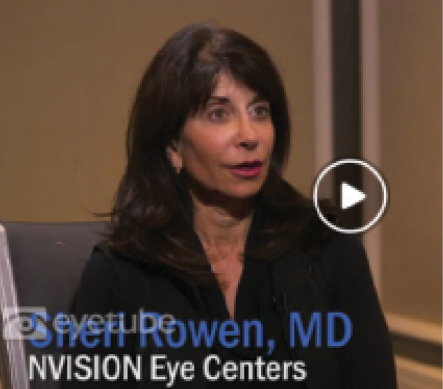
Sheri Rowen, MD, speaks with Steven Vold, MD, regarding dry eye disease and how it pertains to glaucoma.
Once we have a clear picture of the patient’s ocular health, we can determine a treatment strategy, if warranted. For example, patients with blocked meibomian glands can benefit from LipiFlow Thermal Pulsation (Tear Science) to melt the oil and express it. The goal is to release the blockages in the glands that are impeding the flow of natural oil. (For more information on LipiFlow Thermal Pulsation, visit bit.ly/beyeA173.) The device heats the meibum to a critical temperature, and then pulsation expresses the glands of their thickened blockages. The glands are therefore opened, and the meibum can freely flow again with each natural full blink thereafter.
Patients who blink incompletely and those with blepharitis often develop a level of biofilm on the lid margin. This clear, wrinkly-looking film grows over the gland’s orifices and blocks the oil from emerging. We use Blephex (Scope Ophthalmics) to gently remove the film. (For more information on Blephex, visit bit.ly/beyeA175.)
After treatment, I can see the oil start coming out again, so elements of the biofilm were actually blocking the orifices from releasing oil. We then ask patients to use Avenova (NovaBay), which contains hypochlorous acid, to get rid of bacteria, treat their blepharitis, and prevent biofilm on a daily basis thereafter. Because blepharitis is chronic in nature, they will continue to use this product.
Glaucoma Drops
Benzalkonium chloride, a common preservative in topical glaucoma drops, can worsen existing DED and increase patients’ risk of developing the condition. It is therefore worthwhile for practitioners to consider preservative-free options. These include Zioptan (tafluprost ophthalmic solution; Merck) and Timoptic (timolol maleate ophthalmic solution; Valeant Pharmaceuticals), which comes in a unit-dose container. I have switched patients with significant DED to preservative-free drops and observed a real benefit. Alphagan-P (brimonidine tartrate ophthalmic solution; Allergan) contains Purite, and Travatan Z (travopost ophthalmic solution; Alcon), has sorbite, both of which are gentler on the ocular surface than benzalkonium chloride. (For more on the role that medications play in DED, read Drs. Marshall and Noecker’s article.)
By watching for signs and symptoms of DED, glaucoma specialists can tailor treatments to these patients. n
1. Donnenfeld ED, Holland EJ, Bucci FA, et al. Effect of oral re-esterified omega-3 nutritional supplementation on dry-eye disease: double-masked randomized placebo-controlled study. Paper presented at: 2015 American Society of Cataract and Refractive Surgery and American Society of Ophthalmic Administrators Symposium & Congress; April 17-21, 2015; San Diego, CA.
Sheri Rowen, MD
• medical director of cataract surgery NVISION Eye Centers, Newport Beach, California
• clinical assistant professor, University of Maryland, College Park, Maryland
• sheri.rowen@nvisioncenters.com
• financial disclosure: speaker’s bureau for and consultant to Abbott, Alcon, Allergan, Bausch + Lomb, mprimis,PRN, Omeros, Shire, TearLab, and TearScience.
