





Today, people carry pocket devices with high-quality sensors, powerful processing units, and sophisticated software. Applications (apps) that easily perform functions that used to be complex and difficult are quickly becoming indispensable to both practitioners and their patients.
KEEPING UP WITH INFORMATION
An American Society of Cataract and Refractive Surgery survey in 2010 showed that approximately 83% of members used their mobile phones to accomplish some of their professional tasks.1 Information today is multiplying at an explosive rate, and staying current is nearly impossible without aids to separate the wheat from the chaff and deliver knowledge that can be rapidly incorporated into routine clinical practice.
AT A GLANCE
• Mobile applications can make formerly onerous tasks quicker and simpler to complete.
• Mobile technology can improve communication and strengthen the patient-physician relationship.
• Men and women appear to respond to technology-based information in different ways.
IMPROVING VIRTUAL RELATIONSHIPS
Patients are increasingly seeking information and treatment via the Internet. A recent study found that a patient’s willingness to communicate online with a doctor predicted his or her willingness to receive online treatment,2 but it also revealed differences between sexes. One study found that women had a stronger social motive to find health-related information online, experienced greater enjoyment searching for such information, and were more receptive to health awareness campaigns.3 In contrast, men were more open to engaging in a virtual relationship with the doctor, so they may be the primary target group for additional online services. This study also described areas that can reinforce the virtual patient-physician relationship such as setting online appointments, allowing patients to request physician referrals online, writing prescriptions digitally, and discussing normal test results on Facetime or Skype. Using apps to facilitate these tasks can play a vital role in developing the patient-physician relationship. They offer efficient social interaction; ease of information access; and freedom from bulky textbooks, notes, and even heavy, expensive equipment (with the aid of accessories).
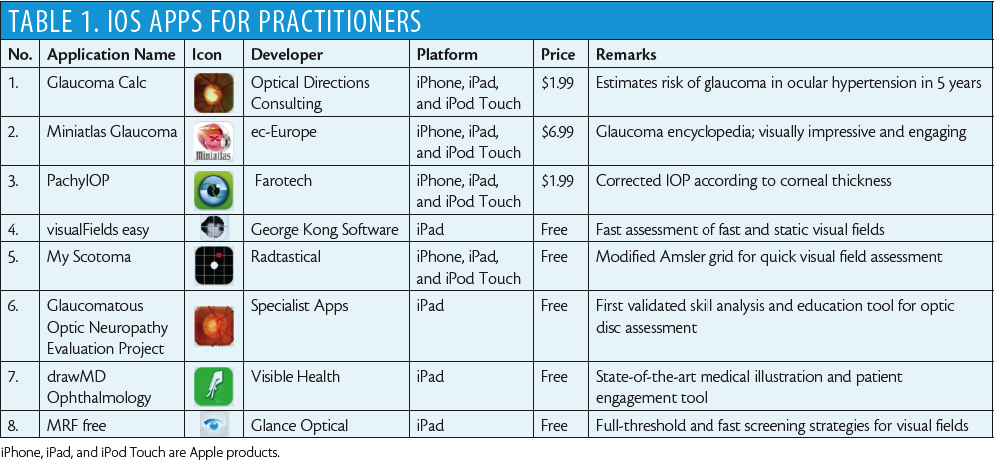
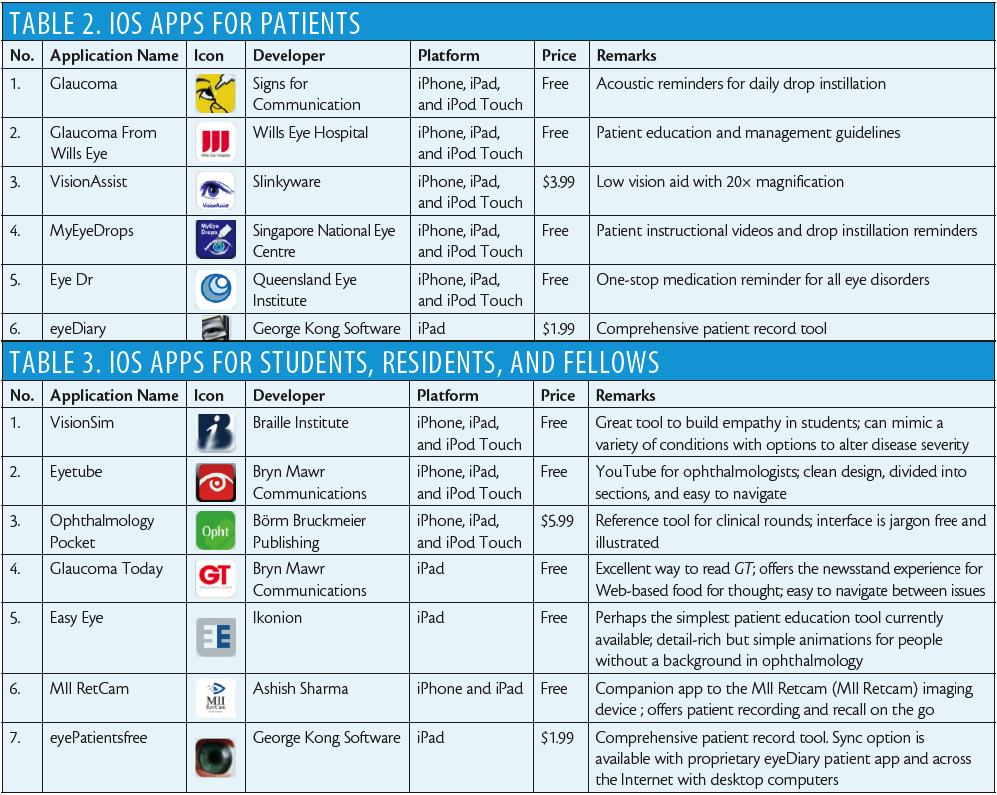
Tables 1, 2, and 3 review some of the apps that can be easily integrated into your workflow to improve glaucoma management. n
1. Moradian S, Safi S. Application of mobile phones in ophthalmology. J Ophthalmic Vis Res. 2015;10(2):200-205.
2. Roettl J, Bidmon S, Terlutter R. What predicts patients’ willingness to undergo online treatment and pay for online treatment? Results from a Web-based survey to investigate the changing patient-physician relationship. J Med Internet Res. 2016;18(2):e32.
3. Bidmon S, Terlutter R. Gender differences in searching for health information on the Internet and the virtual patient-physician relationship in Germany: exploratory results on how men and women differ and why. J Med Internet Res. 2015;17(6):e156.
Parul Ichhpujani, MD
• associate professor, Department of Ophthalmology, Government Medical College and Hospital, Chandigarh, India
• parul77@rediffmail.com
• financial interest: none acknowledged
Suresh Kumar, MD
• professor, Department of Ophthalmology, Government Medical College and Hospital, Chandigarh, India
• drsuresh.kumar.gupta@gmail.com
• financial interest: none acknowledged
Sahil Thakur, MD
• junior resident, Department of Ophthalmology, Government Medical College and Hospital, Chandigarh, India
• +91-8054739096; drsahilthakur@gmail.com
• financial interest: none acknowledged
