



After Cairns introduced guarded filtration surgery in 1968, it rapidly became the gold-standard incisional procedure for the surgical management of glaucoma,1 but of late, the use of traditional transscleral filtration surgery has declined significantly. The reasons for this decrease are multifactorial and include improved pharmacologic therapy; greater use of laser therapy, including selective laser trabeculoplastly and endoscopic cyclophotocoagulation; accumulating evidence that modern phacoemulsification lowers IOP in a large percentage of patients; and most recently, the rapid adoption of new techniques in microincisional glaucoma surgery involving Schlemm canal. Given the newfound luxury of options for patients with mild to moderate glaucoma, surgeons seem to be moving away from procedures with unacceptably high complication rates as reported in major trials such as the Tube Versus Trabeculectomy (TVT) Study2 and toward safer procedures, even if they are less efficacious. Many glaucoma subspecialists are reserving trabeculectomy and aqueous shunts for patients at significant risk of functional impairment.
AT A GLANCE
• Transscleral filtration surgery remains the go-to procedure for patients with markedly elevated IOP as well as for those with severe and progressive glaucoma.
• Two recent industry acquisitions have generated considerable interest in devices that have the potential to transform transscleral filtration surgery—specifically the Xen45 and the InnFocus MicroShunt.
• Compared with trabeculectomy, a potential downside of both implants is that they cannot be titrated. On the other hand, postoperative care is less burdensome.
• Glaucoma surgeons will soon have three major reservoirs to use for outflow procedures: Schlemm canal, the supraciliary space, and the time-tested subconjunctival space. Each has unique pros and cons.
Despite recent advances in microinvasive glaucoma surgery, transscleral filtration surgery remains the go-to procedure for patients with markedly elevated IOP as well as for those with severe glaucoma. There is no more effective way to get out of trouble quickly than transscleral filtration surgery. Interestingly, the attribute of filtration surgery so attractive for severe disease and very high IOP—the ability to markedly lower IOP quickly—is also a major disadvantage. For experienced glaucoma surgeons, the potential to generate hypotony is as important a consideration as unacceptably elevated IOP. Some of the most serious perioperative complications of filtration surgery (specifically, suprachoroidal hemorrhage or effusions, flat anterior chambers, and hypotony maculopathy) have hypotony as an antecedent. Moreover, the healing whims of the conjunctiva continue to frustrate surgeons. For example, antimetabolites are necessary to prevent aggressive fibrosis and bleb failure, yet the weakened conjunctival tissue often breaks down years later, resulting in late bleb leaks and the possibility of bleb-related endophthalmitis.
Two recent acquisitions have generated considerable interest in devices that have the potential to transform transscleral filtration surgery. In September 2015, Allergan acquired the Xen Glaucoma Treatment System, which consists of the Xen45 and the Xen Injector. In July 2016, Santen entered into a definitive agreement to acquire InnFocus, the developer of the InnFocus MicroShunt. Both technologies use the subconjunctival space as the reservoir for aqueous egress to reduce IOP. The two devices are engineered to optimize lumen size and overall length so as to maximize aqueous outflow and safety, mitigate the risk of hypotony, and access the IOP-lowering potential of the subconjunctival space.
THE DEVICES
Xen45
The Xen45 is a permanent gelatin device derived from biocompatible porcine or bovine collagen. It has an inner lumen diameter of 45 µm and a length of 6 mm. Because the surgeon implants the device through a clear corneal incision under gonioscopic visualization (Figure 1), the conjunctiva need not be incised. Mitomycin C will likely be employed during this procedure and may be most effectively administered by subconjunctival injection.
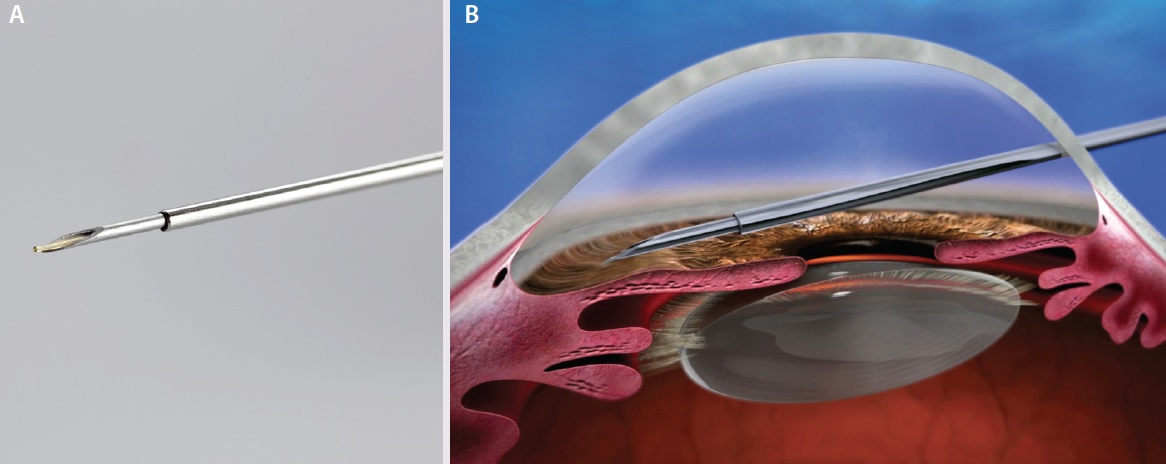
Figure 1. A close-up of the needle (A). Insertion of the Xen45 (B).
(Courtesy of Allergan.)
Advocates of the Xen note that leaving the conjunctiva and sclera completely untouched during the device’s implantation theoretically reduces perioperative inflammation and lessens fibrotic bleb scarring.
InnFocus MicroShunt
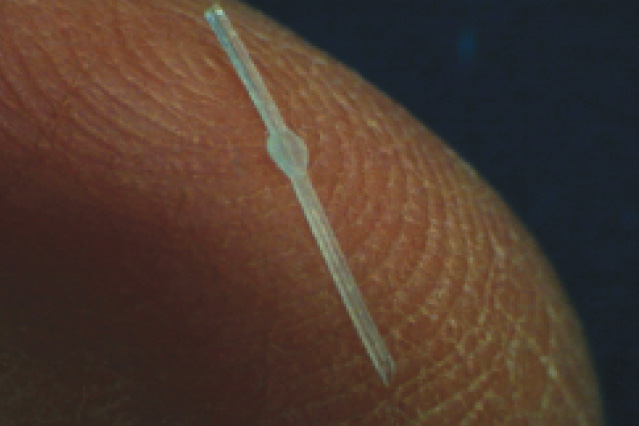
Figure 2. The InnFocus MicroShunt.
(Courtesy of InnFocus and Santen.)
The InnFocus MicroShunt is 8.5 mm long and has a 75-µm lumen (Figure 2). The device is made from an inert biocompatible biomaterial called poly(styrene-block-isobutylene-block-styrene) or SIBS. After performing a conjunctival peritomy, the surgeon places the implant via an ab externo approach through a 25-gauge needle tract incision that is 3 mm long.
Advocates of this device note that the ab externo approach is familiar to most surgeons and that it allows access to the subconjunctival space for applying mitomycin C and direct cauterization of any bleeders that may develop during the dissection.
Research
Watch it Now
In this episode of Ophthalmology Insider, Mark Kontos, MD, invites GT’s Chief Medical Editor Steven Vold, MD; Arsham Sheybani, MD; and Kuldev Singh, MD, to discuss how new surgical devices will change the management of glaucoma in the future.
Although results with the Xen45 and InnFocus MicroShunt have been published,3,4 there are no head-to-head comparative trials in the published literature, and it will take time for surgeons to determine how best to use each device after it is approved by the FDA. Compared with trabeculectomy, a potential downside of both implants is that they cannot be titrated. With trabeculectomy, lysing or releasing sutures allows surgeons to increase outflow as aqueous production increases after the discontinuation of medications. On the other hand, the fact that these procedures cannot be titrated reduces the intensity of the postoperative care, although the blebs generated by each device may need to be needled to enhance flow should fibrosis occur.
MY APPROACH TO THE FUTURE
In the near future, glaucoma surgeons will have three major reservoirs to use for outflow procedures: Schlemm canal, the supraciliary space, and the time-tested subconjunctival space. Each has unique pros and cons. When will the subconjunctival space be used with either the Xen or InnFocus device? It is hazardous to speculate, but here is how I will approach the surgical landscape when these technologies become available.
My experience with canal-based surgery has been favorable. The overall efficacy is modest, but individual cases often far exceed my expectations. These very successful cases occur frequently enough that I will continue to offer this technology to most of my patients who have coexisting cataracts and mild to moderate glaucoma and, in some instances, those who have severe glaucoma that is under reasonable control. The obvious advantage of this strategy is its excellent safety. The disadvantage is that some of these patients will need more surgery in the future. Thankfully, the canal-first strategy takes nothing off the table should further intervention be needed.
LISTEN UP
Gary Wörtz, MD; Ike Ahmed, MD; and John Berdahl, MD, discuss the exciting evolution of microinvasive glaucoma surgery.
For patients in whom canal-based surgery either fails or is deemed inadequate from the start, surgeons will soon have the intriguing options of accessing the supraciliary space and improved, more refined, subconjunctival filtration surgery. The option of keeping all aqueous outflow subscleral (eliminating the risk of bleb-related problems) is appealing, but so is a simplified and more efficient approach to the subconjunctival space. I expect that the Xen45 and InnFocus MicroShunt will be formidable options in the white-hot glaucoma surgical space, particularly for patients undergoing standalone procedures (ie, without coincident cataract surgery) and those with more advanced disease who are at increased risk of functional impairment. n
1. Cairns JE. Trabeculectomy. Preliminary report of a new method. Am J Ophthalmol. 1968;66(4):673-679.
2. Gedde SJ, Herndon LW, Brandt JD, et al; the Tube Versus Trabeculectomy Study Group. Surgical complications in the Tube Versus Trabeculectomy Study during the first year of follow-up. Am J Ophthalmol. 2007;143(1):23-31.
3. Sheybani A, Lenzhofer M, Hohensinn M, et al. Phacoemulsification combined with a new ab interno gel stent to treat open-angle glaucoma: pilot study 2015. J Cataract Refract Surg. 2015;41(9):1905-1909.
4. Batlle JF, Fantes F, Riss I, et al. Three-year follow-up of a novel aqueous humor microshunt. J Glaucoma. 2016;25(2):e58-65.
Thomas W. Samuelson, MD
• attending surgeon, Minnesota Eye Consultants, Minneapolis
• clinical associate professor, University of Minnesota, Minneapolis
• (612) 813-3628; twsamuelson@mneye.com
• financial disclosure: consultant to AqueSys (company acquired by Allergan), Glaukos, and Transcend Medical (company acquired by Alcon); investigator for InnFocus
