




Fast Visual Field Progression Is Associated with Depressive Symptoms in Patients with Glaucoma
ABSTRACT SUMMARY
This prospective observational cohort study evaluated the association between rates of progressive visual field loss and the occurrence of depressive symptoms in glaucoma patients. Two hundred four patients completed the Geriatric Depression Scale (GDS) questionnaires and visual field tests, with a mean follow-up time of 2.2 years. Standard automated perimetry (SAP) measured visual field loss, and an integrated binocular visual field was estimated from monocular tests. Regression models calculated the association between progressive visual field loss and changes in depressive symptoms while adjusting for confounding clinical and socioeconomic variables. The researchers concluded that faster visual field progression was associated with the occurrence of depressive symptoms in glaucoma patients.
DISCUSSION
What is the relationship between the rates of change in binocular SAP mean sensitivity and change in the GDS questionnaire?
The GDS questionnaire is a self-reported, 15-item, validated screening tool for depression in the elderly, and it is frequently used in geriatric assessments. Scores higher than 10 out of 15 almost always indicate depression, and scores higher than five out of 15 are suggestive of depression. Although other glaucoma studies have correlated the severity of visual field loss and the occurrence of depressive symptoms, this study is unique because it investigates the association between the rate of visual field loss and the occurrence of depressive symptoms. Specifically, statistically significant results showed that every loss of 1 dB per year in binocular SAP mean sensitivity was associated with a change of 2 units on the GDS scores during follow-up. Using a multivariable model adjusting for demographic, clinical, and socioeconomic factors, each 1-dB loss in binocular SAP mean sensitivity per year was associated with a change of 3 units on the GDS score.
How might the results of this study influence the management of patients?
The study suggests that patients with accelerated visual field deterioration experience greater changes in GDS scores and may help to identify glaucoma patients who have a greater likelihood of developing depressive symptoms. Other studies have shown an increased prevalence of depression and anxiety in patients with glaucoma.2 It is important for health care providers to recognize the impact that glaucoma can have on the quality of life and well-being of a patient experiencing rapid visual field progression. Because the disease can be a significant predictor of depression, a thorough clinical history, a recognition of the individual’s limitations, and regular screening are imperative for the overall well-being and management of glaucoma patients. Those with depressive symptoms or those who screen positive for depression should be referred to mental health care providers for management.
Association Between Glaucoma and At-fault Motor Vehicle Collision Involvement Among Older Drivers
Kwon M, Huisingh C, Rhodes LA, et al3
ABSTRACT SUMMARY
This retrospective population-based study examined the association between glaucoma and motor vehicle collision (MVC) involvement. Data on at-fault MVC involvement more than 5 years before enrollment were collected using the state records of 2,000 licensed drivers in Alabama older than 70 years. Habitual binocular distance visual acuity, binocular contrast sensitivity, and binocular
driving visual field were analyzed, and Poisson regression was used. The investigators suggested that older drivers with glaucoma were more likely to have a history of at-fault MVC involvement. Specifically, impairment in the driving visual field had an independent association with at-fault MVC involvement.
DISCUSSION
What is the relationship between visual field defects in specific regions and MVC rates?
The researchers used a Humphrey Field Analyzer (Carl Zeiss Meditec) and select test targets that simulated drivers’ environments and gaze through a vehicle’s windshield. Specifically, testing locations included 60º horizontally, 15º superiorly, and 30º inferiorly. After stratifying the visual field data into six subregions, the researchers found that deterioration in the left, upper, and lower fields was associated with increased MVC rates (Figure).
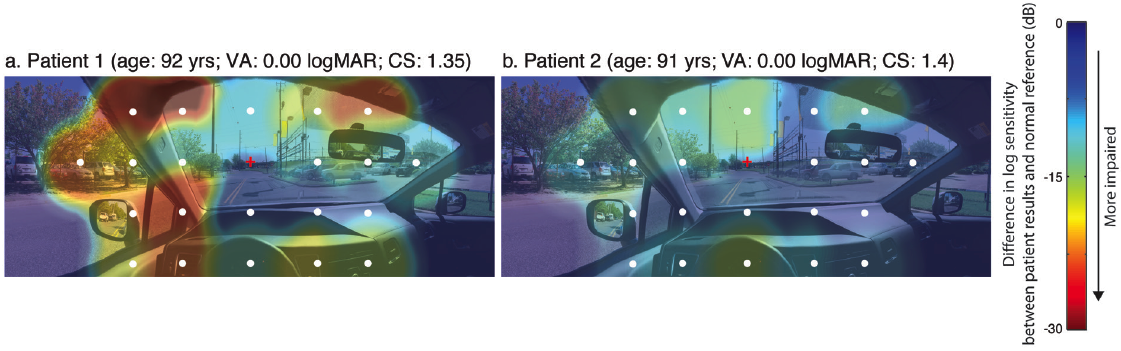
Figure. Researchers superimposed the visual field map on a driver’s view of the windshield. Visual field of a 92-year-old driver who had a history of at-fault MVC (A). Visual field of a 91-year-old driver who was not involved in any at-fault MVC (B). Warm colors represent increasing visual field progression. Reprinted with permission from Kwon et al.3
How might the results of this study influence the management of patients?
This study suggests that drivers with glaucoma have a 1.65 times greater MVC rate compared to those without glaucoma. Furthermore, drivers with severe visual field loss were significantly associated with crash involvement. In the elderly, driving cessation could result in a loss of independence, social isolation, and an overall decreased quality of life. With an aging population, the early detection of visual field defects in glaucoma patients and early screening are crucial for driver safety. An open dialogue among the patient, family members, and health care providers addressing potential driving concerns is critical.
As the investigators mentioned, a limitation of the study includes having all patients’ visual function assessed after crash occurrence, thus possibly overestimating the degree of visual field loss. Also, the study population only included current license holders. Individuals with severe vision loss might have stopped driving, thereby leading to an underestimation of the degree of association between glaucoma and MVC. n
1. Diniz-Filho A, Abe RY, Cho HJ, et al. Fast visual field progression is associated with depressive symptoms in patients with glaucoma. Ophthalmology. 2016;123(4):754-759.
2. Lim NC, Fan CH, Yong MK, et al. Assessment of depression, anxiety, and quality of life in Singaporean patients with glaucoma. J Glaucoma. 2016;25(7);605-612.
3. Kwon M, Huisingh C, Rhodes LA, et al. Association between glaucoma and at-fault motor vehicle collision involvement among older drivers: a population-based study. Ophthalmology. 2016;123(1):109-116.
Section Editor James C. Tsai, MD, MBA
• president of New York Eye and Ear Infirmary of Mount Sinai and chair of ophthalmology for the Mount Sinai Health System in New York
• jtsai@nyee.edu
Karim Damji, MD, FRCSC, MBA
• professor and chair, University of Alberta Department of Ophthalmology, Edmonton, Alberta, Canada
• (780) 735-5954; kdamji@ualberta.ca
• financial interest: none acknowledged
Simrenjeet Sandhu, MD
• research fellow, University of Alberta Department of Ophthalmology, Edmonton, Alberta, Canada
• (780) 450-3335; simrenje@ualberta.ca
• financial interest: none acknowledged
