


Watch it Now
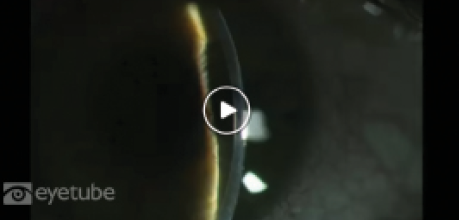
GT thanks everyone who shared innovative techniques, challenging cases, and pearls for glaucoma surgery in this year’s film festival. Our judges have reviewed all of the entries and have chosen a winner: Shakeel Shareef, MD, of Rochester, New York.
Dr. Shareef’s video, “Phacomorphic Glaucoma With PI,” presents a case of uncontrolled phacomorphic glaucoma in the setting of patent peripheral iridotomies. The patient underwent clear lens extraction with goniosynechialysis. The surgical video highlights the deliberate planning and steps taken to avoid perioperative complications. Dr. Shareef’s video stood out to the judges as offering the best combination of education, video quality, narration, and editing.

Phacomorphic Glaucoma With Peripheral Iridotomies
By Shakeel Shareef, MD
In this video, a 25-year-old deaf and mute woman presented with IOP ranging from 30 to 40 mm Hg OS for a 2-week duration on maximal medical therapy despite the presence of multiple patent laser iridotomies. The patient had symptoms of hyperemia, eye pain, and blurred vision (20/50). Her past medical history was significant for premature birth with cryotherapy treatment in both eyes for retinopathy of prematurity at 24 weeks of age.
EXAMINATION FINDINGS
On slit-lamp examination, there was an absence of iris bombe with peripheral iridocorneal touch for 360º. Anterior segment imaging revealed angle closure, and ultrasound biomicroscopy ruled out plateau iris. Optical biometry showed a shallow anterior chamber (AC) depth (2.21 mm) and short axial length (21.7 mm) with steep keratometry measurements (46.00-47.00 D). These findings were consistent with phacomorphic glaucoma. Given that the lens assumed a more spherical shape with anterior displacement of the iris-lens diaphragm because of zonular laxity from prior cryotherapy, I decided to perform clear lens extraction to remove the source of angle closure combined with goniosynechialysis.
SURGICAL CHALLENGES
This case presented several surgical challenges. After consulting with members of the American Glaucoma Society, I identified several areas that needed attention: (1) perioperative IOP control with risk for iris herniation, (2) creation and maintenance of a stable AC, (3) creation of an anterior capsulorhexis in the setting of a flaccid anterior capsule, (4) risk of malignant glaucoma, and (4) selection of an appropriate IOL power.
PREOPERATIVE PROCEDURES
Intravenous mannitol (20% solution 1 g/kg body weight)1 was administered to dehydrate the vitreous 60 minutes prior to surgery in the preoperative holding area, with a maximal lowering of IOP at 90 minutes. The instillation of atropine one drop twice a day began 48 hours prior to surgery to
1. deepen the AC by displacing the iris-lens diaphragm posteriorly
2. flatten the anterior capsule by placing the zonules on stretch to facilitate anterior capsulorhexis
3. counter aqueous misdirection
4. stabilize the blood-aqueous barrier to decrease postoperative inflammation.
I consulted Warren Hill, MD, on IOL selection, and he emphasized that this case was not refractive but primarily a rehabilitative procedure, given that it would be difficult to determine the true effective lens position in the setting of acute angle closure. He further recommended estimating an appropriate final spherical equivalent refraction.
THE PROCEDURE
Intraoperatively, after induction of general anesthesia, I made two temporal 1-mm sideport incisions at 1 and 5 o’clock to counter iris herniation. I injected trypan blue to serve as a visual guide and to decrease elasticity of the anterior lens capsule for better handling during capsulorhexis.2 I injected Healon5 (Abbott) into the AC without overfill to create and maintain a safe workspace.
After completing the anterior capsulorhexis, I initiated clear lens extraction with a biaxial irrigation/aspiration system using a low flow rate of 30 to 40 mL/min. I made every effort to maintain a stable AC with continuous irrigation and viscoelastic supplementation as necessary. After injecting a cohesive viscoelastic to distend the capsular bag, I made a 2.2-mm temporal keratome incision and then injected and properly centered a single-piece, foldable IOL. Following appropriate head and microscope tilt, I inspected the angle with surgical gonioscopy and noted complete closure nasally despite marked deepening of the AC. Under gonioscopic guidance, I performed goniosynechialysis for approximately 180º with micrograspers to gently tease the peripheral iris towards the center until the trabecular meshwork came into full view. I tilted the patient’s head temporally and adjusted the microscope to provide a nasal view.
I created a nasal 1-mm sideport incision at 9 o’clock and then performed a similar goniosynechialysis temporally. During iris manipulation, I injected a cohesive viscoelastic to tamponade any bleeding and to keep the angle open. After restoring the head and microscope to the standard phaco position, I removed viscoelastic from the capsular bag, injected additional cohesive viscoelastic into the AC, and performed a blind goniosynechialysis at 12 and 6 o’clock.
POSTOPERATIVE RESULTS
Two months postoperatively, the patient was off all glaucoma medications and had an IOP of 12 mm Hg. Her visual acuity measured 20/40. A slit-lamp examination revealed a deep AC both centrally and peripherally. Anterior segment imaging revealed wide-open angles. This surgical video highlights the deliberate and careful planning necessary to avoid perioperative complications. n
1. Schacknow PN, Samples JR. Medications used to treat glaucoma. In: Schacknow PN, Samples JR, eds. The Glaucoma Book. Philadelphia, PA: Springer Science + Business Media; 2010:583-628.
2. Dick HB, Aliyeva SE, Hengerer F. Effect of trypan blue on the elasticity of the human anterior lens capsule. J Cataract Refract Surg. 2008;34(8):1367-1373.
Section Editor Soosan Jacobs, MS, FRCS, DMB
• senior consultatnt ophthalmologist, Agarwal’s Eye Hospital, Chennai, India
• dr_soosanj@hotmail.com
Section Editor Jonathan S. Myers, MD
• associate attending surgeon on the Glaucoma Service and director of the Glaucoma Fellowship at Wills Eye Hospital, Philadelphia
• (215) 928-3197; jmyers@willseye.org
Shakeel Shareef, MD
• associate professor, Flaum Eye Institute, University of Rochester School of Medicine, Rochester, New York
• (585) 276-6104; shakeel_shareef@urmc.rochester.edu
• financial interest: none acknowledged
