


Having gone into practice in 1976, I remember using pilocarpine as the initial therapeutic agent to treat primary open angle glaucoma. Having my patients, and myself, go through all the issues associated with pilocarpine, it is fascinating that this old medication is being repurposed to treat a different condition: presbyopia.
Many clinicians my age remember the struggles to keep our patients compliant, and their glaucoma controlled, with pilocarpine. The medication was extremely effective in reducing intraocular pressure (IOP) and safe systemically, however, the problems were the need to use it four times a day and the commonly occurring ocular side effects, including headache, brow ache, induced myopia, and dim and blurred vision. Other local side effects included stinging, burning, and hyperemia, and long-term use was associated with shallowing of the anterior chamber. The side effects were dependent on dose and concentration, which often required the dosage and concentration to be slowly increased to allow the patient to adapt to the side effects.
For many glaucoma specialists, pilocarpine never disappeared from their armamentarium and is still used when therapeutic options have dwindled. Many general practitioners have never used pilocarpine and think of it as a museum item. So, it is interesting that in the not-too-distant future, different versions of pilocarpine will probably become available for presbyopic individuals wanting to temporarily shed their reading glasses.
History
Pilocarpine, a parasympathomimetic alkaloid that comes from the leaves of tropical South American shrubs from the genus Pilcarpus, was introduced in 1877 (Figure). It is a nonselective muscarinic receptor agonist that, when applied topically, causes contraction of the iris sphincter muscle leading to pupillary constriction (miosis). Pilocarpine also causes contraction of the ciliary muscle, opening up the trabecular meshwork spaces as tension increases on the scleral spur, facilitating aqueous humor outflow and reduction of IOP. Pilocarpine has other applications in eye care, such as using the miosis to break an angle closure attack, intracameral administration during cataract surgery, confirming Adie’s tonic pupil, reducing glare post cataract surgery, and now presbyopia.
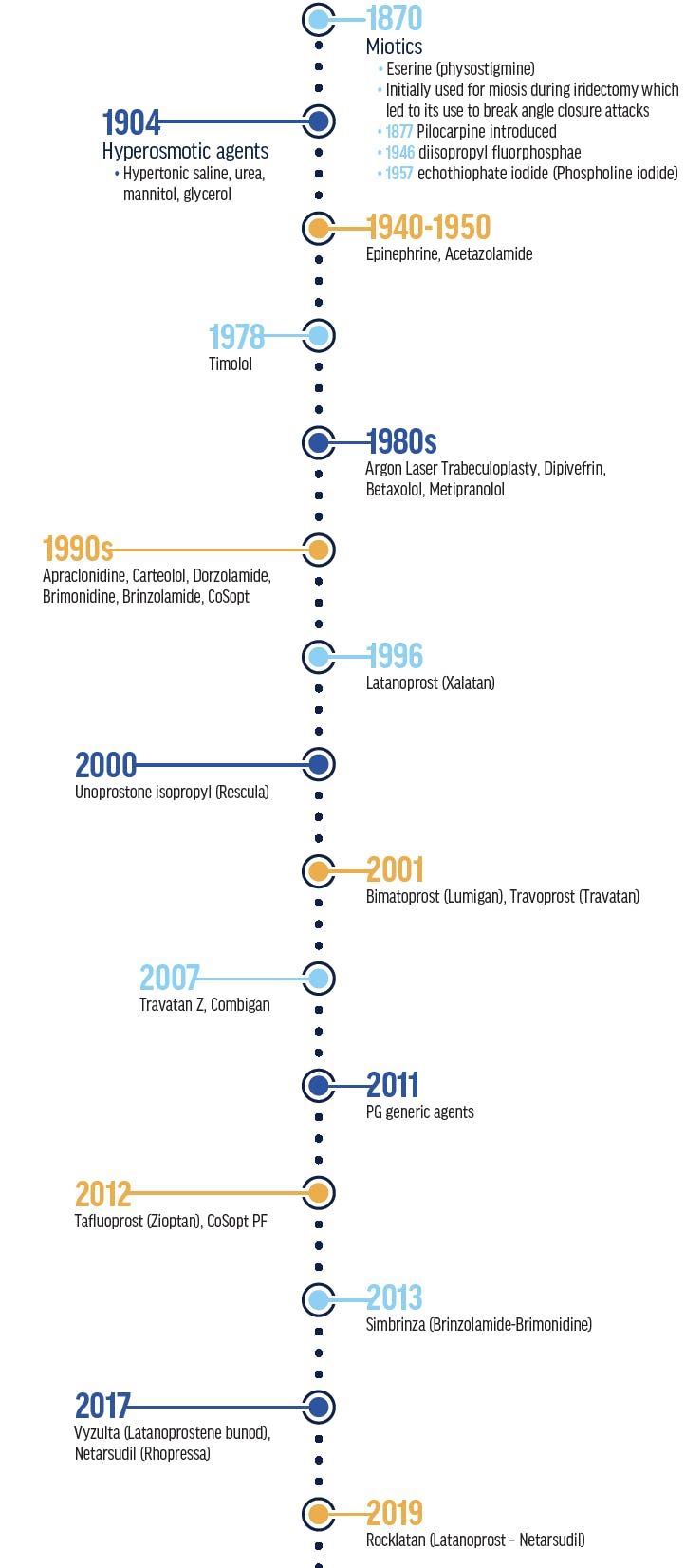
At one time, pilocarpine came in concentrations ranging from 1% to 10%, but only 1%, 2%, and 4% are currently FDA-approved (Isoptocarpine Alcon Laboratories, Fort Worth, TX). Due to its short half-life, a QID dosage is needed to reduce the IOP over a 24-hour period. The reasons why pilocarpine use declined are simple: it bothered almost everyone who took the medication, and it required instillation four times per day to adequately control IOP. As new glaucoma agents have been introduced, beginning with timolol in 1978, pilocarpine was placed further down the ladder of IOP-reducing agents. Years ago, I would substitute a recently introduced agent such as timolol or dipivefrin for pilocarpine. On occasion, the patient, upon return, would request to be placed back on pilocarpine because they preferred their vision with this agent. This brings us to present day.
Today’s Use
Presbyopia is one of life’s inconveniences that affects everyone over the age of 40 to differing degrees. It is due to an aging change in which the crystalline lens loses its flexibility and gradually stiffens. This leads to a loss of accommodation with a resulting blur when looking at near objects, requiring the use of reading glasses. When a miotic is instilled, a small aperture develops, increasing the depth of field and allowing near objects to appear clear.1 The pinhole camera effect allows near vision to improve, but developing a medication that is rapid in onset without disturbing the field of vision, or distance or nighttime vision, is not easy.2,3 If it was, we would have seen an agent to manage presbyopia years ago.
The medication needs to be comfortable, both in the eye and upon instillation, as well as not disturbing to the ocular surface. In regard to the ocular surface, a preservative-free form may be an important option since the medication will be used chronically. It must have an excellent safety profile with sufficient duration of action. The medication won’t be appreciated if the patient still needs reading glasses to read the dinner menu.
Concentrations of pilocarpine in development include solutions ranging from below to above a 1.0% solution, as well as a spray meant to reduce the amount getting into the eye. Thus, for presbyopia therapy, we are looking at sub-glaucoma dosages with the objective of impacting the pupillary size without creating other side effects.1,2,4 The ideal candidate would be an emmetrope or a person with a low refractive error who requires reading glasses.2,3 While the sweet spot would be the new presbyope, an important question will be how the medication is tolerated for older presbyopes who are starting to develop lens changes.1 Some have mentioned its use only in the non-dominant eye to prevent some of the vision-related side effects, but many will want to use it bilaterally. Other miotic agents besides pilocarpine are in development for the treatment of presbyopia, as well as lens-softening agents, which are years from approval.
Potential Challenges
Presbyopic miotic agents are meant to be used for periodic—not permanent—use. One question is whether the pupil may not dilate in the future or become bound down, developing posterior synechiae. Both problems were seen in some individuals after using high concentration pilocarpine for prolonged periods of time. This problem is unlikely to occur when low concentrations and infrequent dosing are used. Higher concentration and frequent dosing (QID) cause an immobile pupil; with low concentration and only once daily use, the pupil should remain mobile and not be bound down or inactive.
One concern with pilocarpine was the risk of a retinal detachment developing, especially in those with lattice degeneration or those who are high myopes. While high myopes are not part of the target audience, lattice may be present in some emmetropes and may require a peripheral retinal examination before the medication is introduced. Still, retinal detachments are unlikely to develop since the concentration and dosage are lower than what was used for glaucoma.

American Optometric Association. 2019 year in review. aoa.uberflip.com. https://aoa.uberflip.com/i/1203282-2019-year-in-review/3? Accessed: March 2, 2021.
Conclusion
Pilocarpine has the potential to improve quality of life for many individuals by allowing them to temporarily throw away their reading glasses.1-4 There are individuals who, as they age, have difficulty adapting to the need for reading glasses. This nonsurgical option is one therapeutic modality that may be used for the improvement of reading vision.2 There will be challenges since medication needs to improve a person’s ability to see up close without disturbing distance or nighttime vision or creating unwanted side effects. This, again, is no small challenge, but hopefully these new attempts will prove successful.
1. Benozzi G, Perez C, Leiro J, et al. Presbyopia treatment with eye drops: an eight year retrospective study. Trans Vis Sci Tech. 2020;9(7):25.
2. Renna A, Alio JL, Vejarano LF. Pharmacological treatments of presbyopia: a review of modern per- spectives. Eye Vis (Lond). 2017;4:3.
3. Abdelkader A. Improved presbyopic vision with miotics. Eye Contact Lens. 2015;41:323-327.
4. Renna A, Vejarano LF, De la Cruz E, et al. Pharmacological treatment of presbyopia by novel binocularly instilled eye drops: a pilot study. Ophthalmol Ther. 2016;5:63-73.

