CASE PRESENTATION
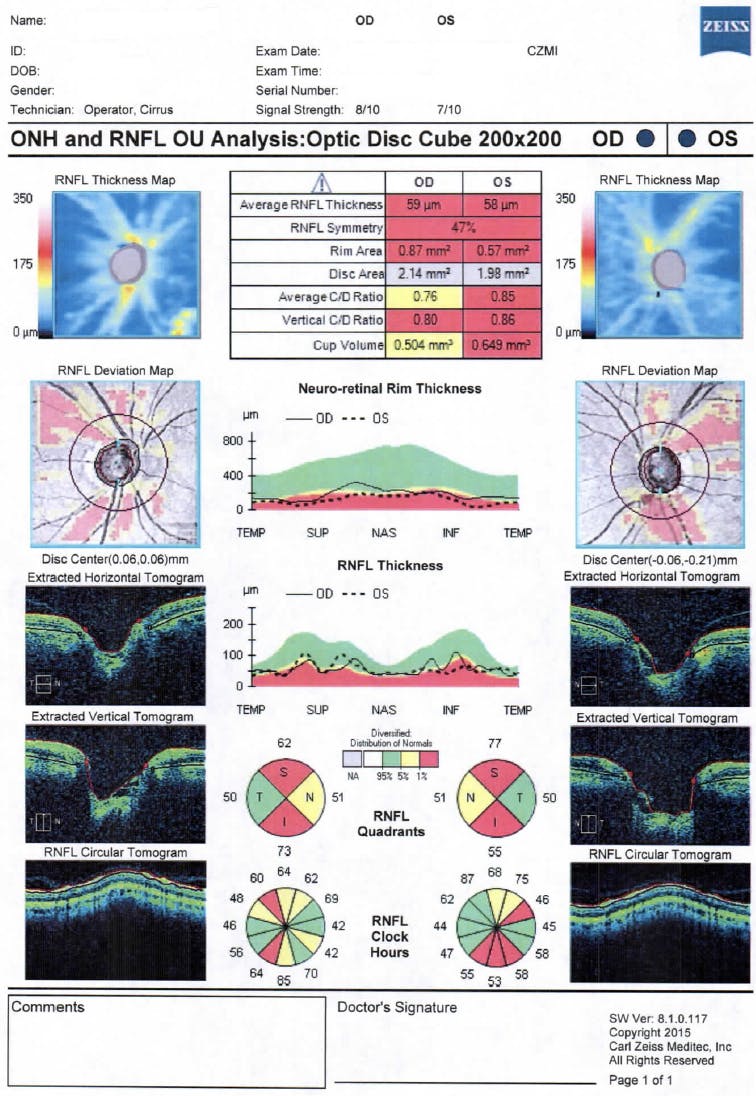
Figure 1. OCT imaging shows significant bilateral thinning of the RNFL, more significant in the left eye.
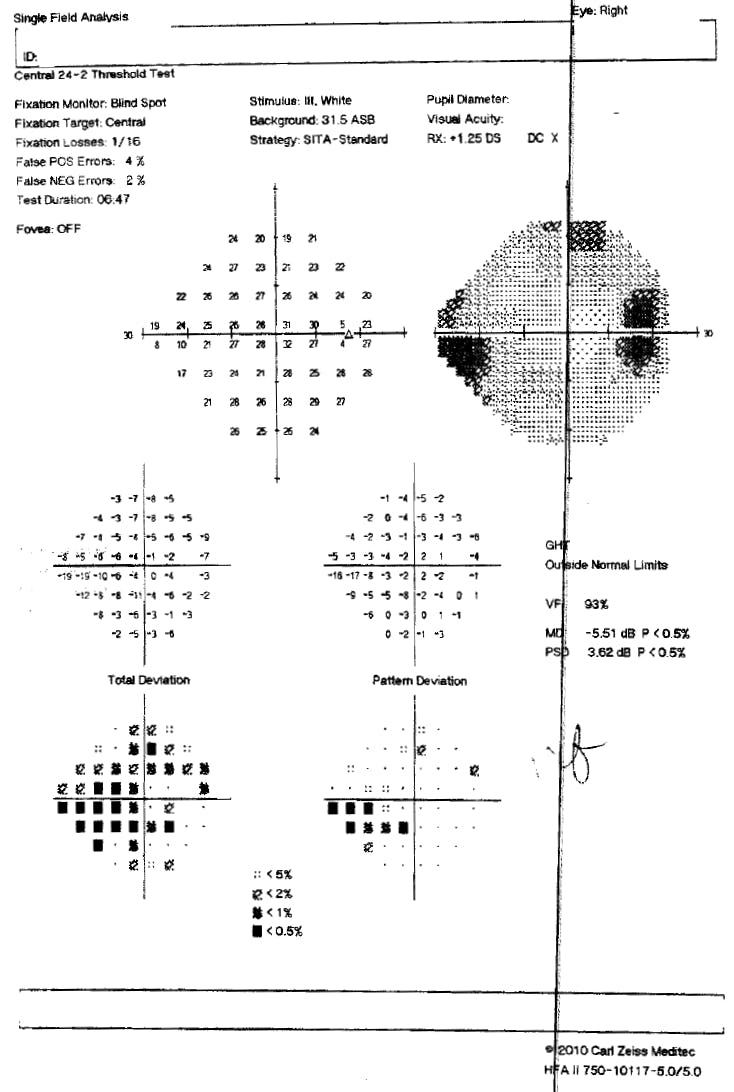
Figure 2. Visual field testing reveals an inferior nasal step in the right eye and a superior altitudinal defect in the left eye.
—Case prepared by Steven R. Sarkisian Jr, MD
SAHAR BEDROOD, MD, PHD
Fortunately, there are several options at this point. Ten years ago, the answer might have been to proceed with a trabeculectomy. Although this is still a viable alternative for this patient, a procedure associated with fewer surgical and postoperative complications may be preferable. The extent of RNFL loss and significant visual field defects in both eyes warrant an IOP target in the low teens. I would also prefer to discontinue the oral methazolamide given its side effect profile.
Based on her mild response to SLT, I would probably avoid angle surgery as a first-line treatment.1 Before proceeding to surgery, I would perform an intracameral injection of a bimatoprost implant (Durysta, Allergan). If this does not reduce the IOP to the target or if the effect is not prolonged, I would place a bleb-based device such as a Xen Gel Stent (Allergan). My surgical approach here would be the ab externo placement of a gel stent with an off-label application of mitomycin C (MMC) and a prolonged steroid taper to help reduce inflammation and scarring of the bleb. Moreover, I would use the time between the injection of a bimatoprost implant and surgery to rehabilitate the ocular surface and treat dry eye disease.
NATHAN M. RADCLIFFE, MD
This patient’s intolerance profile is not entirely uncommon. Patients with an allergy to one medication are more likely to have an allergy to others, and with only five classes of medication available for glaucoma, the options for topical therapy can quickly run out.2 SLT (appropriately delivered here) would have to be considered the first-line option in this scenario. This patient’s response to SLT was modest. The LIGHT study demonstrated that repeat laser trabeculoplasty, even after just a few months, is a reasonable option and SLT can help patients with ocular hypertension and early glaucoma to avoid the next step 75% of the time.3 This patient, however, has a few other important options.
A sustained-release bimatoprost implant was recently approved by the FDA. Its use would be on-label and likely well tolerated here.4 The use of a micropulse transscleral 810-nm laser (Iridex) is another option, although I would use it after trying a bimatoprost implant, repeat SLT, and possibly incisional approaches. Finally, she is a reasonable candidate for a standalone trabecular meshwork procedure such as canaloplasty, goniotomy, or the placement of a trabecular stent, although the last would be an off-label use and would thus likely entail a significant out-of-pocket cost.
MANJOOL SHAH, MD
Fixation-threatening field loss is evident in the left eye, and an inferior arcuate defect with an advanced RNFL defect is present in the right eye. Because this patient has been living with high IOPs, it is worth pursuing a methodical stepwise approach to sustainable IOP control. I would classify her disease as advanced and set a target IOP below 15 mm Hg with at least a 30% reduction from baseline based on the results of the Advanced Glaucoma Intervention Study (AGIS) and the Canadian Target IOP Workshop.5,6
Her intolerance of topical medical therapy means that the goal here is a result free of topical medication because long-term therapy with a systemic CAI is not desirable. Rather, this agent is a bridge to definitive treatment.
The patient’s response to SLT suggests that retreatment may have an effect. Because she was not naïve to treatment at the time of SLT, she may not meet the inclusion criteria for the LIGHT trial, but its results are worth considering nevertheless: Nearly 25% of patients randomly assigned to receive laser therapy in that trial required retreatment,3 and a post-hoc analysis confirmed additive efficacy with minimum risk.7
If repeat SLT does not achieve the target IOP, I would place a bimatoprost implant in each eye. Although the FDA approved this implant for only one injection and although its duration of effect is expected to be only approximately 16 weeks, phase 1 and phase 2 data suggest that at least some patients may achieve prolonged IOP control from a single treatment.8 At the very least, intracameral treatment would buy time to optimize the ocular surface in preparation for the implantation of a subconjunctival microstent with the adjunctive application of 40 to 60 µg of MMC.
The methodical, comprehensive, and holistic approach outlined here attempts to achieve lofty goals in a sustainable manner.
WHAT I DID: STEVEN R. SARKISIAN JR, MD
This patient had glaucoma and significant ocular surface disease (OSD), and she was not enthusiastic about surgical treatment. In addition, I feared that the use of an antimetabolite such as MMC or 5- fluorouracil with a filtration procedure would exacerbate the OSD.
She underwent the implantation of a sustained-release bimatoprost implant in each eye. The procedures were performed 1 week apart. One month after implantation, IOP was 14 mm Hg OU off the oral CAI.
The OSD was treated with oral omega-3 fatty acids and flaxseed oil, topical preservative-free artificial tears, and the placement of an amniotic membrane on each eye. Symptoms markedly improved.
I plan to repeat SLT if the IOP rises above target. Because of the patient’s severe intolerance of medication, we have discussed placing bimatoprost implants again in the future. Although this is an off-label practice because of the risk of corneal endothelial cell loss, and despite potential reimbursement issues, the risk of blindness from glaucoma is more threatening. I plan to observe her closely with visual field and optic nerve evaluations repeated every 3 months.
1. Klamann MK, Gonnermann J, Maier AK, Bertelmann E, Joussen AM, Torun N. Influence of selective laser trabeculoplasty (SLT) on combined clear cornea phacoemulsification and Trabectome outcomes. Graefes Arch Clin Exp Ophthalmol. 2014;252(4):627-631
2. Osborne SA, Montgomery DM, Morris D, McKay IC. Alphagan allergy may increase the propensity for multiple eye-drop allergy. Eye (Lond). 2005;19(2):129-137.
3. Gazzard G, Konstantakopoulou E, Garway-Heath D, et al; LiGHT Trial Study Group. Selective laser trabeculoplasty versus eye drops for first-line treatment of ocular hypertension and glaucoma (LiGHT): a multicentre randomised controlled trial. Lancet. 2019;393(10180):1505-1516.
4. Medeiros FA, Walters TR, Kolko M, et al; ARTEMIS 1 Study Group. Phase 3, randomized, 20-month study of bimatoprost implant in open-angle glaucoma and ocular hypertension (ARTEMIS 1). Ophthalmology. 2020;127(12):1627-1641.
5. Damji KF, Behki R, Wang L; Target IOP Workshop participants. Canadian perspectives in glaucoma management: setting target intraocular pressure range. Can J Ophthalmol. 2003;38(3):189-197.
6. The Advanced Glaucoma Intervention Study (AGIS): 7. The relationship between control of intraocular pressure and visual field deterioration. The AGIS Investigators. Am J Ophthalmol. 2000;130(4):429-440.
7. Garg A, Vickerstaff V, Nathan N, et al; Laser in Glaucoma and Ocular Hypertension Trial Study Group. Efficacy of repeat selective laser trabeculoplasty in medication-naive open-angle glaucoma and ocular hypertension during the LiGHT Trial. Ophthalmology. 2020;127(4):467-476.
8. Craven R, Walters T, Christie W, et al; Bimatoprost SR Study Group. 24-month phase I/II clinical trial of bimatoprost sustained-release implant (bimatoprost SR) in glaucoma patients. Drugs. 2020:80(2):167-179
_1754918026.png?auto=compress,format)