


A 46-year-old black man who works as a laborer and is the primary source of income for his family, which includes three children, was referred for uncontrolled advanced glaucoma:
- Diagnosed with juvenile open-angle glaucoma 6 years prior
- Tmax = 36/40 mm Hg
- OS = no light perception due to glaucoma
- IOP OD had been fluctuating, but now in low 20s on maximum tolerated medical therapy
- Medication use included a prostaglandin, combination beta-blocker/alpha-agonist, and Diamox 250mg po TID; chart lists compliance as “OK”
- Selective laser trabeculoplasty OU 3 years ago
- Family history: Uncle with advanced glaucoma
- General health: good, non-smoker
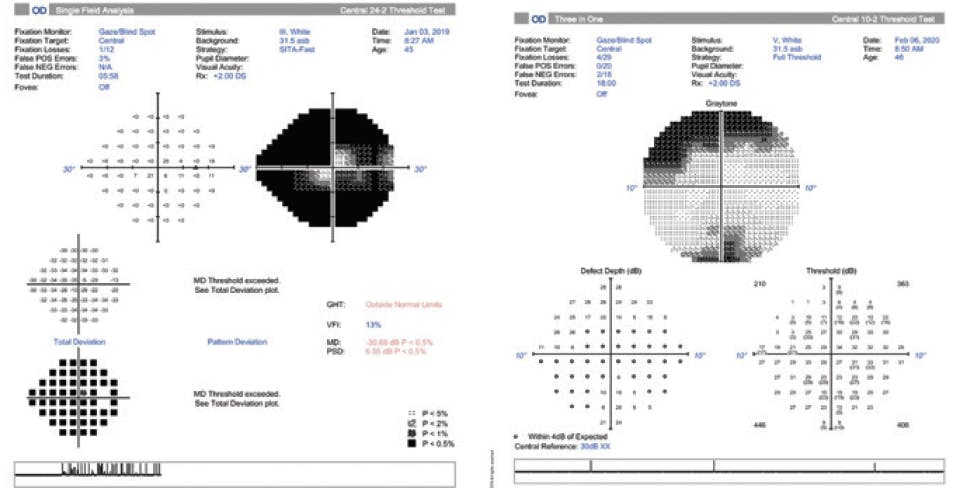
Baseline imaging and visual fields suggested advanced glaucoma (Figures 1 and 2) and examination findings were as follows:
- VA: 20/20 (plano) OD; NLP OS
- IOP: 23 mm Hg OD; 30 mm Hg OS
- Central corneal thickness: 465 µm OD; 456 µm OS
- Anterior segment: unremarkable, conjunctiva 1+ injection, K clear, AC Deep, grade 4 angles, trace pigment, lens clear
- Posterior segment: C/D 0.95 with minimal rim present OD; 1.0 cup OS
- Retina unremarkable
Diagnosis and Management
A number of factors steered us toward procedural management: a history of questionable compliance; current use of three medications (including a combination agent, so in actuality, treatment consisted of four distinct medications); and progression despite maximum tolerated medical therapy. In brief, we had to gain control of the pressure urgently. Within the category of procedures, several things led us to offering MicroShunt, including:
- A need to gain durably low IOP with high probability for diurnal control suggests that MIGS devices and surgeries would not deliver enough IOP-lowering efficacy
- Clinical trial data with MicroShunt suggests potop IOP ~13 mm Hg with low risk for hypotony1,2; historical studies with MIGS suggest final IOP in the mid- to high-teens3,4
- The monocular status requires an intervention with a highly favorable safety profile
- The young age of the patient, coupled with the need to return to work to support his family, suggested a need for a procedure associated with minimal postoperative requirements and high probability for a fast recovery
- The young age of the patient also suggests he will require treatment over a long period of time, and so there is a need to preserve options for the future.
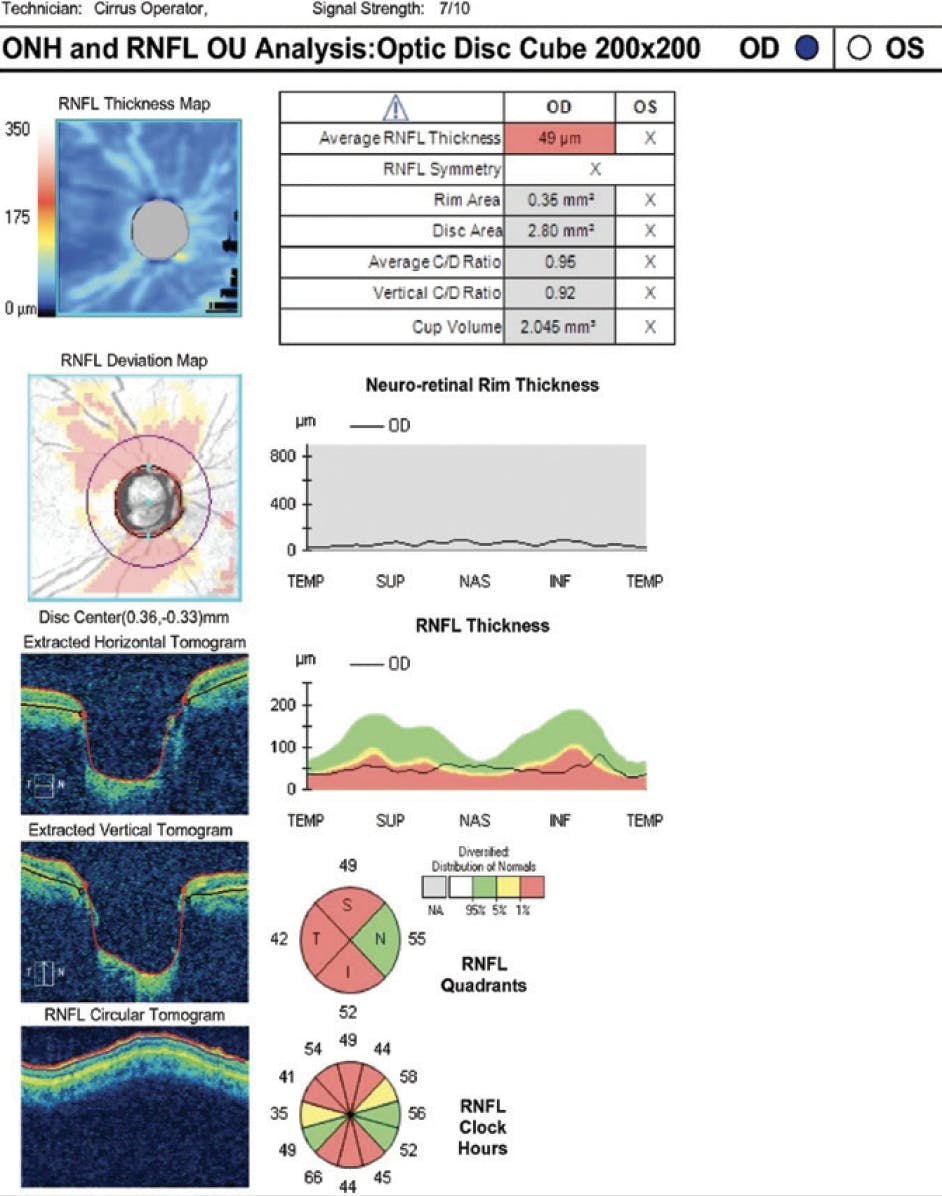
Figure 1. Baseline OCT report indicates findings consistent with advanced glaucoma, including severe cupping in the right eye, minimal rim, a large disc optical canal, and severe retina nerve fiber layer loss.
Discussion
This case demonstrates the utility of MicroShunt in a not uncommon scenario in clinical practice. However, the glaucoma does not need to be as advanced to justify its use. Hypothetically, the device would make just as much sense for a 46-year-old patient with a nasal arcuate defect who was progressing at that pressure. If MicroShunt is effective in advanced cases, and because of the associated safety, it would be reasonable to think about introducing it earlier, as well—especially because more invasive options are available should the need arise.
1. Batlle JF, Fantes F, Riss I, et al. Three-Year Follow-up of a Novel Aqueous Humor MicroShunt. J Glaucoma. 2016; 25(2):e58-65.
2. Batlle JF, Corona A, Albuquerque R. Long-term results of the PRESERFLO® MicroShunt in patients with primary open-angle glaucoma from a single-center non-randomized study. J Glaucoma. Published online ahead of print October 29, 2020.
3. Francis BA, Singh K, Lin SC, et al. Novel glaucoma procedures: a report by the American Academy of Ophthalmology. Ophthalmology. 2011;118(7):1466-1480.
4. Richter GM, Coleman AL. Minimally invasive glaucoma surgery: current status and future prospects. Clin Ophthalmol. 2016;10:189-206.

