


The MicroShunt (Santen, Osaka, Japan) is a surgical device made from a highly biocompatible, bioinert material called poly(styrene-block-isobutylene-block-styrene), or SIBS. The device mechanistically drains aqueous from the anterior chamber to a bleb formed under the conjunctiva and Tenon capsule, where it is then reabsorbed either directly into the episcleral venous system or via microcysts into the tear film.1 Drainage of aqueous through this route bypasses high resistance in the trabecular meshwork, Schlemm canal, and suprachoroidal space.1,2
MicroShunt gained a CE Mark in Europe in 2012 and was approved by Health Canada in 2021. It is not yet approved in the United States and is pending PMA approval from the US FDA. It was investigated in a phase 3 pivotal clinical trial compared to trabeculectomy in the United States and Europe in patients with primary open-angle glaucoma (POAG) where IOP was uncontrolled while on maximum tolerated medical therapy (MTMT) and/or where glaucoma progression warranted surgery (NCT01881425). Year 1 follow-up from the pivotal trial will be published soon3 and Santen is expected to release Year 2 follow-up data later this year. The available data on MicroShunt show the device can yield IOP lowering to the low teens,4,5 and it has also demonstrated success in eyes with refractory glaucoma that previously failed a subconjunctival filtering surgery.6
This article reviews available data on safety and efficacy of the MicroShunt and offers perspective on factors that may influence patient selection and success with using the device. These views reflect direct experience with the device (Ike Ahmed, MD) and the authors’ combined experience identifying unmet treatment needs while treating patients in clinical practice.
Clinical Trial Data
The phase 3 pivotal clinical trial of MicroShunt is the first time in which a filtration device has been compared to incisional surgery. After 1 year of follow-up, IOP was reduced from 21.1 mm Hg at baseline (both groups) to 14.3 mm Hg and 11.1 mm Hg in the MicroShunt and trabeculectomy groups, respectively. Medication use was reduced in both groups, from 3.1±1.0 to 0.6±1.1 in the MicroShunt group versus 3.0±0.9 to 0.3±0.9 in the trabeculectomy group. As for safety, MicroShunt was associated with significantly fewer non-serious adverse events occurring prior to 1 month compared to trabeculectomy (P<.001). The rate of hypotony (defined as IOP <6.0 mm Hg) was 28.9% (MicroShunt) versus 49.6% (trabeculectomy; P<.001), and the rate of hypotony maculopathy was 0.5% (MicroShunt) versus 0.8% (trabeculectomy).3,7,8 Additional clinical trial data from phase 1 and phase 2 studies have been reported (Table).
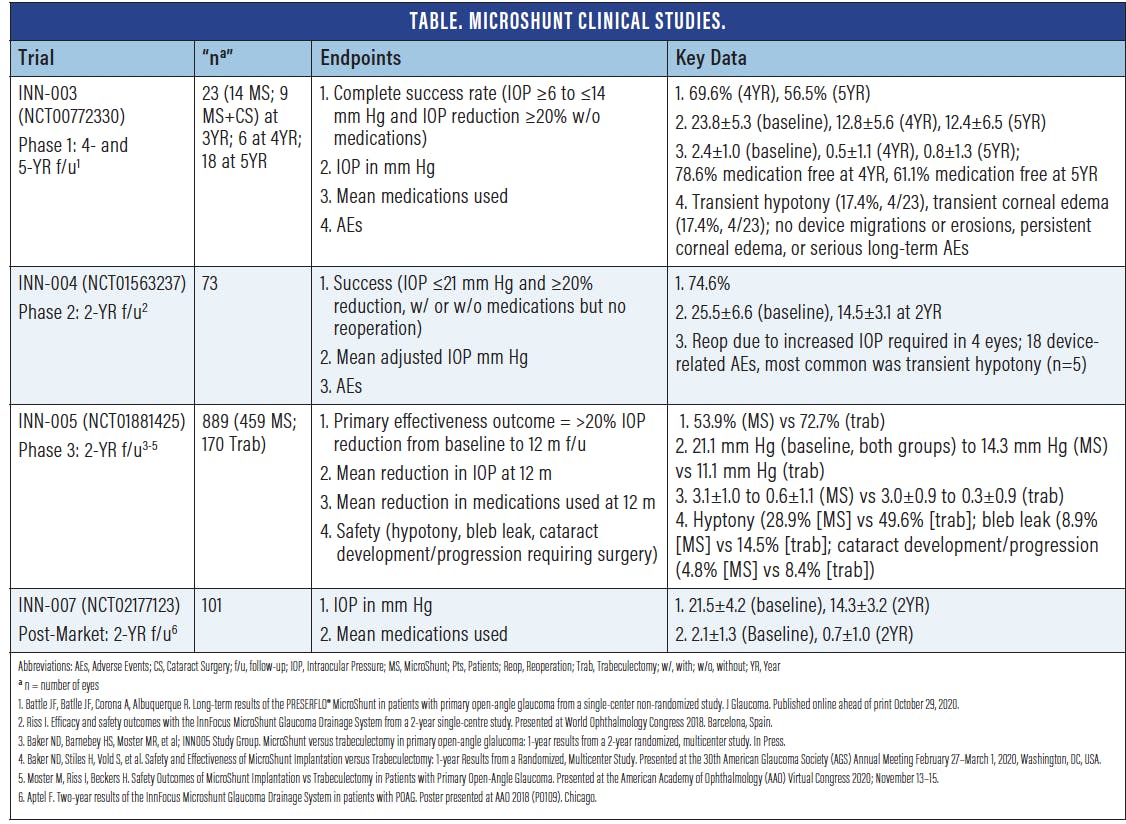
Batlle et al reported outcomes from a prospective, single-arm, single-center feasibility study in 23 patients (n = 14 MicroShunt alone; n = 9 combined with cataract surgery).4 In the latter, qualified success rate (defined as IOP ≤14mm Hg and IOP reduction ≥20%) was achieved in 100%, 91%, and 95% of patients after 1, 2, and 3 years, respectively. Additional outcomes are noted in the Table. Longer term follow-up on this group of patients was reported recently.9 After 4 years, mean IOP was 12.8 ± 5.6 mm Hg (n = 21), and after 5 years it was 12.4 ± 6.5 mm Hg (n = 21). After 4 and 5 years, mean number of medications used was 1.0 and 1.3, respectively, and the rate of overall success was 87.0% and 82.6%, respectively. Common adverse events, occurring in 5% or more of patients, included corneal edema (n = 4), transient hypotony (n = 4), bleb-related complications (n = 3), and device touching the iris (n = 3). Four patients reported serious adverse events and there were two reoperations due to bleb failures.
Other Study Data
Our group (IKA) recently published data from a retrospective, interventional case series of 164 eyes of 132 consecutive patients with open-angle glaucoma and no previous filtering surgery.10 Overall, complete success (defined as no two consecutive IOP readings >17.0 mm Hg without use of glaucoma medication) was achieved in 76.9% of eyes, and qualified success (defined as the same but with use of glaucoma medications) in 92.5%. However, there is important context. We used an escalating mitomycin C (MMC) dose—starting with 0.2 mg/mL at the start of the study before moving to 0.4 mg/mL and then 0.5 mg/mL over time—to assess whether MMC dose was influential in the outcome. Notably, we found that a 0.2 mg/mL dose versus either a 0.4 mg/mL or 0.5 mg/mL dose was associated with a greater risk for failure, but there was no difference in complication rates or risk of failure between 0.4 mg/mL and 0.5 mg/mL MMC doses.10 Two takeaways emerge from our data: 0.4 mg/mL or higher is ideal and probably leads to better success, and, while other factors, including surgical technique, are important, MMC dosing is consequential for the amount of IOP lowering.
A retrospective series compared efficacy and safety outcomes in eyes implanted with a MicroShunt (n = 41 eyes, 33 patients) or Xen (Allergan; n = 41 eyes, 31 patients).11 Baseline characteristics were similar, although more combined surgeries were performed in the Xen versus MicroShunt group (37% vs. 2%). After 2 years, mean IOP was lowered from 19±4.4 to 13.8±3.8 mm Hg (n = 26) in the Xen group and from 20.1±5.0 to 12.1 mm Hg (n = 14) in the MicroShunt group. Mean number of medications was reduced from 2.5±1.4 to 0.9±1.2 in the Xen group and from 2.3±1.5 to 0.7±1.1 in the MicroShunt group.11 Rates of surgical failure and requirement for postoperative intervention were similar; however, more patients in the Xen group required bleb needling (Xen 8/41 [20%] vs MicroShunt 2/41 [5%]; P=.09) and more Xen gel stent eyes required MicroPulse transscleral cyclophotocoagulation (IRIDEX Corporation, Mountain View, CA, USA) for additional IOP control post-procedure (n = 8 [20%] vs. MicroShunt n = 1 [2%]; P =.029).11 Early complications included numerical hypotony (≤5.0 mm Hg) (Xen gel stent (10/41 [24%]; MicroShunt 16/41 [39%]). Both devices were associated with a high safety profile, with only small, non-statistically significant differences in late postoperative complications occurring in the Xen group compared to the MicroShunt group, including hypotony (n = 3 [8%] vs zero) and curling of the stent (n = 6 [15%] vs zero).11
Our group (IKA) also reported outcomes with MicroShunt in a population of high-risk eyes that previously failed at least one subconjunctival filtering surgery.6 In a series of 85 eyes of 79 patients with preoperative median IOP of 22.0 mm Hg on four medications, postoperative median IOP after 1 year was 13.0 mm Hg on zero medications.6 These data highlight a promising treatment option for a traditionally challenging subset of eyes at high risk for complications and surgical failure.
Applications for Clinical Practice
As noted above, MicroShunt is being studied in patients with POAG where IOP remains uncontrolled while on MTMT and/or where glaucoma progression warrants surgery. Our clinical impression is that even within that indication, there is a wide range of patient types for whom MicroShunt would be a reasonable consideration. For example, it may be an option for patients requiring more substantive IOP lowering than what MIGS can offer but who may be less able to tolerate risk of complication with traditional incisional glaucoma surgeries. In addition, because much of the conjunctiva remains intact after surgery, its use should be associated with a fast recovery, which would be beneficial for younger glaucoma patients who must return to work and other life activities. Data showing the ability to achieve IOP in the mid-teens suggests a role for use with patients at risk for rapid progression or refractory glaucoma, and for those experiencing progression despite achieving target pressure.
Furthermore, defining MTMT, which is frequently used as a criterium in opting for procedural approaches, is somewhat of a moving target. Defining it numerically is challenging, although there is evidence that adding a third or fourth glaucoma medication is only moderately successful in achieving a 20% reduction in IOP, especially when cost, adherence, or the occurrence of intolerable side effects is considered.12,13 Instead, MTMT is often defined on an individualized basis. The ophthalmologist, in consultation with the patient, has a wide range of options for achieving the intended IOP target. While lowering IOP by 25% is widely understood to slow progression,14,15 lower targets may be desirable; additionally, susceptibility of the optic nerve to IOP-related damage is individualized.16 As a result, patients requiring a large percentile reduction in IOP or low target pressure may not benefit from medications, and patients experiencing difficulties accessing prescriptions, side effects, or poor adherence have reached a threshold beyond which additional medication use will likely not achieve the target pressure; both groups of patients can arguably be defined as being on MTMT. There is a wide gamut of patient types between these extremes that similarly fit a definition of MTMT, including those who experience progression despite achieving the target IOP.16
Additional clinical trial data involving the MicroShunt are anticipated, as the device would appear to address current unmet treatment needs for a wide range of patients. For now, early experience with the device suggesting the potential to reduce patients’ dependence on medications and avoid invasive surgeries while achieving a beneficial outcome offers significant promise to improve the ophthalmologist’s ability to individualize treatment choices.
1. Pinchuk L, Riss I, Batlle JF, et al. The use of poly(styrene-block-isobutylene-block-styrene) as a microshunt to treat glaucoma. Regen Biomater. 2016;3(2):137-142.
2. Pinchuk L, Riss I, Batlle JF, et al. The development of a micro-shunt made from poly(styrene-block-isobutylene-block-styrene) to treat glaucoma. J Biomed Mater Res B Appl Biomater. 2017;105(1):211-221.
3. Baker ND, Barnebey HS, Moster MR, et al; INN005 Study Group. MicroShunt versus trabeculectomy in primary open-angle glalucoma: 1-year results from a 2-year randomized, multicenter study. In Press.
4. Batlle JF, Fantes F, Riss I, et al. Three-Year Follow-up of a Novel Aqueous Humor MicroShunt. J Glaucoma. 2016; 25(2):e58-65.
5. Beckers HJM, Pinchuk L. Minimally Invasive glaucoma surgery with a new ab-externo subconjunctival bypass – current status and review of literature. European Ophthalmic Review. 2019;13(1):27-30.
6. Durr GM, Schlenker MB, Samet S, Ahmed IIK. One-year outcomes of stand-alone ab externo SIBS microshunt implantation in refractory glaucoma. Br J Ophthalmol. Published online Oct 23, 2020.
7. Baker ND, Stiles H, Vold S, et al. Safety and Effectiveness of MicroShunt Implantation versus Trabeculectomy: 1-year Results from a Randomized, Multicenter Study. Presented at the 30th American Glaucoma Society (AGS) Annual Meeting February 27–March 1, 2020, Washington, DC, USA
8. Moster M, Riss I, Beckers H. Safety Outcomes of MicroShunt Implantation vs Trabeculectomy in Patients with Primary Open-Angle Glaucoma. Presented at the American Academy of Ophthalmology (AAO) Virtual Congress 2020; November 13–15.
9. Batlle JF, Corona A, Albuquerque R. Long-term results of the PRESERFLO® MicroShunt in patients with primary open-angle glaucoma from a single-center non-randomized study. J Glaucoma. Published online ahead of print October 29, 2020.
10. Schlenker MB, Durr GM, Michaelov E, Ahmed IIK. Intermediate outcomes of a novel standalone ab externo SIBS microshunt with mitomycin C. Am J Ophthalmol. 2020;215:141-153.
11. Scheres LMJ, Kujovic-Aleksov S, Ramdas WD, et al. XEN(®) Gel Stent compared to PRESERFLO™ MicroShunt implantation for primary open-angle glaucoma: two-year results. Acta Ophthalmol. Published online September 10, 2020.
12. Neelakantan A, Vaishnav HD, Iyer SA, Sherwood MB. Is addition of a third or fourth antiglaucoma medication effective? J Glaucoma. 2004;13(2):130-136.
13. Jampel HD, Chon BH, Stamper R, et al. Effectiveness of intraocular pressure-lowering medication determined by washout. JAMA Ophthalmol. 2014;132(4):390-395.
14. Heijl A, Leske MC, Bengtsson B, et al. Reduction of intraocular pressure and glaucoma progression: results from the Early Manifest Glaucoma Trial. Arch Ophthalmol. 2002;120(10):1268-1279.
15. Leske MC, Heijl A, Hussein M, et al. Factors for glaucoma progression and the effect of treatment: the early manifest glaucoma trial. Arch Ophthalmol. 2003;121(1):48-56.
16. Prum BE Jr, Rosenberg LF, Gedde SJ, et al. Primary Open-Angle Glaucoma Preferred Practice Pattern(®) Guidelines. Ophthalmology. 2016;123(1):P41-P111.


