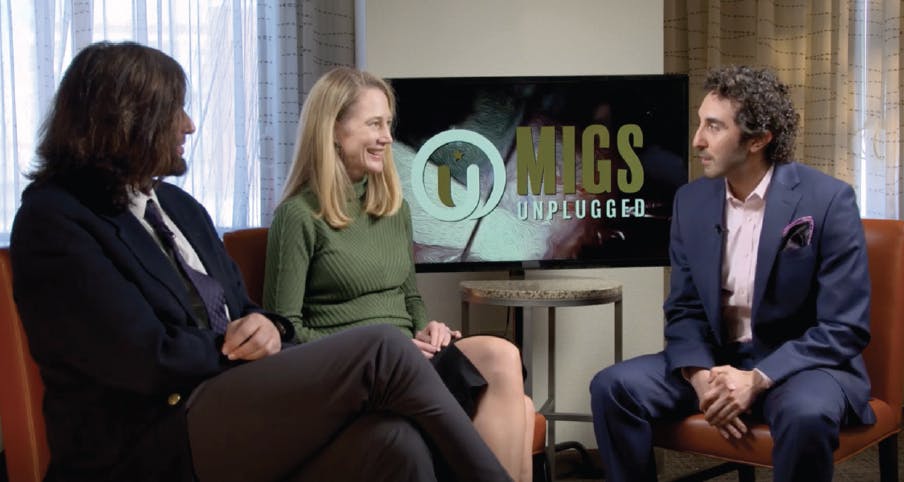
Iqbal Ike K. Ahmed, MD, FRCSC; Arsham Sheybani, MD; and Kelly Muir, MD, share their perspectives on training the next generation of glaucoma surgeons. Click on the image to watch now!
A Trainee’s Perspective
By Rikki Enzor, MD, PhD
When it comes to surgical education, graduated autonomy for trainees is important. Most residency programs recognize that helping residents to grow into performing start-to-finish cataract surgery requires that they participate in individual steps of cases, increasingly gaining more experience and exposure until they are safely performing entire procedures. A similar approach could be applied to other areas of ophthalmology, such as teaching MIGS. A younger resident could sequentially be taught to adjust the patient’s head and the microscope, hold a gonio lens on the eye, obtain an en face view of the trabecular meshwork, and then start using a viscoelastic cannula with their other hand. At that point, a trainee has developed the requisite bimanual skills and learned to acquire a good view, while keeping the risk to patients at a minimum and only slightly slowing down an attending’s OR day along the way. Now the trainee is ready to learn to perform angle-based MIGS. None of this is difficult, but it requires intentionality on the part of training programs and subspecialty surgical attendings.
Communicating expectations is key. A resident who knows what is expected of them because they have been told up front will quickly become a confident contributor to the team. When a trainee does not meet expectations, they often either do not know what is expected of them or have not grown into being able to meet the expectations. More important than pointing out what was done incorrectly is clearly communicating what is desired from a trainee in the future and, if possible, helping them to achieve these objectives. As a current fellow and junior faculty member who regularly staffs resident clinics and occasionally takes faculty call, I am learning that being an effective teacher is much more difficult than I realized as a resident. I would encourage trainees to extend grace to their mentors, and vice versa, because we all have a lot on our plates! It is quite fun to be growing into the role of a fellow and junior faculty member while also helping younger trainees to grow.