Albert S. Khouri, MD
The opportunity to learn from fresh young minds is perhaps the greatest attribute of serving in academia as faculty and residency director. In these roles at Rutgers, I interact daily with medical students and residents. I can think of many occasions when I gained valuable knowledge from observing students and residents learn. These individuals often approach me for shadowing and research opportunities, and I learned long ago that the best ideas come from allowing them to brainstorm and build their own research projects. In that process, I serve as a catalyst, mentor, and learner.
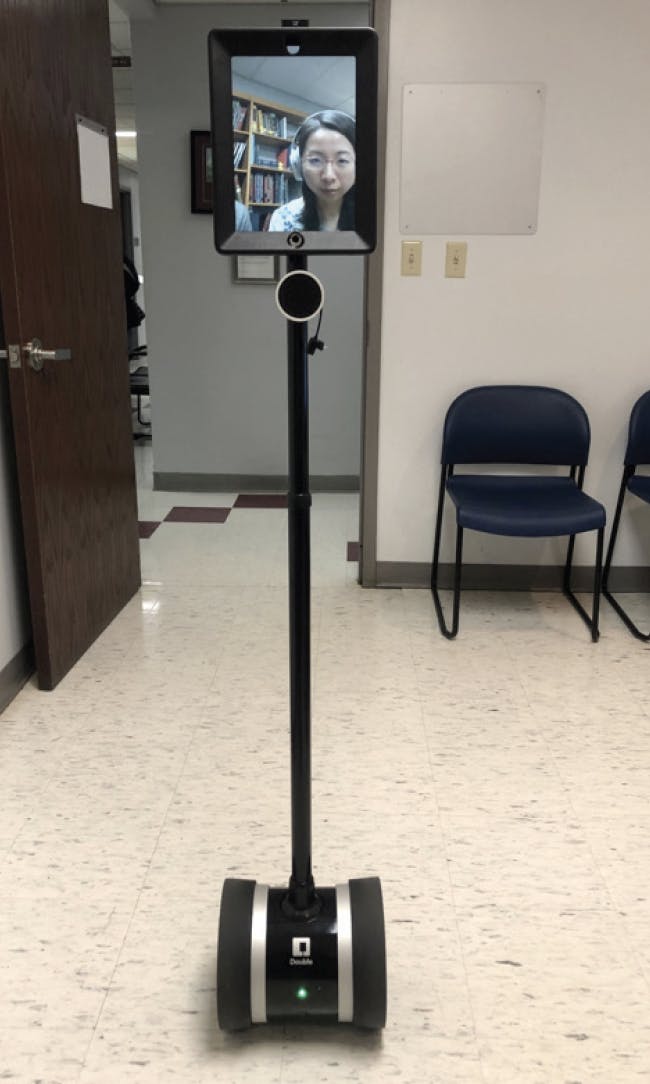
During the peak of the COVID-19 pandemic in New Jersey, a medical student sought to explore remote patient interaction using a robot we had in our lab—an absolutely brilliant idea at a time when all face-to-face interactions for research had come to a grinding halt. She came up with ideas to use our robot to interview patients and deliver questionnaires to evaluate their understanding of glaucoma (Figure). Together, with a team of other students, we designed a protocol and created educational content regarding remote patient interaction during COVID-19. This student’s work was later presented at meetings and published.1 It was inspiring to watch young minds at work on this project and enlightening to see a different perspective on modern issues. I find Ben Franklin’s words on this subject particularly motivating: “Tell me and I forget, teach me and I may remember, involve me and I learn.”
1. Ooms A, Shaikh I, Patel N, et al. Use of telepresence robots in glaucoma patient education. J Glaucoma. 2021;30(3):e40-e46.
Mahmoud A. Khaimi, MD
When it comes to interacting with a younger generation of ophthalmologists, I am fortunate to be able to do so daily in my role as Glaucoma Fellowship Director at Dean McGee Eye Institute. I love the energy that the fellows bring into the OR and appreciate their authentic, tenacious approach to learning. They ask a plethora of questions, ranging from simple surgical pearls to much more thoughtful musings regarding the pathophysiology of glaucoma and how various treatments and surgeries address the disease. They keep me on my toes—and I always encourage them to do so.
Surgical steps aside, I have come to recognize the importance of imparting a deeper sense of learning to my fellows, one that addresses the how, what, and why behind every decision. I recall a fellow who challenged me on the notion of viscodilation. Canaloplasty has been an integral part of my treatment algorithm for many years and is frequently highlighted in my teachings. Having performed this procedure for so long, however, I have fallen into the trap of believing that I had all my bases covered while teaching.
On one occasion, my fellow questioned the volume of ophthalmic viscosurgical device (OVD) delivered during the ab interno surgical technique as compared to the ab externo surgical technique and inquired about the risk profile associated with each approach. Specifically, he asked how I determined the volume of OVD to be delivered for each individual patient and whether this should be based on glaucoma type or disease severity. After reflecting on the questions, I was compelled to restructure my teaching style, focusing specifically on the ins and outs of canaloplasty. As a matter of fact, this inquiry necessitated a reevaluation of any surgical procedure I perform. It also triggered my own desire to better understand how various clinical factors affect the procedure, which led to my current involvement in the multicenter MAGIC study (NCT04769453).
Younger ophthalmologists and their eagerness to learn have taught me the importance of insight for surgeons and for ophthalmologist in general. Subsequently, I have gained tremendous awareness of the critical role that probing and careful examination play in making informed surgical decisions. As a surgeon and an educator, I value the need to always keep asking questions, both of myself and of the profession. Great things will happen if we continue to push the envelope in terms of what ophthalmic technology can achieve.
Bac T. Nguyen, MD
Although the residency and fellowship education system appears to be a one-way transfer of knowledge from attending to trainee, this could not be further from the truth. We, as educators, continue to not only learn from our students but also grow both personally and professionally because of our interactions with them. Every resident and fellow brings something unique to the table. They may have trained elsewhere, thereby bringing their own knowledge and experience about medical management and surgical techniques. In addition, our trainees hail from all over the United States and the world, carrying with them unique social and cultural perspectives that help us all to develop and grow.
There have been many lessons, both big and small, that I have gleaned throughout my time teaching; however, there is one in particular that stands out in my mind: No matter how complex or daunting a problem or challenge may be, it can always be broken down into a series of smaller steps. By tackling each step, one can eventually manage even the most seemingly intractable problems.
The truth of this became apparent as I guided residents through the management of intraoperative complications. When a serious complication such as a capsular rupture happened, I would see their tension and uncertainty build. Before panic and despair could set in, I would have them take a moment to pause and catch their breath. Then I would ask, “What steps do we need to accomplish in order to give the patient the best and safest possible outcome?” We would then set about completing these small tasks, one by one, until we eventually completed the case.
By breaking down a problem into more manageable pieces, the residents were able to process and accomplish each task and eventually overcome an obstacle that had at first overwhelmed them. I have applied this lesson to my own challenges both professionally and personally, and it has helped me immensely.
Janet Serle, MD
I have mentored students and physicians at many phases of their careers. The challenges they face differ based on their educational or career stage, on the environment in which they are learning or working, and on their individual priorities and concerns. The most important lessons I have learned from my many mentees are as follows.
1. It is essential to have a mentor. Having a mentor provides an individual with an ongoing opportunity to review issues with someone who may have expertise, experience, or simply time.
2. The time that mentors and mentees spend together must be protected—it is as important as protected time for research, for patient care, for continuing medical education, and for all the other responsibilities associated with education, training, and the pursuit of a career.
3. Speaking with mentees reminds me of all the decisions we must make both personally and professionally. It reminds me to reserve time for myself to think about issues that may seem minor as well as issues that are of greater importance.