CASE PRESENTATION
A 25-year-old female graduate student with mild open-angle glaucoma was referred to me for an evaluation.
I had performed selective laser trabeculoplasty (SLT) on each of this patient’s eyes 3 years earlier, and she had been under observation for the past 2 years by a local optometrist. The patient’s IOP was reportedly controlled in each eye with the addition of twice-daily timolol, but at a late afternoon visit to her optometrist a week before the patient’s visit to my office, the IOP in each eye was in the mid-20s mm Hg with Goldmann applanation tonometry.
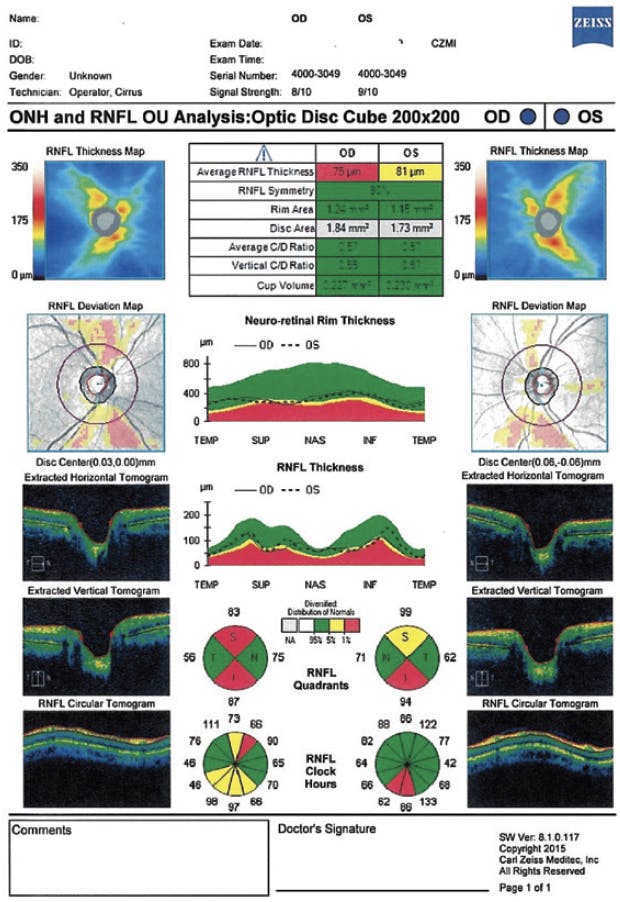
Upon presenting to my office in the midmorning, IOP was 13 mm Hg OD and 16 mm Hg OS. Corneal thickness was 550 µm OD and 540 µm OS. Figure 1 shows an OCT analysis of the patient.
The patient reported adherence to prescribed therapy with timolol. She expressed concern about determining true IOP and a reluctance to undergo repeat SLT or to increase topical therapy unless absolutely necessary. She also struggled to understand why the IOP readings obtained at two different offices were so different.
The patient had a strong family history of glaucoma, and her mother sustained significant visual field loss from the disease before reaching 40 years of age.
How would you proceed?
—Case prepared by Steven R. Sarkisian Jr, MD
HOWARD BARNEBEY, MD
This is an interesting and relatively common scenario; unique features in this case include a strong family history of severe glaucoma and the patient’s young age. The visual field is normal, and the OCT scan shows diffuse thinning of the retinal nerve fiber layer (RNFL) in each eye as seen on the RNFL thickness plot. On the thickness map, however, there is no sign of an RNFL defect. This discrepancy indicates either ocular hypertension or early preperimetric glaucoma.
My first step would be to address the patient’s concern over the variable IOP measurements. Points of discussion include IOP measurement technique (ie, skill) at the different offices, tonometer calibration issues, and time of day. All of these can be addressed with a diurnal curve or home tonometry (iCare Home, iCare USA). Also, despite her best intentions, the patient’s level of adherence may not be exactly what she reported. It would therefore be worthwhile to consider asking her to keep a dosing diary and to observe her technique of instilling eye drops.
The second issue is where to go from here. Her risk of progressive glaucomatous damage appears to be low. What is missing are the baseline measurements from when the patient was first diagnosed. What was the baseline IOP? What were the baseline measurements of structure and function (ie, OCT analysis and visual field tests)? Has there been any sign of disease progression? The OCT scan provided is of good quality with no flagging of RNFL abnormality or cup-to-disc asymmetry.
The next step includes recognizing the possibility that tachyphylaxis may be developing, although this is unlikely based on the morning IOP measurement obtained by Dr. Sarkisian. I would check the IOP in the afternoon. If variation is detected, I would recommend home tonometry and would watch the patient instill her topical medication, as mentioned earlier. If the risk of disease progression is low, I would continue observation and would consider instructing the patient to instill her drops in the morning to make adherence less burdensome. Repeat SLT has been shown to be an effective approach. Another option worthy of consideration is placement of a bimatoprost implant (Durysta, Allergan).
ANNA T. DO, MD
This young patient has several risk factors for disease progression, including a family history of glaucomatous vision loss and fluctuating IOP. Her early presentation raises the question of whether this is a case of juvenile open-angle glaucoma. Finding a regimen by which to stabilize her IOP is of the utmost importance to avoid vision loss similar to that experienced by her mother.
OCT imaging of both nerves shows moderate glaucomatous RNFL loss. The right eye has an average thickness of 75 µm, which correlates to the tipping point after which functional field loss becomes detectable using Humphrey visual field perimetry (Carl Zeiss Meditec).1
Variable IOP readings despite no change in treatment or adherence can be frustrating. This may be an example of a long-term drift, a phenomenon in which timolol’s effect wanes. I would ask the patient to perform home tonometry to determine how labile her 24-hour IOP is and then use this information to counsel her about the need to modify her therapy. The trabecular meshwork in eyes with juvenile open-angle glaucoma tends to be thick and compact and usually responds well to SLT as well as to angle surgery. I would recommend a trial of repeat SLT. Other reasonable options include switching to a topical prostaglandin analogue or a bimatoprost implant. In the future, the patient may benefit from angle surgery if her IOP is difficult to control. Fortunately, she has many options. I would emphasize to her that glaucoma is a lifelong disease that requires careful monitoring and a methodical approach to treatment, which may very well include surgery.
WHAT I DID: STEVEN R. SARKISIAN JR, MD
First, I reassured the patient that most people who lose vision from glaucoma are diagnosed too late and that her optometrist and I would monitor her closely to ensure that she does not sustain visual field loss. Clearly, her IOP was fluctuating, so I wanted to measure her diurnal curve as best I could. I instructed her to perform home tonometry with the iCare Home and discovered that her IOP fluctuated to 24 mm Hg OD and 27 mm Hg OS. SLT was repeated in each eye to flatten the diurnal curve.
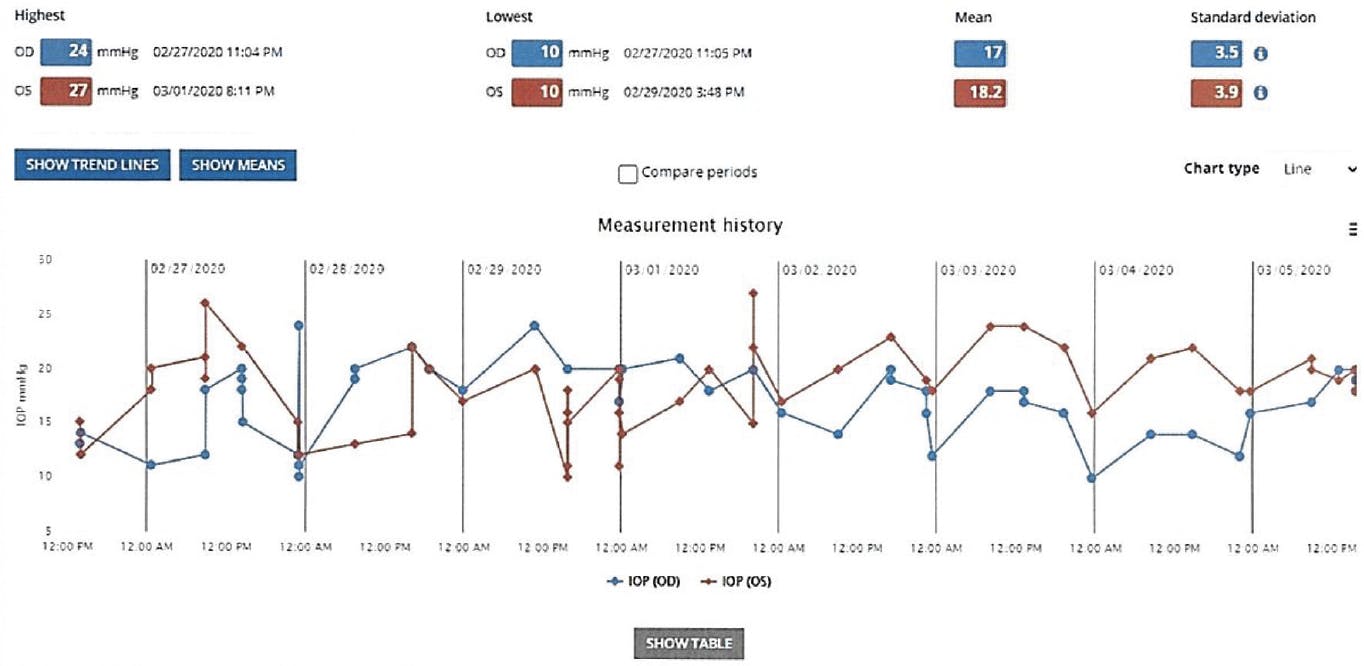
Figure 2 shows the diurnal IOP measurements obtained with home tonometry. Home IOP monitoring can be a useful tool for determining the need for and efficacy of treatment, correctly diagnosing primary open-angle glaucoma in patients previously thought to have low-tension glaucoma, and preventing vision loss.
1. Wollstein G, Kagemann L, Bilonick RA, et al. Retinal nerve fibre layer and visual function loss in glaucoma: the tipping point. Br J Ophthalmol. 2012;96(1):47-52.
_1754918026.png?auto=compress,format)