ABOUT THE AUTHOR
Richie Kahn, MPH, is a health policy professional by training, clinical researcher by trade, and patient advisor by necessity. He is passionate about incorporating patient and caregiver perspectives into the clinical development process and ultimately reducing the time it takes to bring promising new therapeutics and diagnostics to market.
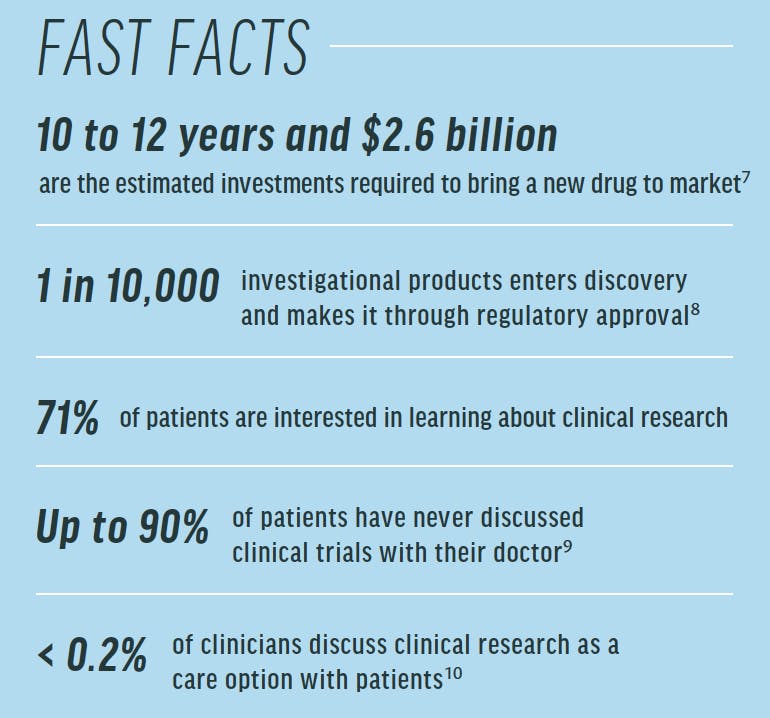
Behind each of the products crammed into sample drawers and inventory cabinets and lining the shelves of pharmacies and medicine cabinets everywhere is a complex history of clinical research. For those who are unfamiliar, clinical research is a high-stakes game, and the statistics are somewhat grim. It is estimated to take 10 to 12 years and $2.6 billion to bring a new drug to market.1 For every 10,000 investigational products that enter discovery, only one makes it through regulatory approval.2 With odds as daunting as these, it makes sense to stack the deck by telling everyone and their grandmother about clinical trials.
COMMUNICATION IS KEY
Spreading the word about clinical trials could dramatically improve participation rates. According to the Center for Information and Study on Clinical Research Participation, 71% of patients are interested in learning about clinical research, and most prefer to do so from a trusted source of medical information, likely clinicians. Frustratingly, up to 90% of patients have never discussed clinical trials with their doctors,3 and less than 0.2% of clinicians broach the topic of clinical research as a care option (CRAACO) with their patients.4
Behind these statistics is typically poor communication or a lack of communication in general. Many young clinicians are not exposed to information on the fundamentals of clinical research and how to incorporate CRAACO into their practices. This was a big part of my remit when I worked at a large contract research organization, an outsourced clinical development firm that takes on development duties for pharmaceutical and device companies. Meeting with residents and fellows to talk about research and how to work cutting-edge science into their care plans was one of the most fulfilling parts of the job.
Unfortunately for patients, researchers, and clinical trial sponsors, poor communication translates into a lack of awareness. As a result, less than 3% of doctors conduct clinical trials,5 and patient participation can be strikingly low. In oncology studies, for example, less than 5% of adult patients participate.6
STEPS TO INCREASE AWARENESS
In order to reduce the time it takes to bring promising new therapies to patients who need them most, it is essential to build awareness of CRAACO. Medical schools and residency programs must incorporate clinical research basics into their training. Trade groups such as PhRMA must sponsor an ongoing and non–study-specific campaign to increase understanding of what clinical research is and is not as well as to build awareness of all the rigorous patient protections built into the process. Lastly, industry must keep in mind that many patients want to work with study staff they can relate to—people who grew up in the same neighborhoods, went to the same schools, share the same values, and look like them. When patients do not feel a connection to a study, they are less likely to participate and more likely to drop out.
If the very real and very manageable issues of poor communication and limited awareness about CRAACO remain neglected, bench-to-bedside timelines will remain lengthy and costs prohibitive, threatening the pace and potential of innovation.
1. Biopharmaceutical research & development: the process behind new medicines. PhRMA. Accessed February 1, 2022. http://phrma-docs.phrma.org/sites/default/files/pdf/rd_brochure_022307.pdf
2. Medical development in a complex, collaborative ecosystem. PhRMA. Accessed February 1, 2022. www.phrma.org/-/media/Project/PhRMA/PhRMA-Org/PhRMA-Org/PDF/M-O/Medicine-Development-in-a-Complex-Collaborative-Ecosystem.pdf
3. Anderson A, Getz N, Benger J. Patient input into leveraging the healthcare professional’s role. Applied Clinical Trials. April 1, 2018. Accessed February 1, 2022. www.appliedclinicaltrialsonline.com/view/patient-input-leveraging-healthcare-professional-s-role
4. Stempel D. New Tufts research explores barriers to clinical trial recruiment success. PatientCentra. January 18, 2017. Accessed February 1, 2022. www.patientcentra.com/patient-recruitment-insights/tufts-research-barriers-clinical-trial-recruitment-success
5. Potthoff J. The value of dierse community-based hospitals in clinical research. Elligo. May 21, 2021. Accessed February 2, 2022. www.elligohealthresearch.com/knowledge-hub/the-value-of-diverse-community-based-hospitals-in-clinical-research/
6. Unger JM, Cook E, Tai E, et al. The role of clinical trial participation in cancer research: barriers, evidence, and strategies. Am Soc Clin Oncol Educ Book. 2016;35:185-198.