Current Knowledge and Attitudes Concerning Cost-Effectiveness in Glaucoma Pharmacotherapy: a Glaucoma Specialists Focus Group Study
Feldman RM, Cioffi GA, Liebmann JM, Weinreb RN1
Industry support: Bausch Health US
ABSTRACT SUMMARY
This pilot focus group study explored clinicians’ views on the direct and indirect costs of glaucoma therapy, the application of cost-effectiveness to decisions, the clinical value of cost-effectiveness studies, and the cost-effectiveness of available treatments. Six US glaucoma specialists participated in two separate 2-hour conference calls managed by an independent moderator. They identified medications, diagnostics, office visits, and treatment changes as key drivers of cost. Variables such as quality of life as well as medication efficacy, side effects, and adherence profiles were considered in economic evaluations to optimize cost-effectiveness.
Study in Brief
A focus group of glaucoma specialists explored the cost of glaucoma therapy and what drives that cost.
WHY IT MATTERS
Considering the many pharmacologic agents available and the rising cost of glaucoma care, it is incumbent on practitioners to identify which medical treatments are the most cost-effective and efficacious in order to maximize patient adherence to therapy. Moreover, as the US population ages and the prevalence of glaucoma increases, it becomes more important for eye care providers to consider cost when prescribing treatment.
Feldman et al concurred that cost-effectiveness is an appropriate component of treatment planning. They also agreed that newer IOP-lowering therapies that have a more favorable side effect profile and offer greater efficacy compared with previously utilized drugs and treatments may help to optimize cost-effectiveness.
DISCUSSION
What drives the cost-effectiveness of glaucoma care?
The investigators noted that resource utilization and direct medical costs increase as glaucoma becomes more severe. Of the total expense of treatment, medication costs range from 42% for mild glaucoma to 56% for advanced glaucoma.2 Approximately one-third of glaucoma-related costs are due to diagnostic testing.3 The results of this study suggest that clinicians can incorporate cost-effectiveness into treatment decisions and that they should be willing to provide care that has proven to be cost-effective.
Which pharmacologic agents are the most cost-effective?
Many pharmacologic agents are currently available for glaucoma treatment. Feldman and colleagues noted that prostaglandin analogues are the most efficacious and convenient of these, with once-daily dosing, and that this convenience is associated with better adherence and greater cost-effectiveness. The investigators also agreed that approximately one-third of patients require second-line adjunctive therapy within 1 year, thereby increasing the cost of treatment. Beta blockers are frequently used as adjunctive therapy because these agents are efficacious and safe and because their dosing schedule is convenient. Feldman et al noted that many generic equivalents are available for beta blocker drops, which can reduce the cost of therapy, but they cautioned that all generics are not created equal.
The investigators agreed that the use of fixed combinations such as dorzolamide combined with timolol and brimonidine combined with timolol can increase patient convenience and adherence and decrease the cost of therapy. The panel expressed hope that recently available medications such as latanoprostene bunod 0.024% (Vyzulta, Bausch + Lomb) and netarsudil 0.02% (Rhopressa, Aerie Pharmaceuticals) expand these benefits. Latanoprostene bunod, for example, has been reported to reduce IOP by 1 to 1.5 mm Hg more than latanoprost 0.005% with once-daily dosing.4 Fixed combinations of these and other drugs may offer greater efficacy, tolerability, adherence, and cost savings in the future.
Cost Analysis of Surgical Intraocular Pressure Management in Glaucoma
Elhusseiny AM, Yannuzzi NA, Khodeiry MM, Lee RK, Smiddy W5
Industry support: No
ABSTRACT SUMMARY
This study quantified and analyzed the relative cost of various glaucoma surgical procedures and selective laser trabeculoplasty (SLT) for each 1 mm Hg of IOP reduction ($/mm Hg). The investigators reviewed published, representative index studies to quantitate the reduction in both mean IOP and the number of glaucoma medications required 1 year postoperatively for each treatment modality. The procedures analyzed included trabeculectomy; the implantation of a Baerveldt glaucoma implant (BGI; Johnson & Johnson Vision), iStent Trabecular Micro-Bypass Stent (Glaukos), Xen Gel Stent (Allergan), or Hydrus Microstent (Alcon); cyclophotocoagulation; SLT; gonioscopy-assisted transluminal trabeculotomy; goniotomy with a Kahook Dual Blade (New World Medical); and surgery with a Trabectome (MicroSurgical Technology). Combined MIGS–cataract extraction was not factored into the study because of the difficulty of accounting for varied indications among practitioners.
Study in Brief
A retrospective literature review found that traditional glaucoma surgeries such as selective laser trabeculoplasty and trabeculectomy were significantly more cost-effective for IOP reduction than other surgical procedures, including MIGS.
WHY IT MATTERS
Approximately 2.7 million people in the United States had primary open-angle glaucoma in 2013. This number is expected to reach approximately 7.3 million by 2050 owing to increased life expectancy. As more people develop glaucoma and associated costs increase, it becomes increasingly important to identify which treatment modalities are the most effective and the most cost-efficient.
The two main outcome parameters utilized for the cost analysis were the reduction in mean IOP and the reduction in mean number of glaucoma medications used 1 year after surgery. Medicare-allowable fee data for 2020 were used to obtain the newly introduced parameter, $/mm Hg, 1 year after surgery. The $/mm Hg IOP reduction was expected to be greater after 1 year because surgical cost ceased to be a factor and the cost of glaucoma medication declined.
One year after surgery, SLT, trabeculectomy, and the implantation of a BGI were the most cost-efficient modalities (Figure).
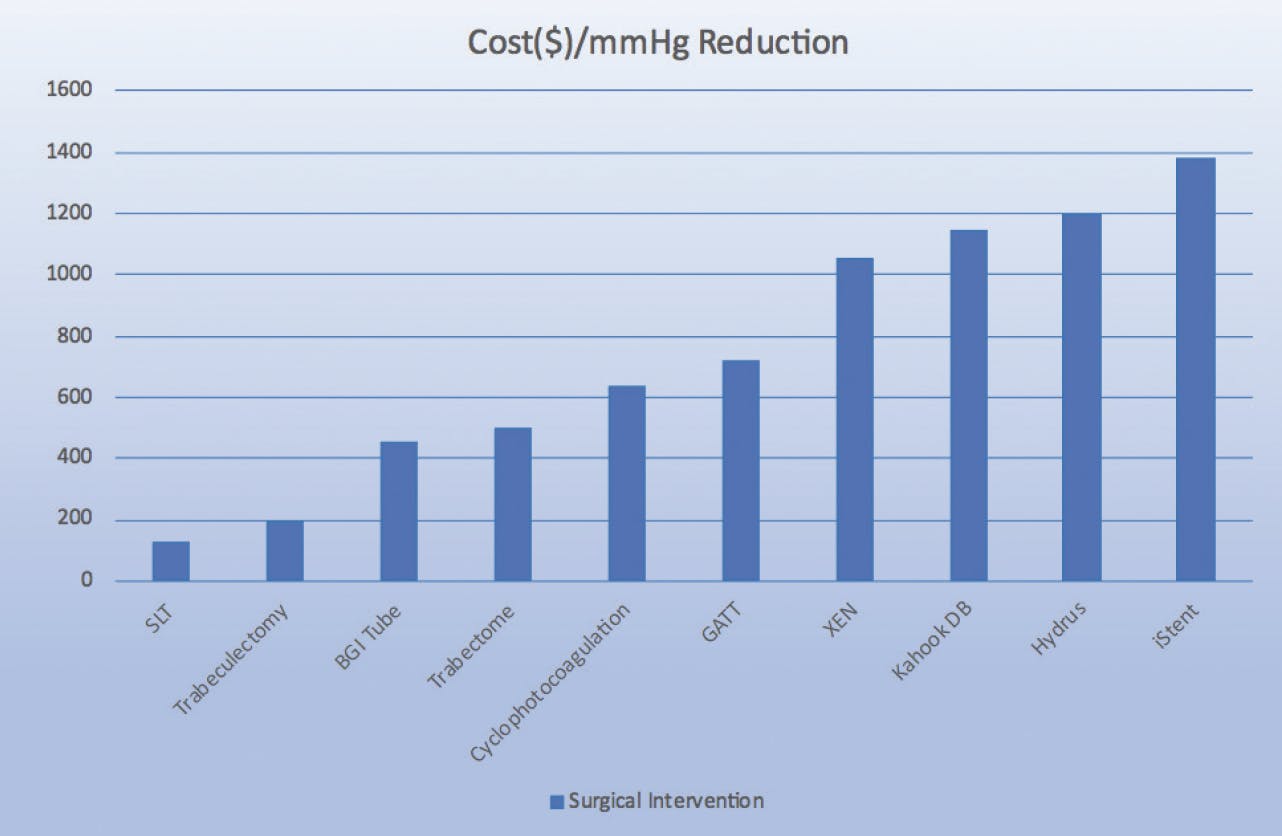
Figure. Bar graph illustrating the cost per each 1 mm Hg IOP reduction ($/mm Hg) at 1 year postoperatively for various glaucoma interventions. Abbreviations: SLT, selective laser trabeculoplasty; BGI tube, Baerveldt glaucoma implant tube; GATT, gonioscopy-assisted transluminal trabeculotomy; Kahook DB, Kahook Dual Blade. Manufacturing information: Baerveldt glaucoma implant (Johnson & Johnson Vision), Trabectome (MicroSurgical Technology), Xen Gel Stent (Allergan), Kahook Dual Blade (New World Medical), Hydrus Microstent (Alcon), iStent (Glaukos). Reprinted with permission from Elhusseiny et al.5
DISCUSSION
Why should cost-efficiency be considered when selecting surgical interventions for glaucoma?
Approximately 65 million people worldwide have primary open-angle glaucoma. A lifetime of medical therapy, office visits and testing, and potential surgical intervention place a large financial burden on patients and secondary payers. In the United States, the annual medical cost of glaucoma and disorders of the optic nerve was an estimated $6.1 billion in 2014, and it is projected to reach $12 billion by 2032.6 Clinicians must therefore take cost into consideration when treating patients.
Which surgical interventions provide the best efficacy with the greatest cost-effectiveness?
SLT, trabeculectomy, and the placement of a BGI provided the greatest $/mm Hg IOP reduction. Elhusseiny et al found these procedures to be much more efficacious and economical than the MIGS procedures studied. Because SLT is safe and relatively efficacious, and because it is performed in the office, this modality deserves consideration for earlier utilization for glaucoma treatment. SLT may provide better IOP lowering and greater cost savings than medication, especially when the procedure is performed initially or early in the disease course.7 Elhusseiny et al concluded that conventional glaucoma surgeries and SLT may be the most appropriate choice for intervention when cost is an important factor.
1. Feldman RM, Cioffi GA, Liebmann JM, Weinreb RN. Current knowledge and attitudes concerning cost-effectiveness in glaucoma pharmacotherapy: a glaucoma specialists focus group study. Clin Ophthalmol. 2020;14:729-739.
2. Traverso CE, Walt JG, Kelly SP, et al. Direct costs of glaucoma and severity of the disease: a multi-national long term study of resource utilisation in Europe. Br J Ophthalmol. 2005;89(10):1245-1249.
3. Quigley HA, Cassard SD, Gower EW, et al. The cost of glaucoma care provided to Medicare beneficiaries from 2002 to 2009. Ophthalmology. 2013;120(11):2249-2257.
4. Weinreb RN, Ong T, Scassellati Sforzolini B, et al; VOYAGER study group. A randomised, controlled comparison of latanoprostene bunod and latanoprost 0.005% in the treatment of ocular hypertension and open angle glaucoma: the VOYAGER study. Br J Ophthalmol. 2015;99(6):738-745.
5. Elhusseiny AM, Yannuzzi NA, Khodeiry MM, Lee RK, Smiddy WE. Cost-analysis of surgical intraocular pressure management in glaucoma. J Glaucoma. 2021;30(11):947-951.
6. Wittenborn JS, Rein DB. The future of vision: forecasting the prevalence and costs of vision problems. Prevent Blindness. Published June 11, 2014. Accessed November 29, 2021. https://preventblindness.org/wp-content/uploads/2020/04/Future_of_Vision_final_0.pdf
7. Gazzard G, Konstantakopoulou E, Garway-Heath D, et al; LiGHT Trial Study Group. Selective laser trabeculoplasty versus eye drops for first-line treatment of ocular hypertension and glaucoma (LiGHT): a multicentre randomised controlled trial. Lancet. 2019;393(10180):1505-1516.