CASE PRESENTATION
A 49-year-old woman with poorly controlled diabetes presents to her retina surgeon’s office with pain, an IOP of 56 mm Hg, and hand motion visual acuity 3 months after undergoing a vitrectomy, membrane peel, and gas tamponade for a tractional retinal detachment. An earlier measurement of the patient’s visual acuity after retinal detachment repair was 20/200. An anterior chamber paracentesis and an intravitreal injection of bevacizumab (Avastin, Genentech) are performed.
One week later, the patient’s IOP is 33 mm Hg on a regimen of four classes of topical medication and twice-daily acetazolamide 125 mg. Although no iris neovascularization is evident, synechial angle closure is observed on examination, and she is referred to the glaucoma service with a presumed diagnosis of neovascular glaucoma (NVG).
When seen later the same week, the patient’s IOP on the aforementioned drug regimen is 52 mm Hg. An examination of the pseudophakic eye reveals frank iris bombe that is confirmed with anterior segment OCT (AS-OCT, Figure) and 360º of peripheral anterior synechiae (PAS). No iris neovascularization is visible; this may be because high IOP is restricting blood flow through vessels (thus masking their presence), or neovascularization might have regressed owing to the previous bevacizumab injection. The patient is unable to complete a visual field test, and OCT imaging is unreliable. The optic nerve rim, however, looks relatively healthy, and the cup-to-disc ratio is 0.7.
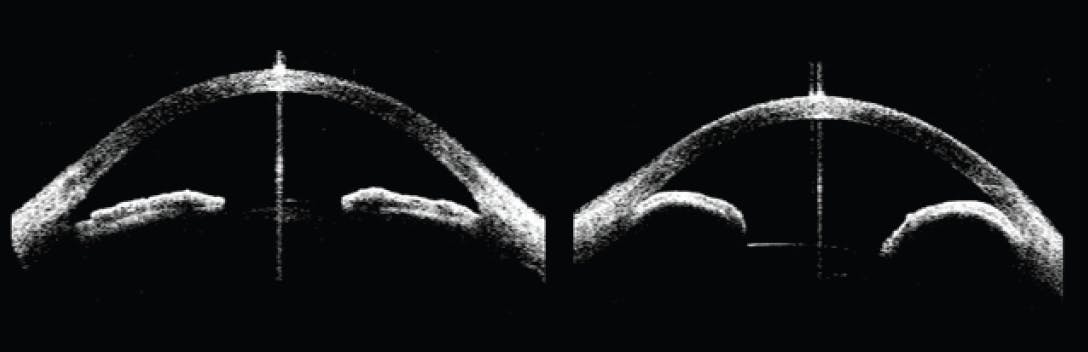
Figure. AS-OCT shows normal anatomy in the right eye (left) and marked iris bombe in the left eye (right).
How would you proceed?
—Case prepared by
Devesh K. Varma, MD, FRCSC
PETER A. NETLAND, MD, PHD
The patient may be experiencing synechial angle closure and NVG secondary to diabetes. Also, clinical and AS-OCT findings suggest that she has developed an occluded pupil and pupillary block with iris bombe owing to posterior synechiae to the IOL. How aggressive management is depends in part on her visual potential, which is still relatively good (20/200), and the relatively healthy-appearing neural rim.
The iris bombe and pupillary block (due to synechiae to the IOL) could be treated noninvasively with laser peripheral iridotomy (LPI). Alternatively, surgical iridectomy and synechialysis (of posterior synechiae around the pupil) could be performed to relieve the pupillary block.
Although the administration of bevacizumab reduces the need for surgical treatment in some patients who present with early NVG, most individuals with 360º of synechial angle closure require surgical management to control their IOP.1
If additional treatment is required here, a drainage implant would likely be my preference.2 In this situation, the location where the tube will be placed requires consideration. Placement in the anterior or posterior chamber is an option. (Was the previously performed vitrectomy in the pars plana region adequate?) If necessary, I would probably place a tube shunt in the sulcus. I would also consider whether the patient needs additional retinal treatment3 and would have a low threshold for adding bevacizumab treatment during the postoperative period.
All of the approaches I have described may require modification and redirection depending on clinical changes over time, the patient’s response to treatment, and other information obtained during clinical follow-up.
JEFFREY R. SOOHOO, MD, MBA
Although the presumptive diagnosis is NVG, it is unclear if neovascularization of the iris or neovascularization of the angle was present at the visit when the patient’s IOP was 56 mm Hg and the paracentesis and intravitreal injection were performed. Given the history and the findings of 360º PAS, NVG is a possible diagnosis. It is an unlikely cause of iris bombe, however, although NVG often leads to synechial angle closure.
It would be prudent to ensure that there is no aspect of pupillary block. I would perform a small LPI. If that does not resolve the iris bombe, I would obtain imaging with ultrasound biomicroscopy to look for anterior rotation or swelling of the ciliary body. (I would also ask the patient if she has a history of medical therapy with agents such as topiramate that are known to lead to rotation/swelling of the ciliary body or iris bombe.)
Because the patient has a history of retinal detachment, a dilated fundus examination or B-scan ultrasound is warranted to evaluate the eye for repeat retinal detachment and a posterior pushing mechanism that is causing the iris bombe. The iris bombe could also be due to uveitis, although it may be difficult to appreciate cell and flare in the setting of a shallow anterior chamber. A careful examination for signs of current or prior intraocular inflammation should be performed.
If an LPI does not resolve the iris bombe and further workup is unrevealing, then I would recommend surgical intervention because the IOP is 52 mm Hg despite therapy with multiple topical IOP-lowering medications and oral acetazolamide. The most definitive procedure would be placement of a glaucoma drainage device. The patient needs immediate IOP lowering, so I would recommend a valved tube or a ligated nonvalved tube with slits to allow some function before the release of the ligating suture. Because the eye is pseudophakic, the tube should be placed in the ciliary sulcus to minimize deleterious effects on the corneal endothelium.
MONISHA M. VORA, MD
The patient appears to be experiencing pseudophakic pupillary block. It is important to determine the underlying mechanism. A likely cause is her history of proliferative diabetic retinopathy, which led to neovascularization of the iris and angle and the subsequent formation of PAS and adhesions between the posterior iris and the optic of the IOL or anterior capsular rim. AS-OCT confirms the presence of iris bombe and the need for relief from pupillary block. Another contributor to pseudophakic pupillary block could be chronic vitreous expansion, which can occur with repeated intravitreal injections and predispose susceptible eyes to angle closure.4
A moderately sized LPI would be my first step, and an inferotemporal location would be my preference in case silicone oil is required in the future. Once the pupillary block has been relieved, the IOP would be rechecked. A patent iridotomy will likely lower the IOP somewhat. Given the 360º of PAS, however, the patient will likely need further surgical intervention.
The patient is young, she has some visual potential, and the optic nerve appears to be relatively healthy. I would therefore place a nonvalved tube shunt in either the pars plana or the sulcus. A nonvalved device such as a Baerveldt glaucoma implant (Johnson & Johnson Vision) or an Ahmed ClearPath (New World Medical) is more likely to lower IOP in this eye (and potentially reduce the patient’s long-term need for topical medication) than a valved tube shunt such as an Ahmed Glaucoma Valve (model FP7, New World Medical).5 Given the patient’s young age and likely need for additional surgery in the future, the placement of a nonvalved, ligated shunt with slits should provide the best chance of adequate IOP control and a long-lasting result.
I would instruct her to continue therapy with aqueous suppressants, including acetazolamide if needed, until the polyglactin ligature suture dissolves approximately 6 weeks after surgery. Topical medications could then be tapered slowly after IOP has been adequately controlled.
WHAT I DID: DEVESH K. VARMA, MD, FRCSC
Given the prominent iris bombe, I thought that the main mechanism was likely acute angle-closure glaucoma, probably due to pupillary block from posterior synechiae between the iris and IOL. An LPI was performed to address the underlying anatomic cause. Shortly thereafter, the IOP improved to 34 mm Hg despite the PAS, and no iris neovascularization was observed. Either the neovascularization had regressed from the previous bevacizumab injection, or, more likely, this was not a neovascular process.
Based on the absence of neovascularization, I felt safe addressing the PAS. A needle synechiolysis using a 27-gauge needle at the slit lamp was attempted to engage the peripheral iris and draw it centrally, and all PAS were released successfully. Pilocarpine was instilled to prevent synechiae from re-forming. On the following day, IOP was 19 mm Hg on a regimen of four topical drug classes, and the patient’s visual acuity was 20/200. She returned to her retina surgeon for observation.
1. Netland PA. The Ahmed Glaucoma Valve in neovascular glaucoma (an AOS thesis). Trans Am Ophthalmol Soc. 2009;107:325-342.
2. Netland PA, Ishida K, Boyle JW. The Ahmed Glaucoma Valve in patients with and without neovascular glaucoma. J Glaucoma. 2010;19(9):581-586.
3. Shalaby WS, Myers JS, Razeghinejad R, et al. Outcomes of valved and nonvalved tube shunts in neovascular glaucoma. Ophthalmol Glaucoma. 2021;4(2):182-192.
4. Krawitz BD, Misra P, Bearelly S, Al-Aswad LA. Late-onset angle closure in pseudophakic eyes with posterior chamber intraocular lenses. J Cataract Refract Surg. 2020;46(12):e48-e51.
5. Christakis PG, Kalenak JW, Tsai JC, et al. The Ahmed Versus Baerveldt Study: five-year treatment outcomes. Ophthalmology. 2016;123(10):2093-2102.