Not for the First Line
Sahar Bedrood, MD, PhD
Cyclophotocoagulation (CPC) is a cyclodestructive procedure that uses laser light to destroy the secretory epithelium of the ciliary body. During treatment, the laser emits light at a wavelength of 810 nm, which is the amount of energy that is absorbed by the ciliary epithelium. A popping noise indicates that the ciliary epithelium has been disrupted.
The types of CPC include transscleral, endocyclophotocoagulation (ECP), and micropulse procedures. Although I perform CPC often, I am selective about its use, particularly as first-line therapy. For the purpose of this discussion, the term first-line therapy indicates a primary surgical procedure. Transscleral CPC exposes patients to various complications and thus, in my opinion, should not be used as a first-line treatment. I would, however, consider micropulse CPC for the first line because it uses less energy than transscleral CPC yet can be effective in some patients. I offer micropulse CPC to patients who have good vision and are hesitant about undergoing surgery.
ECP allows a more focal delivery of energy because direct visualization of the ciliary body is provided by the endoscope, and the ciliary body is disrupted directly. ECP can nevertheless create inflammation, so I do not use it as a primary surgical procedure. I do, however, consider the use of ECP when performing cataract surgery on some patients with glaucoma because I am already making a temporal incision that can be used for the ECP probe.
INDICATIONS AND COMPLICATIONS
Transscleral CPC is indicated for refractory glaucoma in patients who have the following:
- Poor visual potential (hand motion, counting fingers, or worse);
- An inability to undergo incisional surgery;
- Ocular melanoma or other disease that contraindicates incisional surgery;
- Blind, painful eyes; or
- Scarred conjunctiva.
I am reluctant to use CPC as a first-line treatment because of the complications that have been reported and that I have observed. These include persistent hypotony, cystoid macular edema, and anterior uveitis that can be difficult to control and somewhat prolonged.
Several studies have concluded that transscleral CPC can be used as a first-line treatment, but these investigations have various limitations. Lai et al1 included only a small number of eyes (n = 13) and focused on medically uncontrolled chronic angle-closure glaucoma. A study by Sheheitli et al2 evaluated more eyes (n = 48) than Lai, but it was retrospective in nature. Further, the investigators reported a 58.4% success rate in patients whose IOPs were greater than 21 mm Hg;.What about patients with lower IOPs? Is it appropriate to use CPC as a first-line treatment in those eyes?
In a study by Egbert et al3 that is often cited, transscleral CPC was used as the primary surgical treatment for primary open-angle glaucoma. The investigators found that 28% of patients developed a tonic pupil. In patients with good vision and good visual potential, that outcome is unacceptable.
CONCLUSION
Transscleral CPC is an appropriate treatment for refractory glaucoma in patients with poor visual outcomes and poor visual potential. Given the increased risk of complications, however, it is not acceptable for use as a first-line treatment.
1. Lai JSM, Tham CCY, Chan JCH, Lam DSC. Diode laser transscleral cyclophotocoagulation as primary surgical treatment for medically uncontrolled chronic angle closure glaucoma: long-term clinical outcomes. Am J Ophthalmol. 2005;140(4):114-119.
2. Sheheitli H, Persad PJ, Feuer WJ, Sayed MS, Lee RK. Treatment outcomes of primary transscleral cyclophotocoagulation. Ophthalmol Glaucoma. 2021;4(5):472-481.
3. Egbert PR, Fiadoyor S, Budenz DL, Dadzie P, Byrd S. Diode laser transscleral cyclophotocoagulation as a primary surgical treatment for primary open-angle glaucoma. Arch Ophthalmol. 2001;119(3):345-350.
For the First Line
Jeffrey Kammer, MD
Treatment of the ciliary body has undergone a major evolution. Although CPC is stigmatized for being distantly related to cyclocryotherapy, the only similarity between the procedures is that they both target the ciliary body. Compared with ciliary body treatment in the 1960s, today’s approach is much kinder and gentler, making CPC an excellent first-line treatment for glaucoma. In fact, the latest iteration of ciliary body therapy should more appropriately be called cyclomodification because its goal is cellular alteration and not destruction.
A LOOK AT THE DATA
The Table shows outcomes from the Primary Tube Versus Trabeculectomy (PTVT) study1 and outcomes from a 2020 study by Magacho et al2 that evaluated micropulse transscleral CPC (MP-TSCPC) as a primary procedure for glaucoma. The outcomes of these investigations cannot be compared directly owing to their different outcome measures, but some observations can be made.
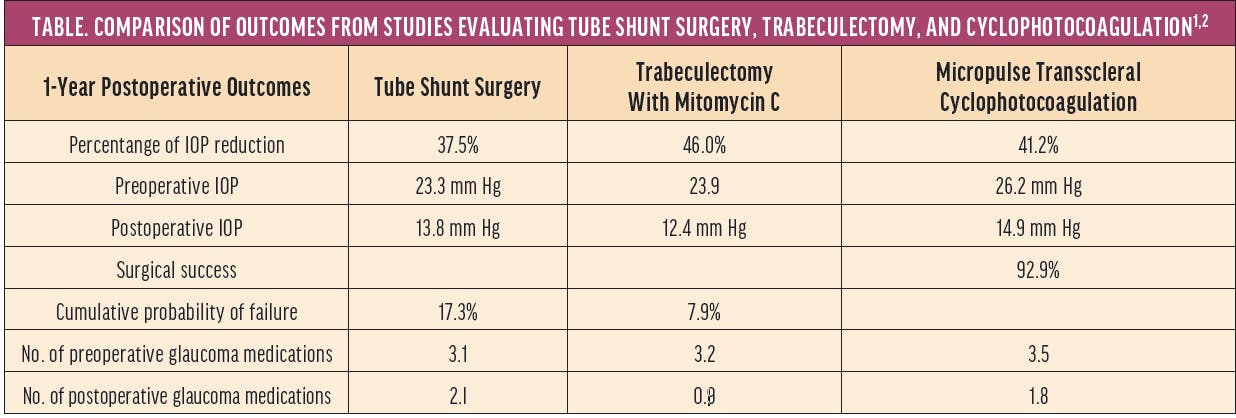
Trabeculectomy provided the greatest percentage of IOP reduction (46%), but MP-TSCPC and tube shunt surgery were not far behind at 41.2% and 37.5%, respectively. Trabeculectomy provided the greatest reduction in glaucoma medications (3.2 to 0.9), followed by MP-TSCPC (3.5 to 1.8) and tube shunt surgery (3.1 to 2.1).
Trabeculectomy, however, had the highest rate of surgical complications (41%), followed by tube shunt surgery (29%) and MP-TSCPC (17.8%). No serious complications occurred in the MP-TSCPC group, compared with 1% in the tube shunt group and 7% in the trabeculectomy group. The incidence of cataract progression was lowest in the MP-TSCPC group (approximately 5% vs 20% with both trabeculectomy and tube shunt surgery). The incidence of prolonged hypotony or phthisis was 0% with MP-TSCPC, 1% for tube shunt surgery, and 3% for trabeculectomy.
MP-TSCPC IN PATIENTS WITH GOOD VISION
Varikuti et al conducted an analysis of 61 eyes of 46 patients who had at least 20/60 BCVA at baseline and were observed for at least 10 months after MP-TSCPC.3 The investigators found that mean IOP and mean number of glaucoma medications were significantly reduced at every follow-up visit. A total of 49 eyes were followed for at least 12 months. At 1 year, mean IOP was reduced by 40.2% from baseline, 85.4% of patients had achieved more than a 20% reduction in IOP, and 79.6% of patients had achieved a reduction of at least one glaucoma medication.
There was no significant reduction in BCVA from baseline at any follow-up point, except for in 10 eyes that lost more than 2 lines of vision. Five of these eyes lost vision owing to cataract progression, two likely owing to glaucomatous progression, two owing to prolonged iritis, and one due to an exacerbation of cystoid macular edema that was present preoperatively. The probability of complete success (IOP range, 6–21 mm Hg or ≥ 20% IOP reduction, BCVA loss ≤ 2 lines, and no reoperation for glaucoma) was almost 75%.
In the PTVT study, the percentage of eyes with 2 lines of vision loss at 1 year was 13% in the tube shunt group and 11% in the trabeculectomy group1; in Varikuti et al, 20.8% of eyes treated with MP-TSCPC had 2 lines of vision loss at 1 year.3 In all investigations, vision loss related mostly to cataract progression and was therefore amenable to treatment.
A VALUABLE ADDITION TO THE TREATMENT PARADIGM
The European Glaucoma Society aptly defined the goal of glaucoma treatment as the ability to “maintain the patient’s visual function and quality of life at a sustainable cost.” Patients can return to work and resume their regular activities within 1 week of undergoing MP-TSCPC, and they report little discomfort.
A major evolution in glaucoma care has occurred over the past 30 years. Ophthalmologists are diagnosing and treating patients earlier and managing their disease for longer periods of time. Nonincisional laser options can offer a valuable addition to this new treatment paradigm and should be considered for what they currently are: effective, minimally invasive, low-risk procedures that can prevent or at least delay the need for incisional surgery with its inherent risks.
1. Gedde SJ, Feuer WJ, Shi W, et al; Primary Tube Versus Trabeculectomy Study Group. Treatment outcomes in the Primary Tube Versus Trabeculectomy Study after 1 year of follow-up. Ophthalmology. 2018;125(5):650-663.
2. Magacho L, Lima FE, Avila MP. Double-session micropulse transscleral laser (cyclo G6) as a primary surgical procedure for glaucoma. J Glaucoma. 2020;30(4):700-706.
3. Varikuti VNV, Shah P, Rai O, et al. Outcomes of micropulse transscleral cyclophotocoagulation in eyes with good central vision. J Glaucoma. 2019;28(10):901-905.