AT A GLANCE
- Nonadherence can be the result of various factors that affect patients’ everyday lives such as limited knowledge of the disease and the cost of medication.
- One factor that may be overlooked in the assessment of adherence is patient self-efficacy, defined as an individual’s belief in their capacity to execute behaviors necessary to attain specific performance goals.
- In a pilot study, the association between glaucoma severity, education level, and health literacy level was significant.
The question, “Do you take your drops?” is more complex than it may seem. Medication nonadherence among patients is a challenge that physicians in almost all specialties must confront. This is especially true for those who specialize in glaucoma because medication regimens for the disease can be complex.
The 2007 Glaucoma Adherence and Persistency Study (GAPS) reviewed large pharmacy databases and found that 55% of patients with at least 1 year of follow-up did not refill their initial glaucoma medication for a period.1 The GAPS investigators noted that only 10% of patients had continuously refilled their index medication by 1 year. Although the investigators acknowledged that pharmacy databases are vulnerable to errors from sampling, the findings confirm that adherence to prescribed medical therapy in glaucoma is poor.
Nonadherence, however, is not one-dimensional. It can be the result of various factors that affect patients’ everyday lives such as limited knowledge of the disease and the cost of medication. It is imperative that physicians be aware of obstacles their patients face outside the clinic that could contribute to their nonadherence.
Several surveys were developed to quantify the reasons for nonadherence. One of the most widely recognized is the Morisky Medication Adherence Scale, or the MMAS. The MMAS-4 is a four-item scale that measures self-reported adherence to prescribed medication.2 It has been widely used to assess medication nonadherence among patients with various chronic diseases, including hypertension, diabetes, and glaucoma.3-5
Glaucoma disproportionately affects African American patients. African American patients are at increased risk of developing glaucoma6 and constitute one of the populations with poor measured adherence to glaucoma therapy.7 The evaluation of health literacy, glaucoma knowledge, and self-efficacy in this population may help to identify which variables pose the biggest obstacles to adherence and guide intervention. The term self-efficacy is defined as an individual’s belief in their capacity to execute behaviors necessary to attain specific performance goals.
VARIABLES THAT AFFECT ADHERENCE
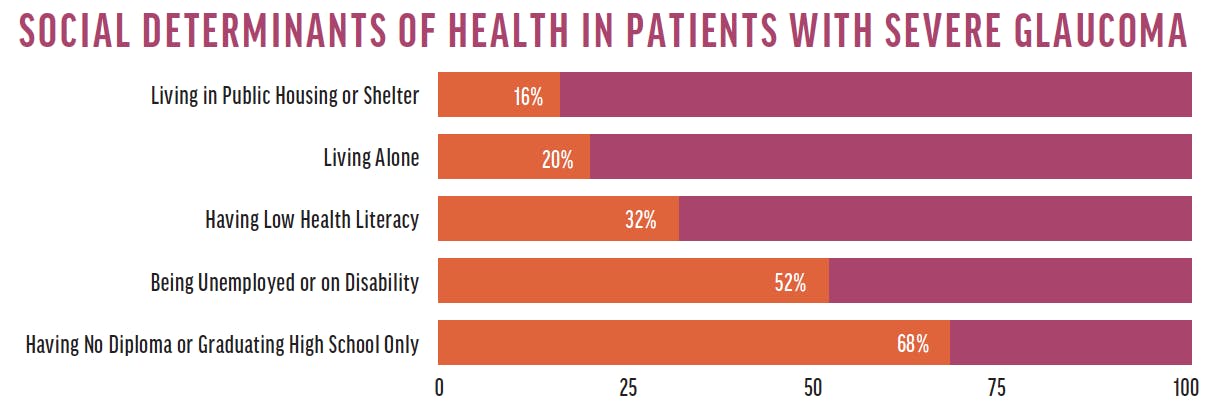
We conducted a pilot study at Rutgers New Jersey Medical School to evaluate the impact of health literacy level, glaucoma knowledge, and patient self-efficacy on medication adherence (Figure).8 The Short Assessment of Health Literacy in both English and Spanish was used to identify patients with low health literacy by testing individuals’ comprehension and interpretation of health-related vocabulary. This helped to determine whether patients could understand the directions and information given to them about their medication.
To evaluate patients’ understanding of glaucoma, we administered the National Institutes of Health’s Glaucoma Eye-Q test, which includes true or false questions about the disease. In our pilot study, 86.4% of patients who completed the Eye-Q test correctly identified the statement “glaucoma can be controlled” as true. Only 50% of patients correctly identified the statement “vision lost to glaucoma can be restored” as false. Our preliminary findings suggest that patients know that glaucoma can be controlled but perhaps fail to recognize that control is important because the vision lost to the disease cannot be restored.
One factor that may be overlooked in the assessment of adherence is patient self-efficacy. A 2018 study by Zhang et al assessed patient self-efficacy with the overall Medication Understanding and Use Self-Efficacy score. This tool evaluates patients’ responses to statements such as “It is easy for me to set a schedule to take my medications each day” and “It is easy for me to ask my doctor questions about my medications.” Zhang et al found that, within a population of patients with chronic illness, those with limited English proficiency had lower medication-related self-efficacy scores than English-proficient patients.9 A language barrier may therefore place patients at increased risk of errors with medication usage and poor adherence.
COMPARING ADHERENCE TO CLINICAL MEASURES OF PROGRESSION
A goal of our pilot study was to evaluate the relationship between a patient’s self-reported medication adherence and clinically measured disease progression. Records of patients’ latest visual field tests (taken within the past 2 years) and OCT images (taken within the past 5 years) were reviewed. Using the Bascom Palmer glaucoma staging system, patients were divided into two groups based on glaucoma severity: mild (mean deviation < -12 dB) and severe (mean deviation > -12 dB).
Individuals who were classified as having severe glaucoma (n = 25) more often reported a maximum education level of high school or less (60%), greater difficulty accessing medication (60%), and a lack of medication adherence (59%). In an investigation with a similar focus, Newman-Casey et al found a “statistically and clinically significant association between medication nonadherence and glaucomatous vision loss.”10 Additionally, the investigators reported that “worse medication adherence was associated with loss of mean deviation over time.”
In our pilot study, severe glaucoma was associated with low health literacy (P < .05). Of participants lost to follow-up, 75% were classified as having low health literacy and low education (no diploma or high school diploma only). The association between glaucoma severity, education level, and health literacy level was significant (P < .05).
CONCLUSION
Adherence to prescribed glaucoma medical therapy is influenced by many factors outside the clinic. The more that eye care providers help patients to evaluate and overcome the obstacles they face, the better their level of adherence is likely to be and the better the chances are of preserving their vision.
1. Friedman DS, Quigley HA, Gelb L, et al. Using pharmacy claims data to study adherence to glaucoma medications: methodology and findings of the Glaucoma Adherence and Persistency Study (GAPS). Invest Ophthalmol Vis Sci. 2007;48(11):5052-5057.
2. Morisky DE, Green LW, Levine DM. Concurrent and predictive validity of a self-reported measure of medication adherence. Med Care. 1986;24(1):67-74.
3. Lee WY, Ahn J, Kim JH, et al. Reliability and validity of a self-reported measure
of medication adherence in patients with type 2 diabetes mellitus in Korea. J Int
Med Res. 2013;41(4):1098-1110.
4. Kong DC, Dooley MJ, Stewart K, Larizza MA. Factors influencing adherence to
molecular therapies in haematology-oncology outpatients. J Pharm Prac Res. 2006;36(2):115-118.
5. Cate H, Bhattacharya D, Clark A, Holland R, Broadway DC. Patterns of adherence behaviour for patients with glaucoma. Eye (Lond). 2013;27(4):545-553.
6. Congdon N, O’Colmain B, Klaver CC, et al. Causes and prevalence of visual impairment among adults in the United States. Arch Ophthalmol. 2004;122(4):477-485.
7. Friedman DS, Okeke CO, Jampel HD, et al. Risk factors for poor adherence to
eyedrops in electronically monitored patients with glaucoma. Ophthalmology. 2009;116(6):1097-1105.
8. Ramirez K, Vega-Garces M, Suarez M, Holland B, Khouri A. Social determinants of health, medication adherence, and glaucoma in vulnerable patients. Poster presented at: ARVO Annual Meeting; May 1-4, 2022; Denver, CO.
9. Zhang Y, Solomon C, Moreno G, et al. Medication related self-efficacy among linguistically diverse patients with chronic illnesses. J Health Care Poor Underserved. 2018;29(3):1054-1068.
10. Newman-Casey PA, Niziol LM, Gillespie BW, Janz NK, Lichter PR, Musch DC. The association between medication adherence and visual field progression in the Collaborative Initial Glaucoma Treatment Study. Ophthalmology. 2020;127(4):477-483.