Effect of Mindfulness Meditation on Intraocular Pressure and Trabecular Meshwork Gene Expression: A Randomized Controlled Trial
Dada T, Bhai N, Midha N, et al1
Industry support: No
ABSTRACT SUMMARY
A randomized controlled trial investigated the effects of mindfulness meditation on IOP and trabecular meshwork gene expression. The study was conducted in India and included 60 patients with primary open-angle glaucoma who had an IOP of at least 21 mm Hg on maximum tolerated medical therapy. The patients were already scheduled to have glaucoma surgery (trabeculectomy).
STUDY IN BRIEF
A randomized controlled trial investigated the effect of mindfulness meditation on IOP and trabecular meshwork gene expression in patients with medically uncontrolled primary open-angle glaucoma. Those who completed 3 weeks of mindfulness meditation experienced a statistically significant decrease in IOP. They also experienced an upregulation of neuroprotective genes and a downregulation of proinflammatory genes and factors.
WHY IT MATTERS
Mindfulness meditation is a noninvasive strategy that may lower IOP in patients with glaucoma who are on maximum tolerated medical therapy.
Individuals in the intervention group were randomly assigned to complete 3 weeks of daily 45-minute mindfulness meditation sessions, while individuals in the control group continued medical therapy alone. The intervention and control groups were similar in age (55.97 ±8.98 years old vs 55.79 ±7.09 years old; P = .92) and sex predominance (male:female ratio, 23:7 vs 22:8). The mindfulness meditation intervention used focused breathing to achieve conscious awareness and directed attention to create relaxation and reduce the stress response.
At the conclusion of the study, the intervention group demonstrated a significant reduction in IOP (20.16 ±3.3 to 15.05 ±2.4 mm Hg; P = .001) compared to the control group (21.2 ±5.6 to 20.0 ±5.8 mm Hg; P =.38). The reduction was maintained in members of the intervention group who achieved success (IOP ≤ 15 mm Hg but > 5 mm Hg) and did not undergo trabeculectomy for an additional 9 weeks. Diurnal IOP fluctuation was significantly decreased in the intervention group (4.07 ±1.3 to 2.95 ±1.75 mm Hg; P = .006) compared to the control group (4.5 ±2.17 to 4.38 ±2.3 mm Hg; P = .83). Scores on the Glaucoma Quality of Life-15 Questionnaire also improved in the intervention group.
A portion of trabecular meshwork tissue was removed for analysis from each patient who underwent trabeculectomy. Downregulation of proinflammatory genes and upregulation of neuroprotective genes and nitric oxide synthetase were found among patients in the intervention group.
DISCUSSION
Should eye care providers recommend mindfulness meditation to patients with progressive glaucoma?
Many providers have patients who are poor surgical candidates or who are averse to undergoing surgery and wish to know if there is another option. IOP is currently the only modifiable risk factor in glaucoma. If surgery or additional medical therapy is not possible for a patient, mindfulness meditation is a low-risk (arguably a no-risk) option and, in most situations, a low-cost strategy that may not only reduce IOP but also benefit the whole person.2 Suggesting mindfulness meditation is akin to advising patients to increase their level of physical activity, which has been shown to slow the rate of visual field loss.3
Dada and colleagues note that the study’s follow-up period is short and that further research is required to determine the long-term effects of mindfulness meditation. It is also worth considering that the practice of mindfulness meditation is a habit that must be formed, which some people may find difficult. Meditation, however, can be suggested to almost all patients, especially those who are immobile or unable to instill topical drops reliably.
How might meditation help patients?
Glaucoma places a significant burden on patients’ quality of life4 and finances.5 Significant visual field loss can increase their dependence on caregivers. Dada and colleagues demonstrated that practicing meditation may improve patients’ quality of life, perhaps by reducing their anxiety about glaucoma.
Dada et al measured nitric oxide levels as well as multiple proinflammatory (EGFR) and antiinflammatory (MNTR1A, NR3C1) genes and elements in the trabecular meshwork. Nitric oxide is known to affect multiple pathways, and it is a component of latanoprostene bunod ophthalmic solution 0.024% (Vyzulta, Bausch + Lomb). Studies have shown that nitric oxide may increase blood flow to the optic nerve head to provide a neuroprotective effect6 and that neuro-inflammation is associated with neuronal cell death.7 These findings provide a solid mechanistic foundation for how meditation may accomplish its observed benefits and suggest the possibility of long-term success in some patients.
Nicotinamide and Pyruvate for Neuroenhancement in Open-Angle Glaucoma: A Phase 2 Randomized Clinical Trial
De Moraes CG, John SWM, Williams PA, Blumberg DM, Cioffi GA, Liebmann JM8
Industry support: C.G.D.M., support from industry outside this work and support from Heidelberg Engineering and Topcon; S.W.M.J. and P.A.W., inventors on a patent application that covers nicotinamide- and pyruvate-based therapies in glaucoma; J.M.L., support from industry outside this work
STUDY IN BRIEF
A phase 2 randomized clinical trial found improvement in visual field test locations and pattern standard deviation but not in mean deviation or visual field index in patients with primary open-angle glaucoma who received supplemental therapy with nicotinamide and pyruvate.
WHY IT MATTERS
Supplemental therapy with combined nicotinamide and pyruvate may help stabilize the visual field of patients who do not have additional medical or surgical options for the treatment of glaucoma. This study is critical to moving forward with randomized controlled trials of possible new neuroprotective treatments for glaucoma.
ABSTRACT SUMMARY
A phase 2 randomized clinical trial assessed the effects on visual field testing of nicotinamide and pyruvate combined in varying doses compared to placebo. The study included 42 patients with primary open-angle glaucoma and moderate visual field loss, 32 of whom completed the study. Median follow-up time was 2.2 (2.0–2.4) months. Participants’ average age was 64.6 ±9.8, and 66% of patients were female.
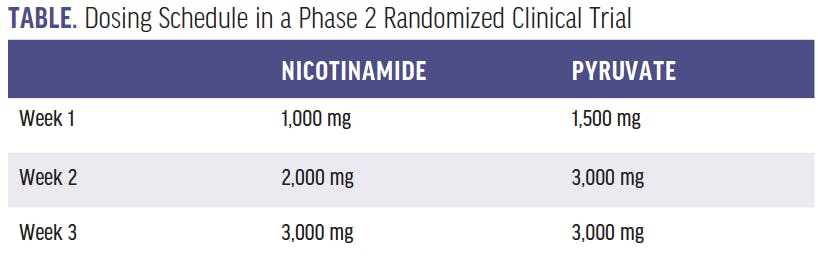
Participants received increasing doses of nicotinamide (1,000–3,000 mg) and pyruvate (1,500–3,000 mg) over the course of 3 weeks (Table). Visual improvement was found in more visual field test locations in the treatment group (median of 15 [6–25] vs 7 [6–11]; P = .005). Pattern standard deviation rate of change showed an improvement in the treatment group compared to the placebo group (-0.06 vs 0.02 dB per week; 95% CI, 0.02–0.24; P = .02). There was no change in mean deviation or visual field index. No significant adverse effects occurred during the study period.
DISCUSSION
For which patients could nicotinamide and pyruvate supplementation be considered?
This study investigated nicotinamide and pyruvate for neurological recovery, but the degree of visual improvement observed is not likely to be meaningful. It remains unknown if the visual field improvement observed indicates that supplementation can confer long-term neuroprotection. De Moraes et al cited previous studies that showed that mitochondrial dysfunction plays a role in the pathogenesis of glaucoma and that the oral administration of nicotinamide and pyruvate (in mice and humans) might be neuroprotective.9-12 Supplemental therapy with nicotinamide and pyruvate may be most applicable to patients who already have low IOPs and experience glaucomatous progression. The cost of the therapy is low.
What can providers tell patients who want to try supplementation?
Patients who are candidates for nicotinamide and pyruvate therapy should be made aware that the sample size for the study by De Moraes et al was small and the follow-up period was short. Glaucoma is a lifelong disease, and it is not possible to extrapolate the supplemental therapy’s duration of effect from the study. Several international clinical trials, however, are underway that may provide further information on the long-term neuroprotective effects of supplementation and the visual function of patients undergoing this form of therapy.
Even if supplemental therapy is not initiated immediately, discussing the option could offer hope to patients. If they wish to consider starting treatment before more definitive evidence becomes available, they should understand that they will have to swallow many pills, which some of them may find difficult.
Regarding side effects, the study described only gastrointestinal discomfort, but this was experienced by several patients in the treatment and placebo groups (33% in the treatment group vs 27% in the placebo group; P > .99) and thus is unlikely to be significant. Practically speaking, patients may be likely to take the more readily available vitamin B3 or niacin (instead of nicotinamide), which is associated with a significant vasodilatory reaction and sometimes intolerable skin flushing.13 Even if patients can find nicotinamide to purchase in North America, its label is often interchangeable with that of niacin, which may confuse them.
1. Dada T, Bhai N, Midha N, et al. Effect of mindfulness meditation on intraocular pressure and trabecular meshwork gene expression: a randomized controlled trial. Am J Ophthalmol. 2021;223:308-321.
2. Grossman P, Niemann L, Schmidt S, Walach H. Mindfulness-based stress reduction and health benefits. A meta-analysis. J Psychosom Res. 2004;57(1):35-43.
3. Lee MJ, Wang J, Friedman DS, Boland M V, De Moraes CG, Ramulu PY. Greater physical activity is associated with slower visual field loss in glaucoma. Ophthalmology. 2019;126(7):958-964.
4. Quaranta L, Riva I, Gerardi C, Oddone F, Floriani I, Konstas AGP. Quality of life in glaucoma: a review of the literature. Adv Ther. 2016;33(6):959-981.
5. Varma R, Lee PP, Goldberg I, Kotak S. An assessment of the health and economic burdens of glaucoma. Am J Ophthalmol. 2011;152(4):515-522.
6. Krauss AHP, Impagnatiello F, Toris CB, et al. Ocular hypotensive activity of BOL-303259-X, a nitric oxide donating prostaglandin F2α agonist, in preclinical models. Exp Eye Res. 2011;93(3):250-255.
7. Rolle T, Ponzetto A, Malinverni L. The role of neuroinflammation in glaucoma: an update on molecular mechanisms and new therapeutic options. Front Neurol. 2021;11:612422.
8. De Moraes CG, John SWM, Williams PA, Blumberg DM, Cioffi GA, Liebmann JM. Nicotinamide and pyruvate for neuroenhancement in open-angle glaucoma: a phase 2 randomized clinical trial. JAMA Ophthalmol. 2022;140(1):11-18.
9. Tribble JR, Vasalauskaite A, Redmond T, et al. Midget retinal ganglion cell dendritic and mitochondrial degeneration is an early feature of human glaucoma. Brain Commun. 2019;1(1):fcz035. doi:10.1093/braincomms/fcz035
10. Williams PA, Harder JM, Foxworth NE, et al. Vitamin B3 modulates mitochondrial vulnerability and prevents glaucoma in aged mice. Science. 2017;355(6326):756-760.
11. Tribble JR, Otmani A, Sun S, et al. Nicotinamide provides neuroprotection in glaucoma by protecting against mitochondrial and metabolic dysfunction. Redox Biol. 2021;43:101988.
12. Harder JM, Guymer C, Wood JPM, et al. Disturbed glucose and pyruvate metabolism in glaucoma with neuroprotection by pyruvate or rapamycin. Proc Natl Acad Sci U S A. 2020;117(52):33619-33627.
13. Huber R, Wong A. Nicotinamide: an update and review of safety & differences from niacin. Skin Therapy Lett. 2020;25(5):7-11.