Glaucoma drainage implants (GDIs) are a vital tool in the hands of surgeons seeking to lower IOP when less invasive therapies fail, but patients and providers are frustrated by 5-year GDI failure rates as high as 18% to 32%.1 One important mechanism of GDI failure is encapsulation or fibrosis over implant plates resulting in decreased bleb permeability and IOP elevation.2 The thickness and permeability of the bleb capsule are determined by patient characteristics, aqueous humor factors, and implant geometry. There is a direct relationship between implant radius and capsule thickness that is attributable to an increase in capsular tension and resultant collagen deposition caused by the height of a large bleb.3 Creating a thinner, more permeable GDI bleb without drastically reducing implant surface area requires decoupling this relationship. Preclinical data generated at the Wilmer Eye Institute indicate that the team from W.L. Gore & Associates (Gore) has achieved this with a novel, investigational GDI prototype (Figure 1) that will soon be evaluated in a first-in-human (FIH) study.
Expanded polytetrafluoroethylene (ePTFE) is a biocompatible, biostable, highly compliant, and versatile microporous polymer. Because it incorporates well into many tissues, ePTFE is widely used in biomedical implants, including vascular grafts, hernia membranes, and sutures.4 By inviting physiologic tissue integration, the ePTFE GDI is intended to promote subconjunctival healing without fibrosis, allowing durable aqueous filtration across the bleb without the use of antimetabolites.
DEVICE CONSTRUCTION AND SURGICAL TECHNIQUE
ePTFE has a customizable microporous structure composed of dense nodes and thin fibrils, which can permit or prevent cellular integration depending on pore size (Figures 1 and 2). The Gore GDI is fashioned from two customized ePTFE membranes that are bonded together at the implant’s perimeter to form a thin, flexible central reservoir. Each membrane is a composite structure, with open ePTFE—into which surrounding cells can integrate—facing subconjunctival ocular tissues and tight ePTFE lining the reservoir to prevent cellular ingress but allow aqueous flow. A silicone tube sized to prevent postoperative hypotony is sandwiched and sealed between the membranes. The reservoir is also designed to constrain inflation height and limit capsular tension that can cause the bleb to thicken.
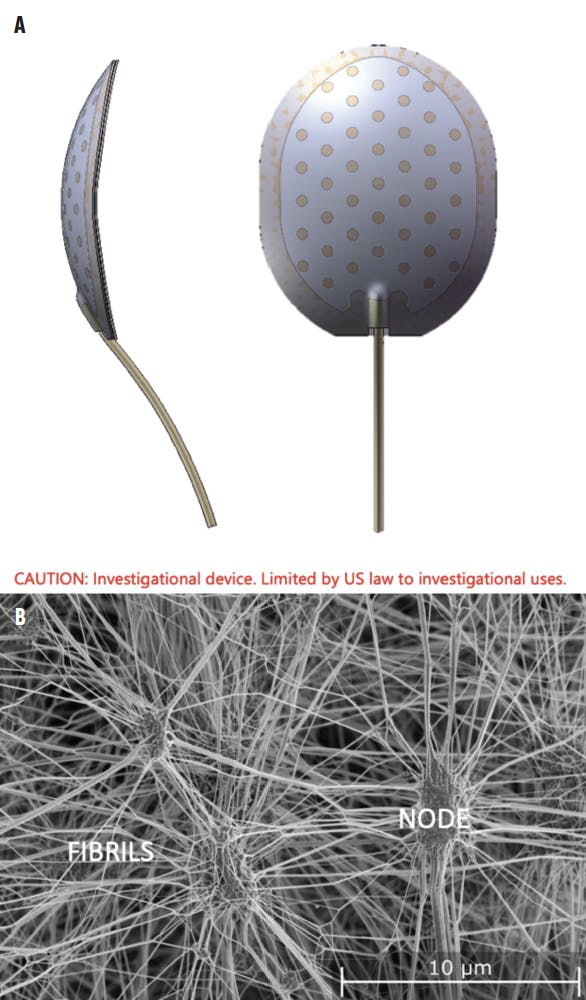
Figure 1. Gore ePTFE. Schematic of the investigational GDI prototype (A). Scanning electron microscopy of ePTFE (B). Varying arrangements of dense nodes and thin fibrils allow customization of the ePTFE membranes.

Figure 2. Bleb histopathology (A, B) shows that ePFTE decouples the relationship (C) between device plate radius and capsule thickness. Masson trichrome-stained cross-sections of blebs over ePTFE (A) and control (B) GDIs show capsule thickness (green line) and cellular integration into ePTFE implants (blue scale bar = 25 µm; asterisk = cell-excluding tight ePTFE layer, X = open ePTFE allowing cellular integration). Scanning electron microscopy shows customized arrangement of ePTFE nodes and fibrils forming open and tight ePTFE membranes (D). Wilcox and Kadri showed a direct relationship between GDI plate radius and capsule thickness (C); they hypothesized that the greater height of a larger bleb increases capsular tension, as modeled by Laplace’s law, leading to collagen deposition.3 The bleb over the investigational Gore GDI prototype (red dot) is significantly thinner than this relationship would predict.
The dimensions of the prototype reservoir (Figure 1) that will be implanted in our upcoming FIH study reflect those of an available GDI in wide clinical use, the Ahmed Glaucoma Valve (New World Medical), although the Gore prototype is thinner (0.75 mm height fully inflated vs 2.10 mm Ahmed plate height). Surgeons will therefore be familiar with the proposed insertion technique—through a limbal peritomy, into a fornix-based pocket, and with a scleral tunnel for tube placement in the anterior chamber. Importantly, however, ePTFE’s biointegration is expected to safeguard against GDI exposure, eliminating the need for a tissue patch graft.
PRECLINICAL EVIDENCE
Three months of in vivo study in a rabbit model demonstrated the formation of much thinner, more permeable blebs surrounding experimental Gore GDIs than were seen around equivalently sized silicone controls mimicking GDIs used in humans today.5 By comparing experimental Gore GDIs that were and were not exposed to aqueous humor flow and did and did not balloon with aqueous filling, we were able to separate independent effects of reservoir geometry and aqueous humor exposure and confirm that increased height thickens bleb capsules. That said, when blebs of the same height over experimental ePTFE GDIs and silicone controls were compared histologically, it was clear that capsules over ePTFE GDIs were much thinner than controls (40.2 ±32 µm vs 117.5 ±48 µm; P = .048), with far less collagen deposition (Figure 2). These findings were noteworthy given the tendency of rabbits’ eyes to mount a robust inflammatory response with extensive scarring, leading to the failure of most glaucoma filtering surgeries in this animal model.
By cannulating the silicone tube of the Gore GDI in the anterior chamber and using constant-flow fluorescein perfusion with an in-line manometer to measure flow resistance, we were able to demonstrate the permeability of experimental Gore GDI blebs (Figure 3). Whereas control blebs filled like closed chambers, with pressure rising sharply once the blebs were full, ePTFE blebs achieved steady-state pressures as flow across their membranes came to equilibrium. When infusion stopped, pressure decayed rapidly in ePTFE blebs as fluorescein diffused across experimental Gore GDIs and their capsules but remained high in encapsulated control blebs. Moreover, when fluorescein outflow was visualized, fluorescent signal was locked within the borders of impermeable control blebs but freely diffused outside the permeable ePTFE GDI capsule.
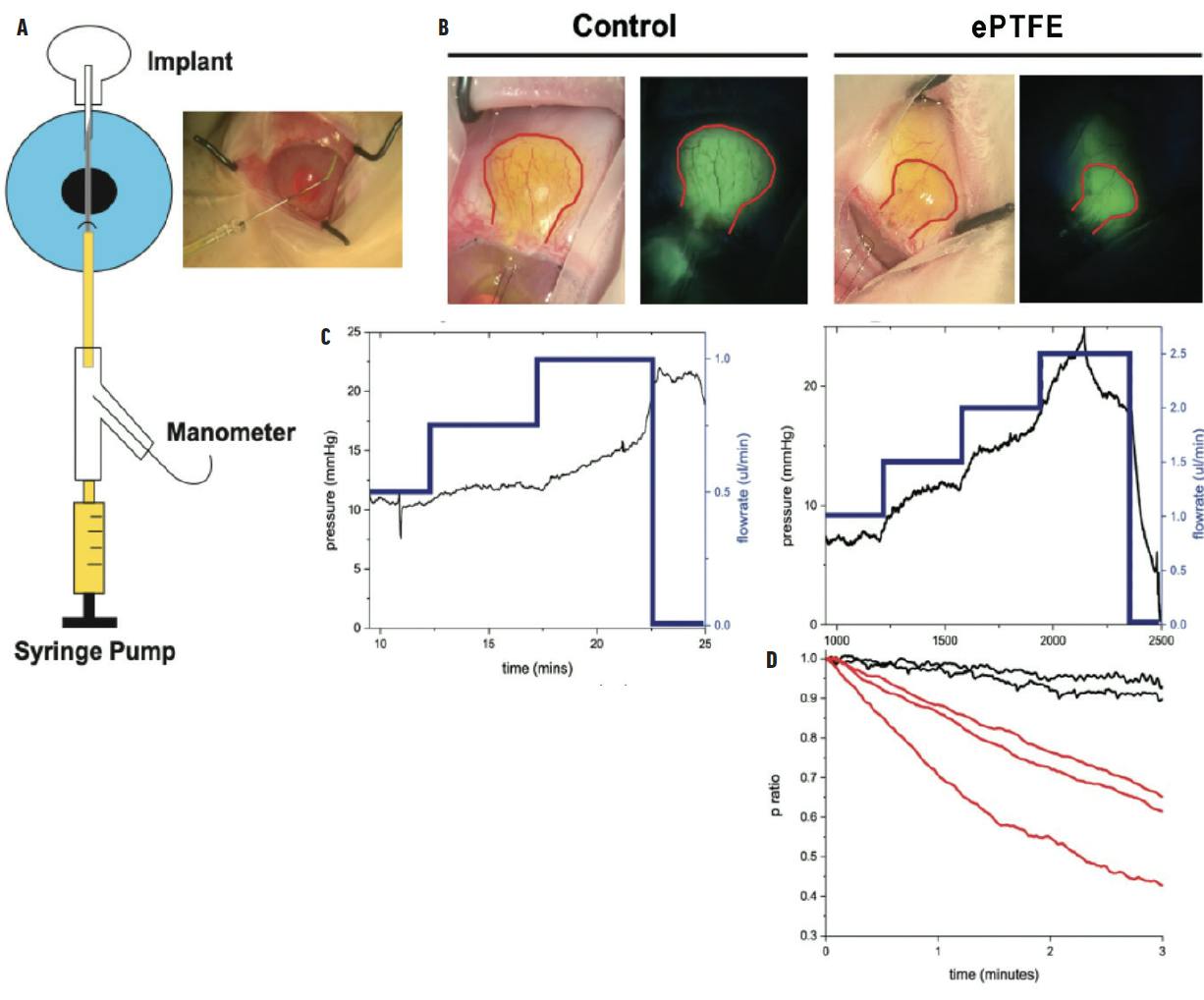
Figure 3. Bleb permeability studies. Schematic of apparatus (A) for studying bleb permeability (left) and picture of anterior chamber cannulation of tube (right). Images of control and ePTFE GDIs (device borders highlighted in red) show extension of fluorescein beyond only ePTFE devices (B). Permeability studies of control (left) and ePTFE (right) implants demonstrate an absence of steady-state flow and pressure decay in controls (C). Pressure measurement in control (black) and ePTFE (red) tubes after stopping fluorescein infusion shows pressure decay only within ePTFE devices (D).
OUTLOOK
Decoupling GDI geometry from capsular fibrosis using customized Gore ePTFE appears to be an exciting step forward for glaucoma surgery. Our rabbit studies were encouraging and suggest effective aqueous filtration with no major safety concerns. As we have scaled the prototype Gore GDI for human use, our focus has been on optimizing aqueous outflow without introducing new uncertainties. The implant is sized to maximize surface area while avoiding placement on or under muscles or encroachment on the optic nerve. Constraining reservoir inflation to a height of less than 1 mm adds the geometric advantages of a low bleb to the material advantages of ePTFE, while minimally increasing resistance, and our tube geometry is designed as a safeguard against hypotony. We are eager to kick off a 12-month, 20-patient FIH study later this year.
1. Budenz DL, Barton K, Gedde SJ, et al. Five-year treatment outcomes in the Ahmed Baerveldt Comparison Study. Ophthalmology. 2015;122(2).
2. Addicks EM, Green WR, Robin AL, Quigley HA. Histologic characteristics of filtering blebs in glaucomatous eyes. Arch Ophthalmol. 1983;101(5).
3. Wilcox M, Kadri OA. Force and geometry determine structure and function of glaucoma filtration capsules. Ophthalmologica. 2007;221(4):238-243.
4. Ebnesajjad S. Medical and surgical applications of expanded PTFE. In: Ebnesajjad S, ed. Expanded PTFE Applications Handbook. Elsevier; 2017:193-211.
5. Bicket AK, Szeto J, Roeber P, et al. A novel bilayered expanded polytetrafluoroethylene glaucoma implant creates a permeable thin capsule independent of aqueous humor exposure. Bioeng Transl Med. 2021;6(1).