At least one in three patients uses alternative medical treatments, and surveys indicate a growing interest in the use of vitamins, supplements, and other alternative therapies for chronic conditions such as glaucoma.1 The disease has a multifactorial pathogenic process that includes damage from free radicals, oxidative stress, and increased IOP,2 and many patients perceive alternative treatments as potential methods to target the pathogenesis of glaucoma. These treatments may carry potential adverse effects, so clinician awareness of their use is important. However, it seems that only a small minority of patients discloses using alternative medicine.
ALTERNATIVE TREATMENTS
Alternative treatments for glaucoma include vitamins, cannabis, homeopathic remedies, and lifestyle modification (Table 1).

Vitamins. Vitamins are one of the most popular and readily available alternative treatments due to their perceived benefits and ease of access. Omega-3s are thought to have antiinflammatory and antioxidant effects on the eye.3 Vitamins A, C, B9, and B12 have antioxidant benefits. Vitamin A is an essential component of rhodopsin, which is essential to vision in dim light. At high concentrations, vitamin C may reduce IOP through an osmotic effect, although this may be limited by side effects.4,5 Vitamin B12 may have a neuroprotective effect, with evidence correlating low B12 levels to neuroretinal pathology.6
Hand in hand with vitamin intake is the consumption of dark leafy greens, which contain high levels of vitamins A, C, and K and nitrate. Nitrate or nitric oxide is thought to contribute to IOP regulation by increasing aqueous outflow, and new drugs are being designed to target this pathway.7
Although many vitamins are purported to provide a variety of ocular benefits, further study is required to establish a direct link to glaucoma outcomes.
Cannabis. Cannabis has been an area of focus in glaucoma because it produces a short-term decrease in IOP. The drug’s effects, however, last only 3 or 4 hours. A long-term benefit would require a high level of cannabis compounds (tetrahydrocannabinol and cannabidiol) to be maintained within the patient’s system. Given the drug’s side effects, there is currently no clinically viable route to administer cannabis for the treatment of glaucoma, but clinical investigations of this treatment are ongoing.8
Homeopathic remedies. It has been suggested that various homeopathic remedies exert neuroprotective and antioxidant effects on the eye, which could slow glaucomatous progression. The most popular of these remedies are ginkgo biloba and bilberry. Ginkgo biloba is thought to have vasodilatory and antiinflammatory properties in addition to antioxidant properties, all of which could increase retinal and choroidal circulation and reduce free radicals. A direct link between these neuroprotective effects and improved visual fields has yet to be established, and published results are conflicting.9
Bilberry has been proposed to have a neuroprotective effect and to decrease retinal ganglion cell death after injury.9 In animal studies, bioflavonoids (compounds found in fruits and vegetables) and turmeric have been shown to have neuroprotective effects on retinal ganglion cells, especially after cell injury.10
Lifestyle modification. Certain lifestyle modifications may affect IOP. These include changes in sleeping position to avoid consistent pressure on one eye, exercise and maintenance of a normal body mass index, smoking cessation, meditation or yoga, and acupuncture.11-14 Of these methods, adjustments in sleeping position are the most proven to affect IOP. Exercise may also yield IOP-lowering effects. Other practices such as meditation and acupuncture have known benefits for overall health and are adopted by some patients for this reason, but their direct impact on glaucoma has yet to be proven. (For more on the effects of mindfulness meditation on IOP, read “The Literature” column.)
TREATMENT TRANSPARENCY
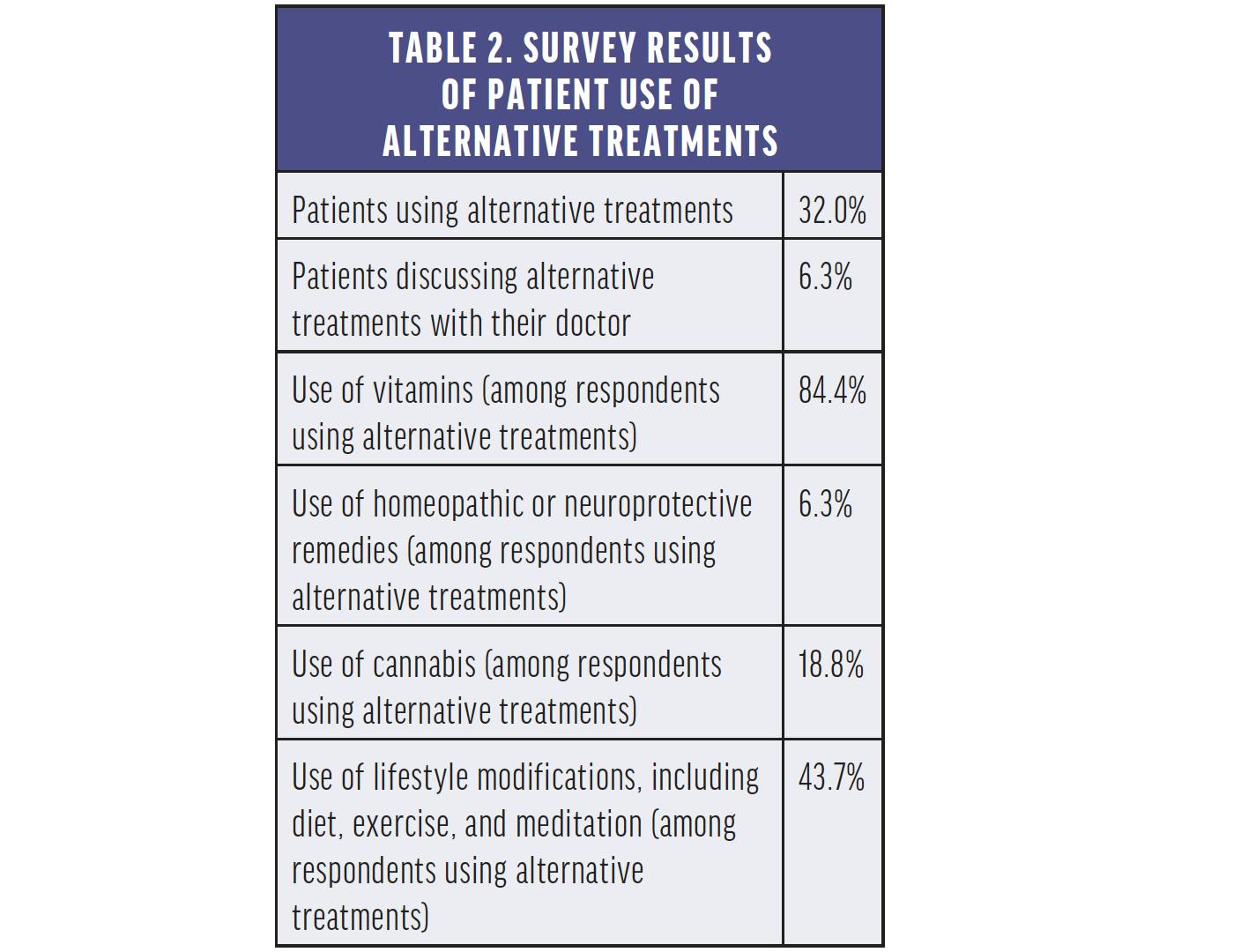
A patient survey conducted recently by the Rutgers Department of Ophthalmology and Visual Sciences demonstrated that many patients use alternative treatments but do not tell their doctors (Table 2). Of the patients surveyed, 32% reported using alternative treatments to supplement their glaucoma care, but only 6.3% informed their doctor of this practice. The most commonly used alternative treatments were vitamins and neuroprotective homeopathic supplements. The survey results highlight a need for more research on alternative treatments so that doctors and patients can openly discuss their use and viability in glaucoma.15
CONCLUSION
Many alternative treatments are commonly sold as over-the-counter supplements, but their use is not without risk. Some alternative treatments such as cannabis and vitamin C must be used at high concentrations to yield ocular benefits and can therefore have adverse effects. Cannabis can have negative neurological and memory effects and cause dry mouth, dry eye, and hypotension. High concentrations of vitamin C can cause diarrhea and dehydration. Additionally, excess consumption of vitamin A can lead to night blindness and intracranial hypertension, and excessive intake of omega-3 supplements and vitamin E has been linked to bleeding. Other homeopathic remedies listed herein do not have specifically set safe limits or may have unknown side effects at high concentrations.5
Alternative treatments, either as adjunctive or standalone therapy, have some promising properties for glaucoma care. However, current evidence is not sufficient for directly linking them to improved outcomes in long-term glaucoma care, and more information is needed to set parameters for clinical use.
1. Wan MJ, Daniel S, Kassam F, et al. Survey of complementary and alternative medicine use in glaucoma patients. J Glaucoma. 2012;21(2):79-82.
2. Weinreb RN, Aung T, Medeiros FA. The pathophysiology and treatment of glaucoma: a review. JAMA. 2014;311(18):1901-1911.
3. SanGiovanni JP, Chew EY. The role of omega-3 long-chain polyunsaturated fatty acids in health and disease of the retina. Prog Retin Eye Res. 2005;24(1):87-138.
4. Ramdas WD, Schouten JSAG, Webers CAB. The effect of vitamins on glaucoma: a systematic review and meta-analysis. Nutrients. 2018;10(3):359.
5. Harvard Medical School. Listing of vitamins. August 31, 2020. Accessed April 1, 2022. www.health.harvard.edu/staying-healthy/listing_of_vitamins
6. Turkyilmaz K, Oner V, Turkyilmaz AK, et al. Evaluation of peripapillary retinal nerve fiber layer thickness in patients with vitamin B12 deficiency using spectral domain optical coherence tomography. Curr Eye Res. 2013;38(6):680-684.
7. Wareham LK, Buys ES, Sappington RM. The nitric oxide-guanylate cyclase pathway and glaucoma. Nitric Oxide. 2018;77:75-87.
8. Aref A, Oh D, Al-Khaled T. Cannabinoids for glaucoma. EyeWiki. May 2, 2021. Accessed April 1, 2022. https://eyewiki.aao.org/Cannabinoids_for_Glaucoma
9. Ige M, Liu J. Herbal medicines in glaucoma treatment. Yale J Biol Med. 2020;93(2):347-353.
10. Nakamura O, Moritoh S, Sato K, et al. Bilberry extract administration prevents retinal ganglion cell death in mice via the regulation of chaperone molecules under conditions of endoplasmic reticulum stress. Clin Ophthalmol. 2017;11:1825-1834.
11. Kim YW, Park KH. Exogenous influences on intraocular pressure. Br J Ophthalmol. 2019;103:1209-1216
12. Jung Y, Han K, Park HYL, Lee SH, Park CK. Metabolic health, obesity, and the risk of developing open-angle glaucoma: metabolically healthy obese patients versus metabolically unhealthy but normal weight patients. Diabetes Metab J. 2020;44(3):414-425.
13. Law SM, Lu X, Yu F, Tseng V, Law SK, Coleman AL. Cigarette smoking and glaucoma in the United States population. Eye (Lond). 2018;32(4):716-725.
14. Dada T, Gagrani M. Mindfulness meditation can benefit glaucoma patients. J Curr Glaucoma Pract. 2019;13(1):1-2.
15. Patton A, Khouri AS. Survey of alternative treatments for glaucoma. Paper presented at: Association for Research in Vision and Ophthalmology Annual Meeting; May 2022; Denver, CO.