Over time, I have found certain prediagnosis experiences to have meaningful applications to my postdiagnosis life. For example, I became interested in Won Buddhism at a young age—in fact‚ one of my first destinations after getting my driver’s license was my local Won Buddhist temple.
For those who are unfamiliar, Won Buddhism is a Korean offshoot of more traditional Buddhism that leans more toward philosophy than religion and has played a role in my life for some time. A spirituality for the modern age, Won Buddhism provides an opportunity to practice without heading for the hills and abandoning one’s familial and personal responsibilities. During my time in the Won Buddhist sangha (community), I zeroed in on a few main themes, expectation versus reality chief among them.
As my vision declines, the concept of expectation versus reality continues to crop up in unexpected ways. This article details a few such disparities that I have encountered and examines the ways in which I cope with them.
CASE IN POINT: RECEIVING A (MIS)DIAGNOSIS
Expectation: Resistance
In a previous installment of this column, I talked about my diagnosis of Wolfram-like syndrome and the misdiagnoses encountered along the way (click here to read more). At one point, I was told I had overstayed my welcome on this earth and would soon experience a progressive degeneration like that of someone with Lou Gehrig’s disease; I would lose my ability to breathe independently while remaining aware of my reality.
Reality: Acceptance
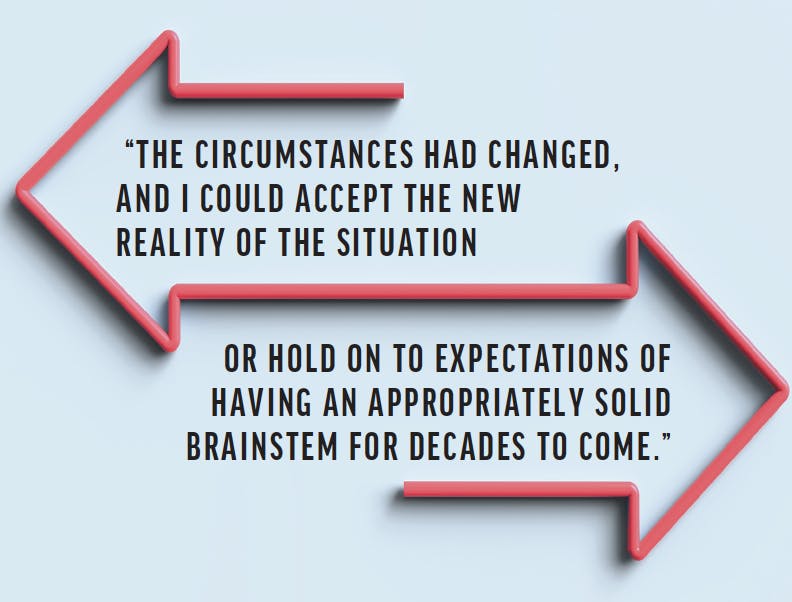
As a lapsed Buddhist, I have been told by my wife that my response to this diagnosis was unnerving. When faced with the news that my brain stem would be turning to jelly, I apparently responded with an admirably Buddhist level of detachment. The circumstances had changed, and I could accept the new reality of the situation or hold on to expectations of having an appropriately solid brainstem for decades to come. I accepted that a career involving nonstop travel was no longer in the cards for me, and I took the opportunity to get back to my love of advocacy.
CASE IN POINT: (NOT) SHARING THE ROAD
Expectation: Yield
I recently ran the Catamount Climb, one of my favorite half-marathons, and, for the first time, trained with a running guide. While training, I started wearing a reflective vest with the word blind on the front and back in big, bold letters. The vest was more for others than for me; the idea was that it would put my fellow runners and the race volunteers on notice so that they would give my running guide and me a wide berth. At least, that is what I expected would happen.
Reality: Merge
Throughout my months of training and during the race itself, I saw countless motorists, runners, and dog walkers notice my vest, stare, and move directly toward me in a zombie-like fashion. At times, I was even forced to hop into a gutter or dodge a vehicle on a mission to test my vision. These experiences made me think long and hard about commuter etiquette (as well as mutter exasperated obscenities and employ some expressive hand gestures). Regardless of whether I can convey the importance of sharing the road and respecting others, I will keep running. In fact, my next race is in just a few weeks.
ABOUT THE AUTHOR
Richie Kahn, MPH, is a health policy professional by training, clinical researcher by trade, and patient advisor by necessity. He is passionate about incorporating patient and caregiver perspectives into the clinical development process and ultimately reducing the time it takes to bring promising new therapeutics and diagnostics to market.
LIFE’S TEACHINGS
When life does not go according to plan, I have found the best course of action is to stay flexible. I certainly did not plan to go blind and pivot from a job in sales to a career laser-focused on advocacy. I did not expect to give up driving or start thinking about using a white cane and seeing eye dog in my 30s. I also did not envision joining the board of One Rare (onerare.org), a 501(c)(3) that serves young adults affected by rare disease, or having the good fortune now to consider some world-class patient advocates my dearest friends.
I find myself in the advantageous position of understanding the constraints of clinical development while also recognizing that we do a lousy job of incorporating the patient perspective into the technologies we build and studies we design. As I get older, I also have the honor of helping advocates who are just developing their voices find receptive ears and helping those without audiences find their platforms.
And you know what? Although my reality often does not match my expectations, I wouldn’t change it for the world.