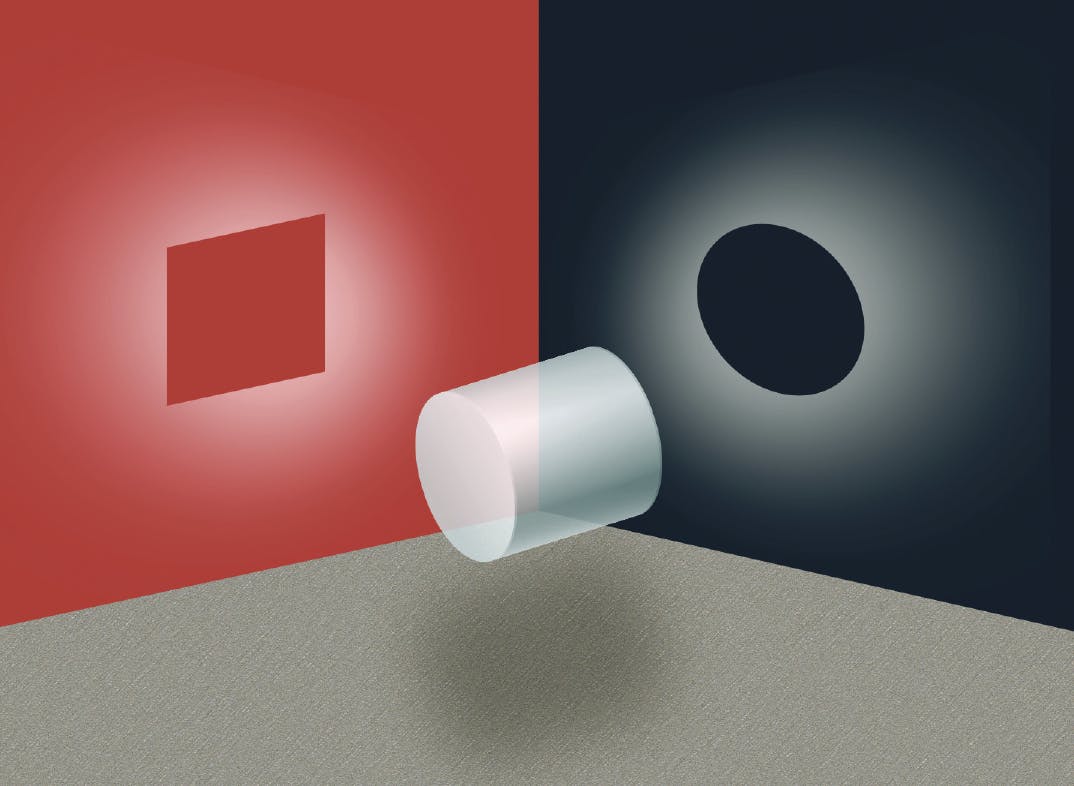
Square or circle? Looking at each shadow individually, the answer seems obvious: The shadow on the left is cast by a square object, and the shadow on the right by a circular one. With the right perspective, however, it becomes clear that the shadows are cast by the same object, a cylinder. Reality is not always obvious, and seeing it clearly sometimes requires a shift in perspective.
The presentation of a patient in the clinic provides a somewhat limited view of them as a person. By default, they are patients with glaucoma, and our encounters are molded by the patient-physician dynamic. The roles are established; the perspective is set.
In this era of interventional glaucoma especially, however, we have a responsibility to see our patients from the right perspective—to view the full picture of how they are affected by their disease and its treatment. We must resist assuming that something is a circle or a square when, in fact, it could be a cylinder.
Making assumptions about our patients’ feelings toward their disease and its management limits our understanding and our ability to provide the treatment that works best for them. The truth is that most patients struggle with their glaucoma medications, but that is not always apparent to us.
I most often discover that I have missed identifying a patient’s struggle with adherence when I mention the need for surgery. At this point, they typically admit if they have not been using their medication as prescribed. With the line of communication opened, patients often disclose the obstacles that they have encountered, and we can then work together to determine the next best steps.
The earlier we can elicit these honest conversations with patients, the more likely we are to see success with their glaucoma care. Each patient has an individual reality—the trick is adjusting our perspective to see it.