The COVID-19 pandemic necessitated virtual patient visits and ushered in a new era of remote health care. For ophthalmologists, the requisite early efforts to conduct virtual eye assessments were not without challenges; however, over time, new telemedicine technologies and practices emerged to facilitate the delivery of eye care. Eventually, hybrid models emerged using asynchronous data acquisition in satellite offices and paired with real-time video conferencing between the patient and the physician.
In a 2021 survey conducted by Capitena Young et al,1 77.4% of responding eye care providers reported providing telemedicine during the pandemic. About 50% of glaucoma providers stated that they planned to continue using telemedicine after the pandemic. This article identifies existing and evolving solutions designed to support remote monitoring of glaucoma today and in the future.
VISUAL ACUITY TESTING
Several visual acuity tests have been validated for remote patient use.
In 2021, Siktberg et al found that an ETDRS visual acuity test self-administered by patients at home following a standardized protocol was equivalent to a standard technician-administered visual acuity test.2 Another validated option is the Home Acuity Test, which was developed at the Moorfields Eye Hospital and is free to download or print at www.homeacuitytest.org.3
The Peek Acuity app (Peek Vision; available for Android devices), developed by the International Centre for Eye Health in London, evaluates distance vision only and requires two people to perform. The OdySight app (Tilak Healthcare; available for Apple devices) can be used to perform visual field and Amsler grid testing and is able to calculate the distance between the patient and the screen and detect the amount of ambient light.
TONOMETRY
Several tonometry systems have been developed for at-home use.
The Sensimed Triggerfish (Sensimed) is an FDA-approved ocular monitoring system that includes a contact lens sensor to capture spontaneous circumferential changes at the corneoscleral area as a surrogate for IOP fluctuations. Data are transmitted through a thin, flexible cable to a portable recorder worn by the patient. At the end of the recording period, the data are transferred wirelessly to the physician’s computer.
The iCare Home (iCare USA) is a rebound tonometer designed for patients’ use. No topical anesthesia is required. Patients must be upright when taking their measurements with the iCare Home, but the device provides guidance via audio cues and a positioning light. The iCare Home has not been validated in eyes with corneal thicknesses greater than 500 to 600 µm or more than 3.00 D of astigmatism. In a review article, Liu et al found that tonometry measurements with the iCare Home and Goldmann applanation tonometer were reasonably similar. They also concluded that the iCare Home tended to overestimate IOP in eyes with higher IOP values and underestimate IOP in eyes with lower IOP values; it was most accurate for measuring IOPs between 16 and 23 mm Hg.4
The Eyemate (Implandata Ophthalmic Products) is the newest device in this class and is currently approved for use only in Europe. The system contains a suprachoroidal sensor that is surgically implanted and paired with the Eyemate reader, which the patient holds in front of their eye to record their IOP. According to a study by Szurman et al, the overall mean difference between IOP measurements obtained with Goldmann applanation tonometry and those obtained with the Eyemate was 1.31 mm Hg.5
HOME/PORTABLE VISUAL FIELD TESTING
New approaches to portable perimetry have emerged, including a tablet-based perimeter and a virtual reality (VR)–based perimeter.
Tablet-based perimeters were first developed for glaucoma screening in rural and underserved areas and patient populations. These devices are cost-effective, user-friendly, portable, and small. Their use entails a shorter testing time than the Humphrey Field Analyzer (HFA, Carl Zeiss Meditec); however, variable results may be produced owing to certain testing conditions that are difficult to control at home, such as ambient illumination, viewing distance from the tablet, and fixation stability.
The Melbourne Rapid Fields (MRF) is an FDA-cleared class I device, formerly known as VisualFields Easy. The MRF is a free app that is available on the iPad 3 (Apple) or later model or via a web version for use on a laptop or television screen. The MRF uses a modified 24-2 grid that is equivalent to the HFA 24-2 program. Studies have shown the MRF to have good correlation to the HFA 24-2 for test-retest reliability and mean deviation and pattern standard deviation indices.6 A screening study of 206 patients in Nepal showed that the MRF could effectively identify moderate and advanced visual defects but might miss early cases of glaucoma and underestimate glaucomatous defects.7
Currently, several head-mounted VR perimeters are commercially available (see Commercially Available VR Perimeters). They are lightweight, portable, and less expensive than visual field machines. VR perimeters are also more ergonomically comfortable; patients can move their heads and take the test in different positions. Eye-tracking technology improves fixation and generates more repeatable data than tablet-based systems by blocking out room light and maintaining a constant viewing distance. However, these are emerging technologies, and limited studies show variable outcomes with correlation to HFA indices. Further investigations are needed.
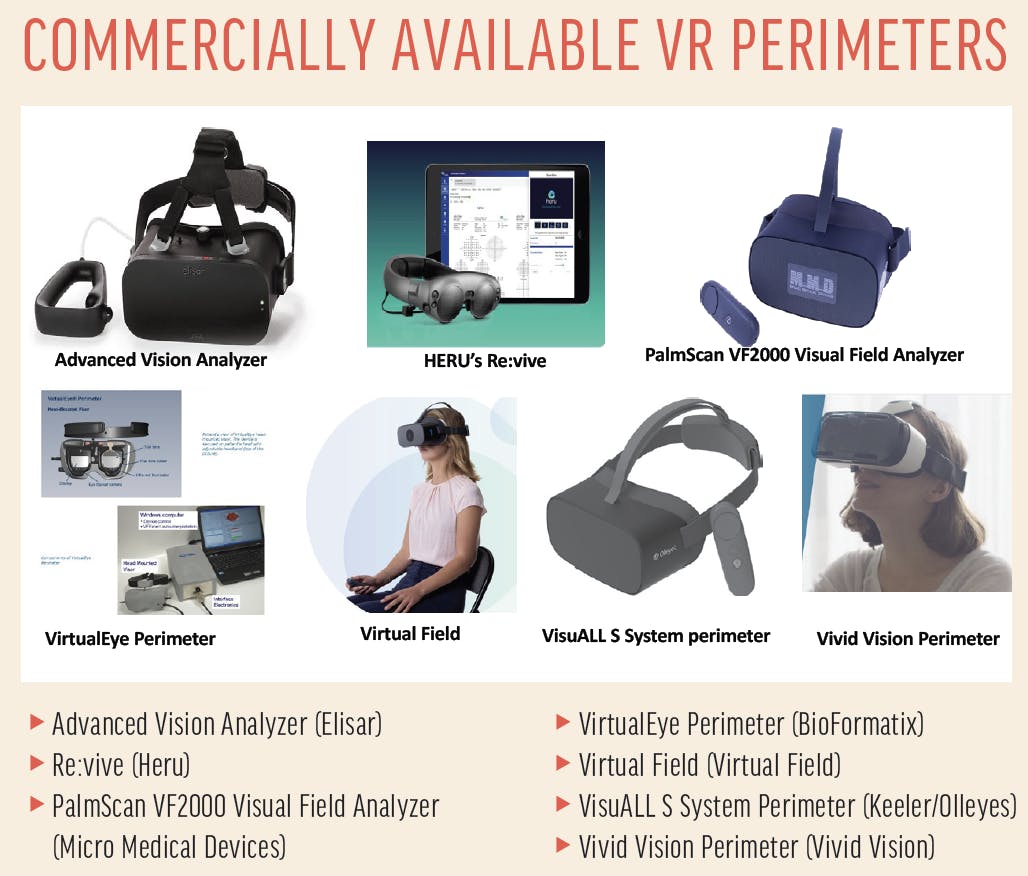
Most VR perimeters come with a clicker that is designed to capture the patient’s response, making patient response a factor in their performance. A few systems use oculokinetic perimetry, which employs the eye’s foveation reflex and senses any change in gaze direction as evidence of target acquisition.
Objective assessment of visual function is the next frontier, and the nGoggle (nGoggle Diagnostics) is one developmental device with this capability. The nGoggle is a portable brain-computer interface that uses multifocal steady-state visual evoked potentials. It integrates electroencephalogram and electrooculogram sensors, a smartphone-based VR headset, and proprietary software to collect information about the visual field without relying on patient response. In a 2017 validation study,8 the investigators found good repeatability and superior diagnostic accuracy with the nGoggle compared to standard automated perimetry.
PORTABLE OPTIC NERVE IMAGING
Several portable devices are available for optic nerve imaging. They include (1) portable fundus cameras by Carl Zeiss Meditec, Nidek, Topcon, and Volk; (2) handheld smartphone camera adapters; and (3) an FDA-approved portable handheld OCT unit (Envisu C2300, Leica). As it stands, these devices have limited utility for home monitoring: They require a technician or other trained individual for image acquisition, and image quality can be variable. The devices also tend to lack stability and are more sensitive to motion artifacts and alignment issues.
One home OCT device, the Notal Home (Notal Vision), is commercially available. This AI-enabled, patient-operated home OCT program is designed for monitoring neovascular age-related macular degeneration. It features the Notal OCT Analyzer, an image analysis algorithm that provides automated detection of fluid in neovascular age-related macular degeneration, macular edema, and retinal vein occlusion.
AI ALGORITHMS
To date, two autonomous AI algorithms have been approved by the FDA for the detection of diabetic retinopathy and diabetic macular edema with fundus photographs: the IDx-DR and EyeArt. No FDA-approved AI algorithms exist yet for glaucoma, but many studies are underway to explore their use (1) with fundus photography to predict retinal nerve fiber layer thickness and visual field defects, (2) with OCT imaging to predict visual field defects, and (3) with visual fields to detect glaucoma and predict glaucomatous progression. In the future, it may be possible for glaucoma providers to utilize AI to diagnose glaucoma, predict disease progression, and identify rapid progressors. (Editor’s note: For more on AI in glaucoma, see pg 48.)
REIMBURSEMENT CONSIDERATIONS
In response to the COVID-19 public health emergency, the Telehealth Services During Certain Emergency Periods Act was passed in March 2020. The act relaxed rules regarding Medicare coverage of telemedicine—namely, it allowed telehealth services in all parts of the United States (not just rural locations), it allowed telehealth to be performed at home, and it provided equal rates of physician reimbursement for telehealth visits and in-person visits. This public health emergency was due to expire on October 15 but was extended until January 2023.
PREDICTIONS
It is an exciting time in teleglaucoma. Many technologies on the market and in development could enable high-quality virtual care. More studies are needed to validate the feasibility, reliability, and efficacy of these innovations, and legislative policy is essential to fairly cover and compensate for telemedicine services. Teleglaucoma will improve patient access to and quality of care. It will likely be an important part of everyday clinical practice in the near future, if it is not already.
1. Capitena Young CE, Patnaik JL, Seibold LK, Kahook MY. Attitudes and perceptions toward virtual health in eye care during coronavirus disease 2019. Telemed J E Health. 2021;27(11):1268-1274.
2. Siktberg J, Hamdan S, Liu Y, et al. Validation of a standardized home visual acuity test for teleophthalmology. Ophthalmol Sci. 2021;1(1):10007.
3. Crossland MD, Dekker TM, Hancox J, Lisi M, Wemyss TA, Thomas PBM. Evaluation of a home-printable vision screening test for telemedicine. JAMA Ophthalmol. 2021;139(3):271-277.
4. Liu J, De Francesco T, Schlenker M, Ahmed II. Icare home tonometer: a review of characteristics and clinical utility. Clin Ophthalmol. 2020;14:4031-4045.
5. Szurman P, Mansouri K, Dick BH, et al. Safety and performance of a suprachoroidal sensor for telemetric measurement of intraocular pressure in the Eyemate-SC trial. Published online November 12, 2021. Br J Ophthalmol. doi:10.1136/bjophthalmol-2021-320023
6. Kumar H, Thulasidas M. Comparison of perimetric outcomes from Melbourne Rapid Fields tablet perimeter software and Humphrey Field Analyzer in glaucoma patients. J Ophthalmol. 2020;2020:8384509.
7. Johnson CA, Thapa S, Kong YXG, Robin AL. Performance of an iPad application to detect moderate and advanced visual field loss in Nepal. Am J Ophthalmol. 2017;182:147-154.
8. Nakanishi M, Wang YT, Jung TP, et al Detecting glaucoma with a portable brain-computer interface for objective assessment of visual function loss. JAMA Ophthalmol. 2017;135(6):550-557.