Artificial intelligence has transformed several industries, and interest in its potential applications has intensified during the COVID-19 pandemic. Nearly 2,000 articles on AI in ophthalmology have been published to date—1,300 of which were published since 2020 (Figure).
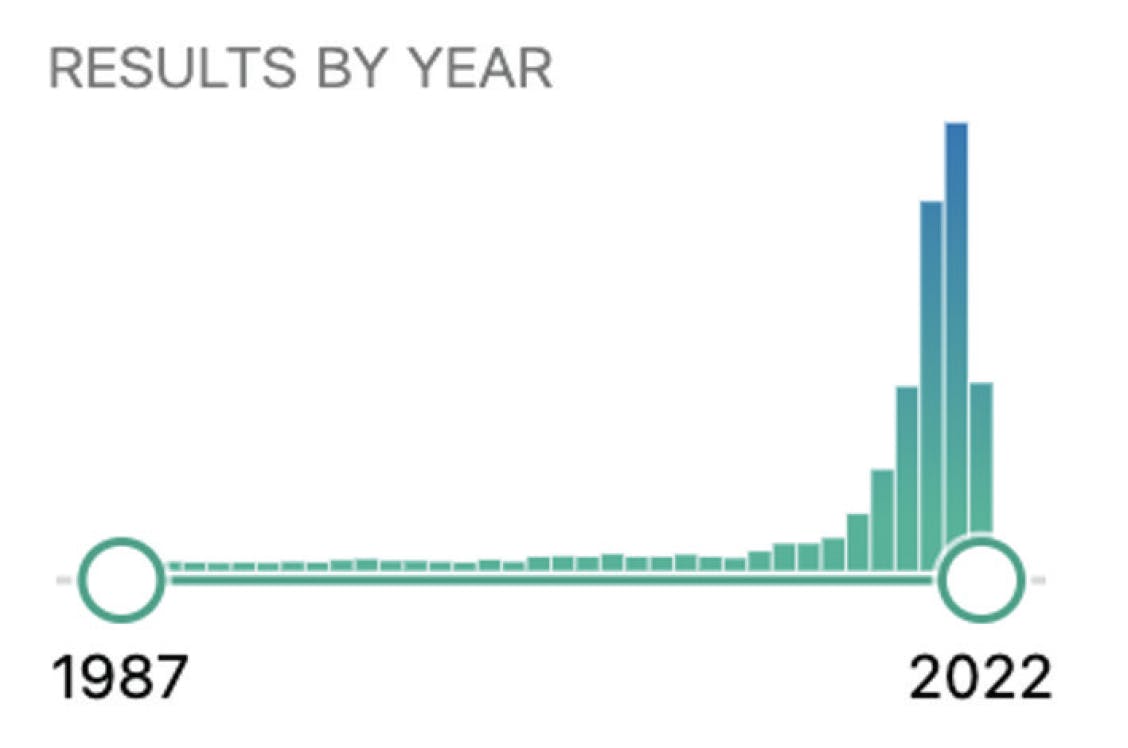
Figure. The results by year of a search of the PubMed.gov site using the terms artificial intelligence and ophthalmology.
Embracing AI in ophthalmology involves both the patient interface and the economy growing around AI—new digital departments and centers, collaborations with tech giants such as Google and Microsoft, and the ophthalmic industry developing AI-based technology to help ophthalmologists deliver higher-quality patient care.
WHY DID IT TAKE SO LONG TO GET HERE?
Imaging is used for diagnosis, documentation, preoperative planning, and postoperative assessments. Recent advances in imaging technology are creating possibilities for the use of AI in ophthalmology. Experts such as data scientists are required to clean data, consider useful variables or features, create algorithms, and optimize parameters to maximize the predictive performance of their model. This process is both time and resource intensive.
The initial focus of AI in ophthalmology was on retinal disease and glaucoma, but it has expanded to include anterior segment disease.1-5 One example is the use of AI for the diagnosis of infectious keratitis, keratoconus, Fuchs endothelial dystrophy, IOL calculations, and cataract grading.5
CAUTION IS WARRANTED
Then. It is sometimes pleasant to remember the world as it was before the COVID-19 pandemic began. Ten years ago, researchers were beginning to study the potential applications of deep learning in health care, and IBM was launching the marketing machine that would propel the company’s flagship in the health care field. IBM expected Watson Health to revolutionize medicine—starting with oncology—through the use of its algorithms trained to personalize treatment for each patient.
In 2016, Geoffrey Hinton, a pioneer of deep learning, made the following prediction: “I think that if you work as a radiologist you are like Wile E. Coyote in the cartoon. You’re already over the edge of the cliff, but you haven’t yet looked down. There’s no ground underneath. It’s just completely obvious that in 5 years deep learning is going to do better than radiologists. It might be 10 years.”
Now. Watson Health did not live up to its promise. Its partnerships with leading cancer centers slowly disappeared. Earlier this year, IBM sold Watson Health to a private equity firm for about five times less than Watson’s development cost. Radiologists, meanwhile, are far from obsolete.6
The point. Despite the progress in ophthalmology made possible by AI, it is wise to approach the arena with caution and modesty. Analyzing what makes the application of AI techniques to the medical field difficult can suggest where AI may have the greatest utility.
Introducing the Digital Ophthalmic Society
By Michael Parise, BS, and Eric Rosenberg, DO, MSE


Disc operating systems, commonly known by the acronym DOS, have been around since the advent of personal computing in 1981. Fundamentally, a disc operating system allows users without coding proficiency to use and interact with all the functionality a computer can offer. Like a disc operating system, the Digital Ophthalmic Society, or DOS for short, is an instrument for those who stive to improve the interaction between technology, ophthalmology, and the user.
More granularly, the DOS is a platform for learning and growth, with the specific aim of creating, understanding, and implementing digital solutions for the clinical problems ophthalmologists face every day. The DOS provides equitable ground for housing discussions, partnerships, and ideas among ophthalmic surgeons, industry leaders, and engineers who strive to leverage digital technology to improve and strengthen the field. By facilitating this interaction through peer-to-peer communication, lectures, and policy/protocol development, the DOS’ mission is to ensure that ophthalmology is positioned to lead the charge into the future of digital solutions in medicine.
What this future looks like is largely up to us as providers to decide. Technology is enabling ophthalmologists to optimize diagnostics and outcomes more today than ever before. The adoption of this technology, although instrumental, is offset by its limitations in redundancies, time-consuming nature, and lack of interconnectivity. As the availability and efficiency of digital technology grows rapidly, we are in an exciting position to leverage these advances to improve the lives of many, from practitioners to students to patients to administrators.
For practicing physicians, the reality of a collective centralized system that intelligently reads and learns from massive, stored databases is within reach. Systems such as these could be built to provide ophthalmic surgeons with a range of intelligence—from seamless, real-time suggestions in the OR to preoperative statistical analysis to guide treatment. On the backend, developing systems to decrease redundancies, increase access to care, and streamline decision-making and documentation can allow physicians to see more patients with greater efficacy. Furthermore, designing interoperable systems and integrating them with machine learning and neural networks will likely change the way we approach our understanding of certain pathologies.
For patients, the implementation of blockchain technology is already being harnessed to provide a space for them to store their personal health information digitally and safely. Implementing products like these would limit excessive and unnecessary repeat studies when a patient goes from one provider to another, efficiently store and transfer pertinent details from patient allergies to notes from visits to other providers, and aid in eliminating some effects of patient-provider discontinuity. As the COVID-19 pandemic helped demonstrate, there is a massive opportunity for telemedicine to improve the lives of patients. Virtual care visits may begin to provide us with additional details and higher-yield data points on progressive pathologies. Similarly, these technologies may be instrumental in early disease detection and progression.
Finally, digital spaces such as the metaverse could provide platforms for students to more efficiently interact and learn from attendings without having to be in the same room or even city. The days of silently reading a textbook in the library could be replaced by accessible, interactive, 3D educational content. Virtual and augmented reality systems could provide a unique interactive learning classroom for beginner and advanced techniques alike. Lastly, the harnessing of nonfungible tokens to track completed coursework, certifications, and credentialing would ease the administrative burden on hospitals and students at all levels of training.
The possibilities are undeniably exciting to think about, but they are not within reach unless we are all on board. From physicians with decades of experience to new trainees, everyone will need to bring creative ideas to the table in order for us to utilize the massive influx of technology to its full potential. At a baseline, it is critical for our patients’ health that individuals take an interest in learning to use the digital technology that is and will soon be available to us. With that in mind, the DOS believes that it is just as much up to providers to drive the success of digital technology in ophthalmology as it is to those writing the hard code behind it.
Michael Parise, BS
- Student doctor, Touro College of Osteopathic Medicine, New York
- Financial disclosure: None
Eric Rosenberg, DO, MSE
- Cornea, cataract, and refractive surgeon, SightMD, Babylon, New York
- Assistant Professor of Ophthalmology, Westchester Medical Center, New York
- Cofounder, Digital Ophthalmic Society
- ericr29@gmail.com
- Financial disclosure: None
WILL AI REPLACE OPHTHALMOLOGISTS?
Now. It is easier to understand that AI is not readily applicable to medicine if one recognizes that AI does not really exist. There is no actual intelligence in current algorithms, even the most sophisticated ones; they are part of a continuum that includes the simplest regression methods. The complexity and performance of AI in certain situations notwithstanding, it can only be as knowledgeable as the data on which the algorithms are developed. AI has the capacity for inference, not innovation.
Directions in AI during the past decade have been influenced mainly by advances in deep learning. These have resulted in massive performance gains in image recognition and language understanding and translation. The doctor’s role, however, is rarely limited to simple image reading, and understanding and contextualization are beyond the reach of algorithms. Likewise, the lack of common sense of deep learning and AI can lead to errors in interpretation that are sometimes comical—akin to suggestions on a person’s favorite online shopping site that are statistically plausible to the given algorithm but completely irrelevant to the shopper. That type of error, however, could have disturbing consequences for patient care.
Future directions. If any AI prediction currently must be validated by a doctor, then how can the technology be applied to medicine? One possibility is to focus on problems that are compatible with a spreadsheet. IOL power calculations are a good example. They require numerical data, are measurable in a reproducible way, and have a numerical output.
Another possibility is image analysis tasks that require good sensitivity but can tolerate average specificity (if the images are reviewed by an expert), where the medical context has less influence on the classification and the volume of work to be done justifies the assistance of an algorithm. A good example is screening programs such as for diabetic retinopathy.
It is difficult for algorithms to compete with a doctor’s expertise and medical responsibility, but they have a place in drafting tasks for reports and tasks that improve efficiency.
Standardization is the key to the implementation of AI in a real-world clinical setting.
In 2021, the FDA issued the Artificial Intelligence/Machine Learning–Based Software as a Medical Device Action Plan to allow development of these technologies. The goal is to maintain the safety and effectiveness of the software as a medical device.7
The point. A fundamental step toward the use of AI in ophthalmology is to learn to ask the right questions. We must define problems for AI to solve that meet the following criteria:
- Are simple to express but complex to predict;
- Require large banks of available numerical data;
- Are measured in a reproducible and standardized manner;
- Encourage pooling data to reach the solution;
- Require defining a minimum threshold of methodological quality for the publication of scientific articles evaluating predictive algorithms; and
- Involve the use of a separate test set and, ideally, a blind evaluation is conducted by an independent center.
CONCLUSION
Uncertainty regarding how an AI algorithm will perform in a clinical setting is the biggest hurdle in implementation. Medical education must teach students how to use code and demystify AI.
1. Gatinel D, Debellemanière G, Saad A, Dubois M, Rampat R. Determining the theoretical effective lens position of thick intraocular lenses for machine learning-based IOL power calculation and simulation. Transl Vis Sci Technol. 2021;10(4):27.
2. Debellemanière G, Dubois M, Gauvin M, et al. The PEARL-DGS formula: the development of an open-source machine learning–based thick IOL calculation formula. Am J Ophthalmol. 2021;232:58-69.
3. Zéboulon P, Ghazal W, Gatinel D. Corneal edema visualization with optical coherence tomography using deep learning: proof of concept. Cornea. 2021;40(10):1267-1275.
4. Zéboulon P, Ghazal W, Bitton K, Gatinel D. Separate detection of stromal and epithelial corneal edema on optical coherence tomography using a deep learning pipeline and transfer learning. Photonics. 2021;8(11):483.
5. Rampat R, Deshmukh R, Chen X, et al. Artificial intelligence in cornea, refractive surgery, and cataract: basic principles, clinical applications, and future directions. Asia Pac J Ophthalmol (Phila). 2021;10(3):268-281.
6. Strickland E. IBM Watson, heal thyself: How IBM overpromised and underdelivered on AI health care. IEEE Spectrum. 2019;56(4):24-31.
7. Artificial Intelligence and Machine Learning in Software as a Medical Device. US Food & Drug Administration. Accessed May 13, 2022. https://www.fda.gov/medical-devices/software-medical-device-samd/artificial-intelligence-and-machine-learning-software-medical-device