Most busy tertiary care ophthalmology centers experience a high volume of consultations. As a result, an almost universal approach is used when managing these cases, barring a few exceptions. All patients generally undergo an evaluation of their “ophthalmic vital signs” that includes visual acuity testing, IOP measurement, and a pupillary examination. Additional assessments may be required depending on the patient’s pathology.
All new consultations also require a dilated fundus examination, unless dilation is contraindicated, such as in patients with acute angle-closure glaucoma. One example of a routine consultation is a patient with a corneal foreign body. In this scenario, the on-call doctor is typically consulted to remove the foreign body and rule out additional pathology. Often during this initial examination, incidental findings (eg, elevated IOP) and concurrent findings (eg, an increased cup-to-disc ratio) are observed. In this scenario, patients are asked if they have a history of glaucoma. Commonly, the answer is “no,” likely because many of these patients do not have refractive errors and therefore have never been seen by an optometrist or ophthalmologist.
After a patient is deemed a glaucoma suspect in the emergency department (ED), they are advised that they likely warrant further evaluation in an outpatient clinic. However, poor follow-up is common, especially because many patients may feel significantly better if their initial need (such as corneal foreign body removal, traumatic iritis resolution, eyelid laceration repair, etc.) was addressed in the ED. Likely owing to several factors such as poor access to care and low health literacy, many of these glaucoma suspects do not follow up and consequently may develop advanced glaucoma despite incidental early detection. There is hope, however, that this paradigm may be changing.
A TELEOPHTHALMOLOGY APPROACH
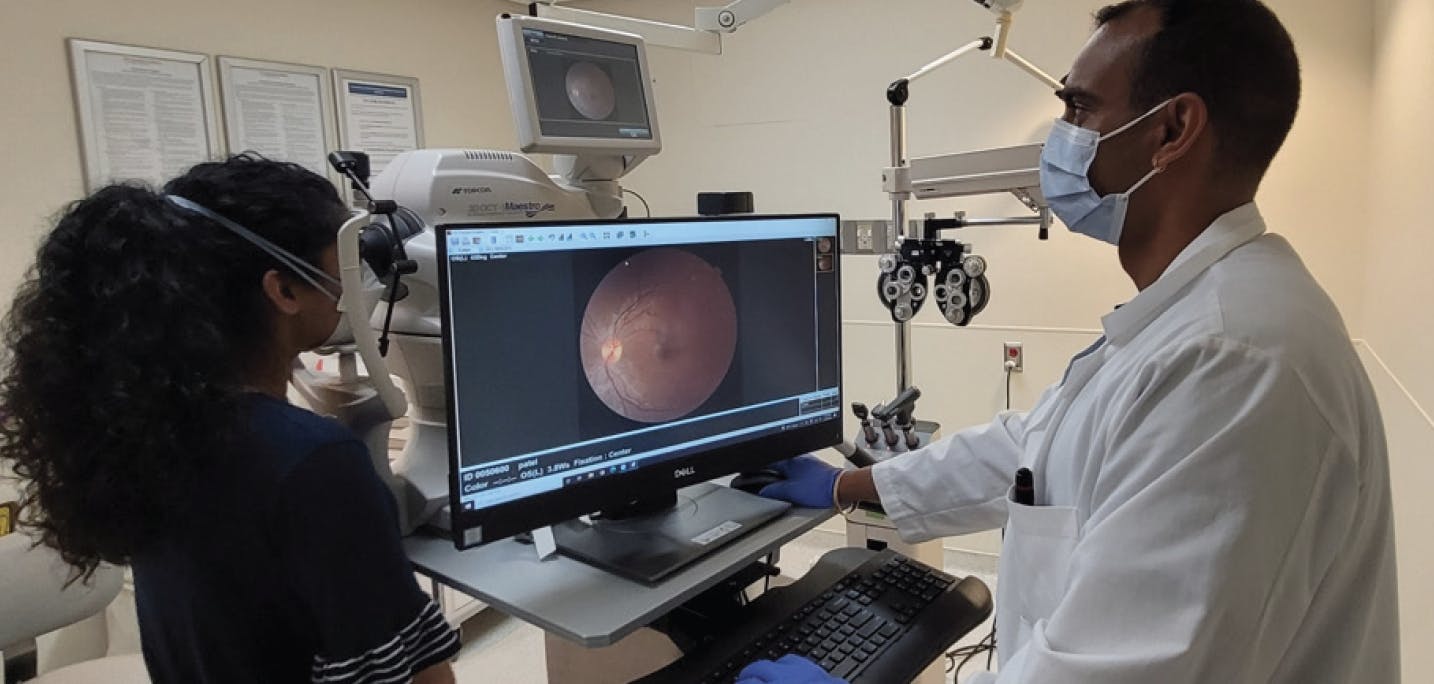
Our high-volume ED recently added a combined portable 3D OCT device and fundus camera that can perform high-quality assessments of the optic nerve and macula. This technology is actively changing our approach to managing glaucoma suspects encountered in the ED. Residents who encounter patients with increased cup-to-disc ratios, especially in conjunction with elevated IOP, now attempt to obtain an OCT scan of the optic nerve for a quantitative evaluation of the retinal nerve fiber layer (RNFL) in real time. Although we are still exploring the portable OCT unit’s general accuracy and sensitivity, the results thus far have been promising.
Our initial goal was to prove that patients with increased cup-to-disc ratios but full RNFLs as detected by the portable OCT unit had similar findings to those produced by the gold-standard OCT platform in our outpatient clinic. In these instances, both machines had 100% concordance when it was thought that a patient had no RNFL loss. Because an OCT scan without evidence of RNFL loss usually represented a low likelihood of glaucoma, this agreeability between both machines was an essential first step. We were then able to conclude that glaucoma suspects who were seen in the ED and did not have any evidence of RNFL loss on the portable OCT machine did not require urgent follow-up for glaucoma evaluation. The next step was ensuring adequate sensitivity of the portable OCT unit for RNFL loss when compared to our clinic OCT machine. Once we confirmed that the results correlated (albeit the portable OCT machine had a slight overprediction of RNFL loss), we felt comfortable using these data to guide recommendations for patients in our ED. Rather than inform patients that they may have glaucoma, we are able to counsel more strongly that they likely have glaucoma and that it is imperative that they return to the clinic for further testing.
case example
The following case report illustrates the value of real-time glaucoma screening in an ED setting.
A patient presented to our ED for a corneal abrasion. He had a questionable history of glaucoma that was diagnosed approximately 1 year prior by an outside provider. He had been lost to follow-up after transitioning from a nursing home to a homeless shelter and had not received treatment for months. On examination in our ED, his visual acuity was 20/40 OD and 20/300 OS, and IOP was 22 mm Hg OD and 21 mm Hg OS. A dilated fundus examination confirmed that the optic nerves appeared glaucomatous.
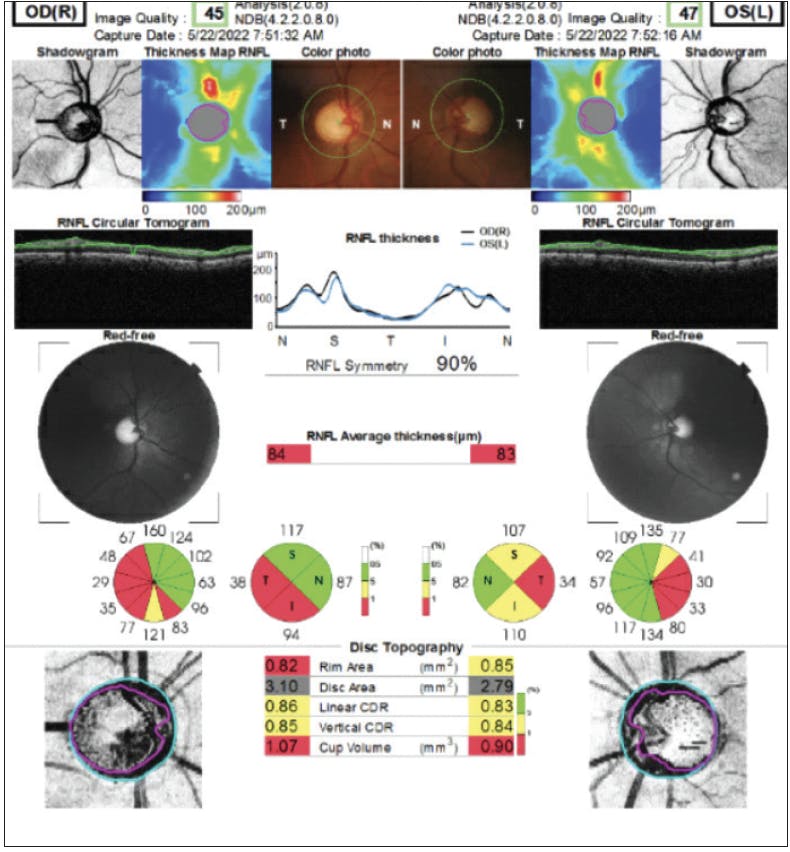
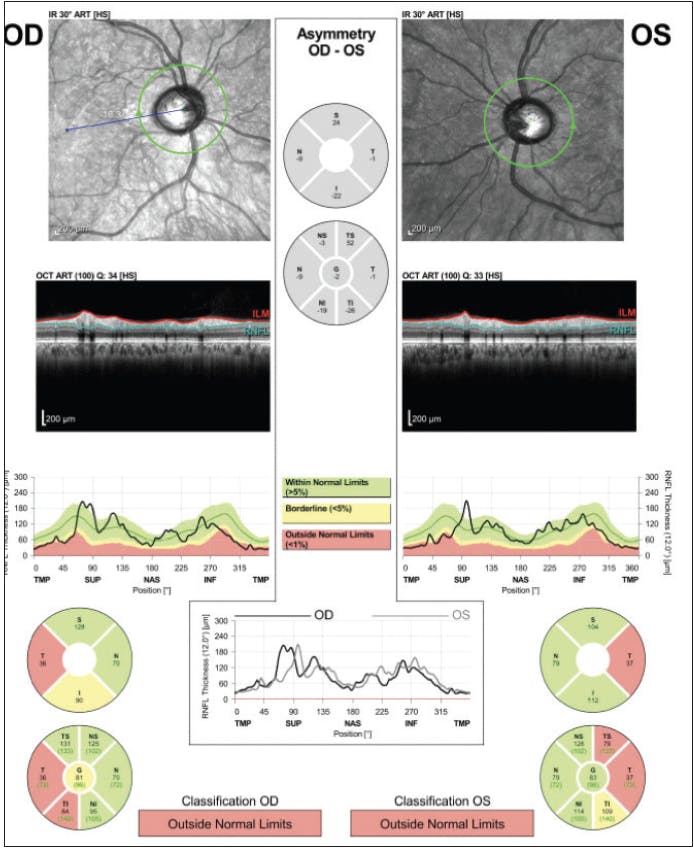
As a result, a portable OCT image was obtained, which illustrated thinning in both eyes. The patient was counseled on the extent of his glaucoma and on the importance of strict follow-up going forward. The patient followed up in our general eye clinic for his corneal abrasion and was promptly referred to our glaucoma specialist the following week. Figure 1 depicts the patient’s OCT image taken with the ED fundus camera, and Figure 2 depicts the OCT image taken in our clinic.
GOING FORWARD
After confirming the accuracy of our portable OCT machine, the next step was to determine how its use would affect our practice patterns. We now plan to have glaucoma suspects identified in the ED skip repeating OCT imaging in our clinic at their follow-up visit and instead proceed to visual field testing. After considering a patient’s IOP measurements, OCT images, and visual field tests, if there is enough reliable evidence to suggest that they may have glaucoma, then we hope to initiate treatment at that same visit.
By minimizing the number of visits before an intervention, the goal is not only to treat patients earlier but also to make them aware that they have a condition that requires frequent follow-up and lifelong treatment. The hope is to lose fewer patients to follow-up each year, thereby preventing potential glaucomatous progression.