Why I Adopted MicroPulse Technology
Dr. Mahootchi: TLT using MicroPulse technology is a unique, non-incisional, safe procedure that can delay the need for invasive and higher-risk surgical therapy. I've been using MicroPulse TLT for over 7 years. It's important for my patient base when they may have decades left to manage their glaucoma.
I find MicroPulse TLT is versatile. I can do one eye or both eyes, and I can combine it with other procedures. I use it to treat many stages and types of glaucoma. I use it for pressure that is out of control or to simply eliminate or reduce medications. It really allows me a lot of choices, and because the CPT code is well-established, it’s consistently reimbursed. Patients recover very quickly and are pleased with their experience and results.
Dr. Ghoghawala: I agree with Dr. Mahootchi. TLT with MicroPulse technology is very versatile, and the insurance coverage is universal. In 2018, I incorporated MicroPulse into my practice. It’s been a quick and easy tool in my glaucoma toolbox. At the point when I used to think, "Oh man, I have to do incisional surgery now,” I can defer that surgery for several years using MicroPulse TLT and repeat treatment as needed.
IOP Maintained Off Meds Six Years Post Single MicroPulse TLT
Case study by Ahad Mahootchi, MD
A 71-year-old Caucasian female presented in 2015 with progressive optic nerve cupping, and her VF had progressive loss. Her IOP was in the mid to high teens. She had glaucoma with contraindications or adverse reactions to timolol, latanoprost and brimonidine. Argon laser trabeculoplasty was unsuccessful, and dorzolamide was the only drop she could tolerate.
I performed TLT using MicroPulse OU and stopped her dorzolamide. Her IOP was 11-14 off medication for the next six years without further VF loss. In the summer of 2022, her IOP increased to 21, and MicroPulse TLT was repeated OU. She now has IOP in the mid-teens on no medication OD and dorzolamide only OS. She is thrilled.
Benefits of TLT with MicroPulse Technology
Dr. Ghoghawala:
Lessening the burden of glaucoma
The lifetime burden of disease control for glaucoma is so challenging for the patient. Frequently, when a patient is on drops, their IOP may suddenly escalate. You can quickly mount a series of drugs to reduce IOP, but often the drops, even in combination, will fail to achieve the target pressure. A patient previously stable on drops may also suddenly develop intolerance to a medication. In these situations, you’re left to find other options in your glaucoma toolbox. I’ve found MicroPulse TLT provides an excellent and easy-to-use intervention to help people manage their IOP without a lot of risk.
In my experience, patients return to normal activities the following day, with no lifestyle changes and little risk of complications postop or pressures that are too high or too low. Also, there isn’t a high risk of vision loss. MicroPulse TLT has a very favorable safety profile, and the worst case that I've experienced is a lack of IOP reduction. I check patients POD1 and then follow-up after one to three weeks.
Versatile for a variety of glaucoma types and severities
I use MicroPulse TLT for any stage of glaucoma: mild, moderate, or severe. For me, the initiative to use MicroPulse TLT is mostly associated with a loss of IOP control.
I find the biggest clinical advantage is that I can delay or avoid a higher-risk incisional surgery with MicroPulse TLT. Additionally, I use it for patients who have had failed incisional glaucoma surgery or when a successful incisional surgery IOP control wanes over time. It’s titratable and repeatable, potentially delivering years of non-incisional IOP control.
I use MicroPulse TLT for the treatment of glaucoma on patients with conditions such as POAG, closed-angle, neovascular, and pseudoexfoliative glaucoma with consistent results. In my experience, IOP reduction is about 30% or more in moderate, pre-incisional patients.
I found MicroPulse TLT easy to incorporate into my workflow. If there’s a sudden urgency for IOP reduction, I can immediately use MicroPulse TLT to save vision. I can add the patient to my surgery schedule without stress, because it’s about a ten-minute procedure. MicroPulse TLT allows me to keep patients in my practice rather than sending them to a specialist.
IOP Quickly Reduced in Patient with Mild POAG
Case study by Shahed Y. Ghoghawala, MD
A 74 year-old-woman with a history of mild POAG presented in July 2021 with a VF OS showing mild superior arcuate effect with mean deviation -5 dB. On Lumigan, Cosopt PF, and brimonidine, her IOP OS was 17, and her pachymetry OS was 563 μm. She had been treated with SLT OU in 2016 and OS in 2019.
She returned four months later with IOP OS of 34 on drops. I stopped Lumigan and started her on Vyzulta. She missed a follow-up due to cancer treatment, then returned in April of 2022 with IOP OS of 31, while still on the three drops. I performed TLT with MicroPulse in June, applying six 10-second sweeps per quadrant with 2500 mW using the revised MicroPulse P3 probe.
On Vyzulta, Cosopt PF, and brimonidine, her IOP OS at POD1 was 12, followed by 22 at POM1 and 21 at POM2. The patient is happy. Given the thick pachymetry, the IOP is relatively tolerable. If it elevates or the VF worsens, I will consider repeating MicroPulse TLT.
Dr. Mahootchi:
Patients maintain lifestyle
In my experience, there is no decrease in vision after MicroPulse TLT, so patients don’t have to adjust their lifestyle. They can typically return to work or other activities the following day. I often treat bilaterally.
Because MicroPulse is non-incisional, the patient isn't risking infection and doesn’t have to take an antibiotic. I recommend discontinuation of blood thinner prior to MicroPulse TLT if it’s safe, but this isn't required. MicroPulse TLT is easy for the patient, and I have many grateful patients after treatment.
As someone who also does aesthetic surgery, or lid surgery, I am very aware of the dark circles patients get under their eyes from the prostaglandin analogs. Many patients know that’s a side effect, and they don’t want to use the drops. I don’t see much benefit in going past two drops on anybody, and I consider MicroPulse TLT earlier than most people.
A major advantage to the procedure, both for the patient and the clinic, is the ease of follow up. After treatment, I don’t see patients again for about five weeks unless they had terrible VF prior to treatment; and they stop one medication at one week and steroids at two weeks. In three weeks, about 80% of people who are going to respond have responded. In five weeks, 100% of the ones who are going to respond are there. Of course, good professional judgment is needed about how severe a case is at initial presentation. If it’s really severe you might want to see them in two weeks, and you may also not want to stop the glaucoma medicines.
For me, MicroPulse TLT takes three or four minutes of laser time in the OR, and then I typically see the patient for just one post-op visit. There aren’t many glaucoma procedures that only have a single post-op visit.
Clinical benefits without limiting future interventions
In my experience, IOP reduction ranges from 15-25% in moderate, pre-incisional patients and from 25-40% reduction from highest premedicated IOP. I use MicroPulse TLT for the treatment of glaucoma on patients with conditions such as POAG, closed-angle, and neovascular glaucoma with consistent results; and before, after, and combined with other therapies. Occasionally, I combine it with cataract surgery, and I’ve had good results combining MicroPulse TLT with goniotomy.
Having depended on MicroPulse TLT for over 7 years, I’ve found it's repeatable and doesn't limit future treatments.
Economic Benefits
Dr. Mahootchi: TLT using MicroPulse is a quick procedure, so it's easy to fit into my workflow. I can perform five or six procedures in an hour.
This minimal chair time has economic benefits, as does the easy reimbursement for this repeatable procedure. Owning my ASC, I see additional financial reimbursement benefits from the procedure’s facility fee.
MicroPulse® Technology
MicroPulse technology chops a continuous-wave laser beam into short bursts, allowing the tissue to cool between each application. MicroPulse technology, when used to deliver transscleral laser therapy, allows the physician to have greater thermal control than traditional continuous-wave transscleral cyclophotocoagulation, which lowers the risk of complications and allows its use earlier in the management of glaucoma.1
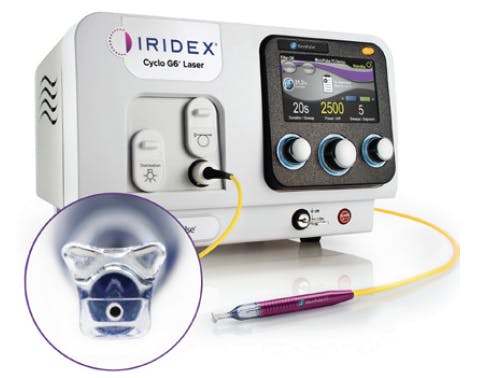
Cyclo G6® Laser and revised MicroPulse P3® Delivery Device
TLT with MicoPulse technology is performed with the Iridex Cyclo G6® Laser and the revised MicroPulse P3® Delivery Device — a sterile, single-use handheld probe.
Typical Starting Parameters & Treatment Techniques for TLT using the Cyclo G6® Laser in MicroPulse Mode and the MicroPulse P3® Probe Based on Guidance from the MicroPulse TLT Delphi Panel2
Typical Starting Parameters
- Power: 2500 mW
- MicroPulse duty cycle: 31.3%
- Sweep velocity: 4 sweeps of 20 seconds each per hemisphere, or 4 sweeps of 10 seconds each per quadrant
- Escalating dosing can be accomplished by increasing sweeps or slowing the sweep speed.
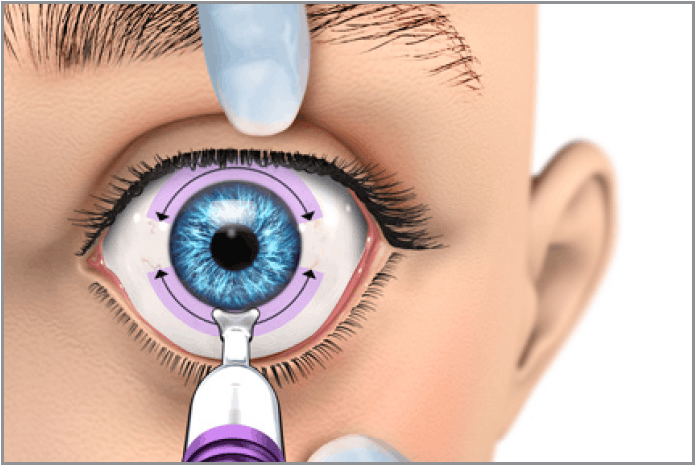
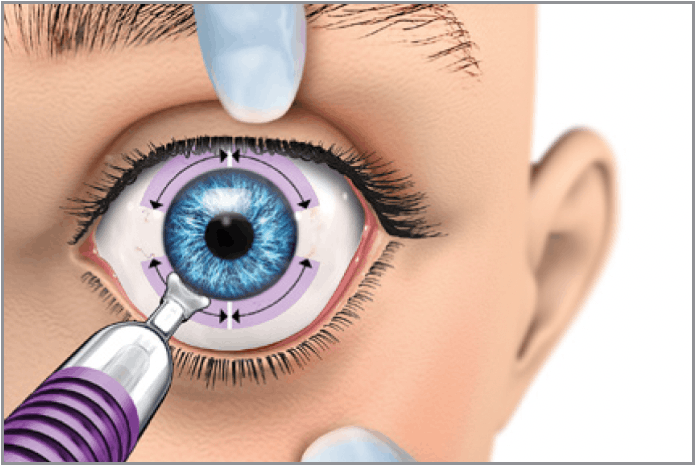
Treatment Techniques
- 1. Always apply an optically neutral coupling agent to the eye for more effective power transmission.
- 2. Orient the probe with the wide, curved side (bunny ears) aligned at the surgical limbus to ensure consistent treatment application.
- 3. Keep the scleral-matching curvature flat and flush with the sclera throughout the procedure. It is important to not rock the probe and to keep full contact throughout the procedure.
- 4. Sweep the probe in a back-and-forth manner over a segment, i.e., hemisphere or quadrant.
- 5. When treating, avoid the 3 and 9 o’clock positions; avascular areas, including over blebs or tubes; and patches of thin sclera.
- 6. Post-op pain and inflammation are usually minimal; and therefore, cycloplegia or pain medication is rarely used. Topical NSAIDS and/or topical steroids with dosage for 1 to 4 weeks may be used for most cases. Except for acetazolamide, which is often discontinued immediately after treatment, topical hypotensive medications are maintained until the response to MicroPulse TLT permits tapering.
Optimizing My Treatment Techniques
Dr. Ghoghawala
I treat quadrants rather than hemispheres, because I find it more ergonomic. With a quadrant approach, I’m able to more easily maintain good positioning on the globe and along the limbus, and have better control of the micro movements per second to maintain a slow sweep.
I do ten seconds per sweep, and five to seven sweeps per quadrant. The duration of a sweep can go up to 15 seconds. For me, the choices within these ranges are dependent on the patient’s preoperative pressure, their pigmentation status, and whether it’s a repeat treatment.
I use between 2500 mW and 2600 mW of power with a 31.3% duty cycle. So the parameters that I actively adjust are: the number of sweeps, the sweep speed, and the power of the laser.
Dr. Mahootchi
If a patient has prominent eyes, I sweep the whole hemisphere. If not, I will do quadrants. I always treat 300°, omitting the 3 and 9 o’clock meridians. I agree with the Delphi panel’s recommendations of starting with a 20-second pass and 4 sweeps per hemisphere.
I use 2500 mW of power. I don’t increase the power. I think the most important thing is getting consistent speed that is not too fast or too slow. It’s also important to make sure that the MicroPulse P3 probe is placed on the limbus, not too far anteriorly or posteriorly. When you’re careful about these parameters, the treatment works really well.
Flatten the Learning Curve
Dr. Ghoghawala: Sweep speed and number of passes are critical. Getting that right is the strongest predictor for successful outcomes and durability. To achieve top results right out of the gate, I suggest the following:
- Talk with your Iridex representative for guidance, and attend the Iridex Academy. Although I’ve used MicroPulse TLT for 4 years, I attended the Academy to learn the newest treatment recommendations, latest clinical evidence, and pearls to optimize clinical outcomes. It's an hour-long live webinar instructed by a glaucoma specialist well-experienced with MicroPulse TLT. I found the Academy helpful and learned how to safely increase the number of sweeps per quadrant and the power of the laser.
- Slow down. This is counter to normal surgical intuition, which is to go as fast as you can.
Dr. Mahootchi adds:
- Videotape yourself. The procedure looks extremely simple, but if you have one of your colleagues hold a phone and make a little movie, you’ll be your best critic about how well you are holding the probe perpendicular and maintaining good positioning. You’ll see your speed – and see yourself cheating.
- Don’t confuse your MicroPulse TLT results by using a steroid drop that is going to raise your pressure. I just use a drop such as loteprednol for a short period of time.
- At the beginning, I found it helpful to pick easy cases such as patients with eyes that are not very deep set. The simpler I made it, the more I could focus on the technique. In a short time, I was able to apply that technique to other patients.
Shahed Y. Ghoghawala, MD is a comprehensive ophthalmologist who performs glaucoma, cataract, cornea and eyelid surgery.
Contact: shawala@gmail.com
Ahad Mahootchi, MD is a comprehensive ophthalmologist who performs glaucoma, cataract and eyelid surgery.
Contact: am@seebetterflorida.com
1. Aquino MC, et al: Micropulse versus continuous wave transscleral diode cyclophotocoagulation inrefractory glaucoma: A Randomized Exploratory Study. Clin Exp Ophthalmol 2015.
2. Grippo T, et al: Micropulse® transscleral laser therapy for the treatment of glaucoma: Guidelines from an international delphi panel. Patient selection & best practices. White paper 2022:1-8.
The MicroPulse P3 Probe indications include, but are not limited to, transscleral cyclophotocoagulation for the treatment of primary open-angle glaucoma, closed-angle glaucoma, and refractory glaucoma. Iridex, the Iridex logo, MicroPulse, Cyclo G6 and MicroPulse P3 are registered trademarks of Iridex Corporation. All other trademarks are the property of their respective owners. U.S. Patents 7,771,417; 8,945,103
Iridex | 1212 Terra Bella Avenue | Mountain View, CA 94043 | 800.388.4747 (U.S. Inquiries) www.info@iridex.com
(U.S. & Int’l Inquiries) | www.iridex.com - LT0760 12.22