As defined by the US Centers for Disease Control and Prevention, health disparities are preventable differences in the burden of disease, injury, or opportunities to achieve optimal health that are experienced by socially disadvantaged populations. Overall, health care accounts for less than 20% of a patient’s health; the other 80% is made up of socioeconomic factors (40%), physical environment (10%), and health behaviors (30%).1 Health disparities are driven by social and economic inequities, including economic stability, food, education, and the health care system itself, and they affect the health and well-being of our patients with glaucoma.
DISPARITIES IN GLAUCOMA AND GLAUCOMA CARE
Prevalence. Glaucoma is six times more prevalent and begins about 10 years earlier in Black patients versus White patients, as shown in the Baltimore Eye Survey.2 A recent investigation by Kang et al3 showed that Black patients are six times more likely to have advanced visual field loss (for more on these findings, see pg 58). The Los Angeles Latino Eye Study (LALES)4 showed a high proportion of previously undiagnosed glaucoma (75%) among the study’s participants, and Hispanic men are predicted to be the largest demographic group with glaucoma by 2050. Additionally, lower socioeconomic status is associated with a higher prevalence of glaucoma and more advanced disease.
The differences in glaucoma prevalence are multifactorial.5-8 Rates of glaucoma surgery vary among races; for example, fewer argon laser trabeculoplasties and trabeculectomies are performed in Black Medicare beneficiaries compared with White Medicare beneficiaries. Regional differences in the diagnosis of primary open-angle glaucoma and angle-closure glaucoma among Medicare beneficiaries also exist (both over- and underdiagnosis).
Care utilization. Disparities in follow-up care exist on both the patient side and the provider side. On the patient side, several factors are independently associated with inconsistent follow-up, including Black race, Latino ethnicity, unfamiliarity with the necessary treatment duration, lack of knowledge about the permanency of glaucoma-induced vision loss, and the perception that it is not important to attend all follow-up visits.9 Many of these factors relate to patient communication.
On the physician side, several factors are associated with decreased monitoring of glaucoma.10 A study by Elam et al11 showed that patients with Medicaid were 234% more likely not to receive any glaucoma testing in the 15 months after initial diagnosis compared to patients with commercial health insurance. Both White patients and Black patients with Medicaid had higher odds of no testing than patients with commercial health insurance—198% higher odds among White patients and 291% higher odds among Black patients.11 Additionally, wide regional variability exists in visual field testing, fundus photography, and other ocular imaging, with some communities demonstrating less than 60% of patients undergoing appropriate testing.12
Medication adherence, one of the greatest challenges in glaucoma care, is affected by several factors, including social determinants of health, health literacy, patient forgetfulness, and difficulty with medication administration or scheduling.13,14 Black race was shown to be negatively associated with correct daily eye drop usage and with whether the patient used of 80% or more of prescribed doses.15 Additionally, non-Hispanic African-American patients and Hispanic patients are more likely to report an inability to afford their glaucoma medications than their White counterparts.16 Unfortunately, a recent study showed that adherence to ocular hypotensive medications has worsened during the COVID-19 pandemic, and rates of adherence were significantly worse in Black patients than in White patients.17
Disparities in surgical care are also affected by several factors, including age, region, provider type, and distance from provider. Rates of surgery have been reported to be higher among Black patients, potentially due to underdiagnosis, later presentation, or both.18 Higher rates of surgical failure have also been reported among Black patients compared to White patients.19
STEPS TO ADDRESS DISPARITIES
Three key steps to eliminating health disparities have been proposed.20 The first step is to detect health disparities, which entails defining the disparities, identifying vulnerable populations, and measuring the disparities in these vulnerable populations. The second step is to understand health disparities, which means identifying the determinants of health at the levels of the patient/individual, provider, clinical encounter, and health care system. The third step is to reduce health disparities, which involves developing interventions to address the disparities, evaluating these interventions, translating and disseminating them, and then changing policy.
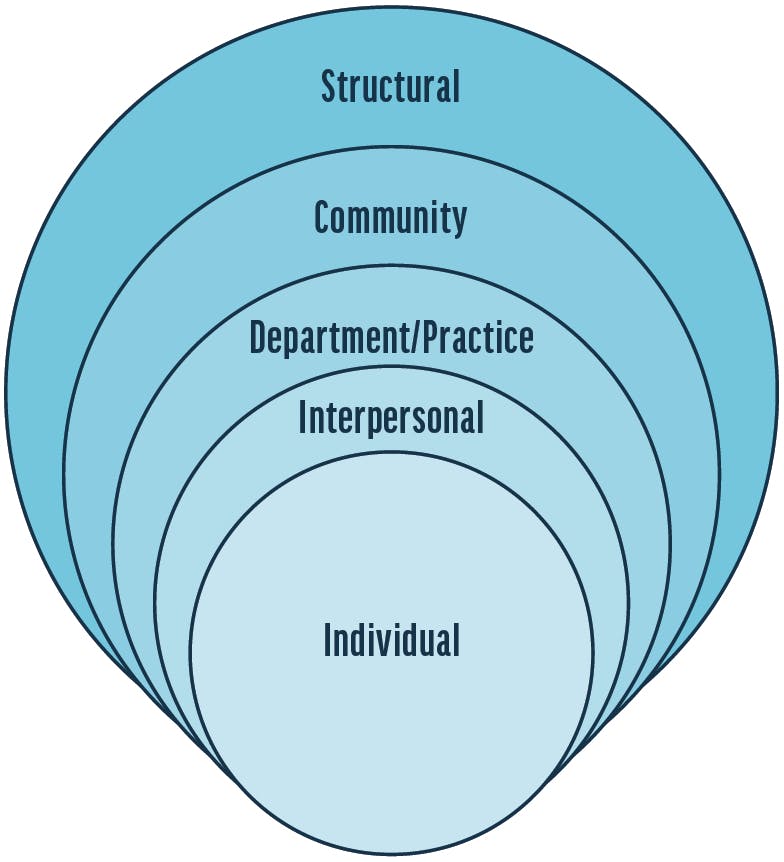
The process of reducing disparities is complex, and an ecological framework is helpful in outlining the different levels at which this work can be done (Figure). At the individual level, we can provide and participate in education on implicit bias and cultural humility. At the interpersonal level, we can listen to and learn from patients. At the department or practice level, we can ensure that resources are available to address social determinants of health. At the community level, we can better utilize community-based participatory research. At the structural level, we can prioritize advocacy and policy on local, state, and national scales.
Gelb et al21 described three physician attitudes toward medication adherence among patients with glaucoma. As they noted, the reactives are less proactive about discussing adherence with their patients. The skeptics are less likely to believe they can change their patients’ adherence even if discussed. The idealists—which represent only 16% of the physician population surveyed—actually believe that they can improve adherence and consistently address it with patients. Regardless of our individual mindsets, we can all strive to provide more patient-centered communication, using open-ended questions (the ask-tell-ask model). Ultimately, physician behaviors matter, so we must strive to ensure equitable practices in testing and follow-up care.
Several community-based participatory research efforts are being undertaken. In particular, Angela Elam, MD, has launched the Community-Based Treatment for Glaucoma Program (ComBAT) to address the public health gap between guidelines for detecting and treating glaucoma and studies that document applications of these guidelines. Paula Anne Newman-Casey, MD, has initiated the Screening and Intervention for Glaucoma and Eye Health through Telemedicine (SIGHT) program, a telemedicine-based glaucoma screening program in trusted community clinics. Elevating the voices of the communities we serve is an integral step on the path to achieving health equity.
Ask-Tell-Ask Model
A collaborative communication method that includes asking patients open-ended questions and assessing their knowledge before sharing information
CONCLUSION
Most physicians are comfortable recognizing that health disparities exist. It can be harder, however, to acknowledge the systemic racism, xenophobia, and other belief structures that perpetuate these differences. As we look to address the disparities in glaucoma and glaucoma care, it may be helpful to keep in mind the differences between inequality, equality, equity, and justice. Inequality is unequal access to resources. Equality is an even distribution of tools and assistance but not universal access to them. Equity means having custom tools to address inequality. Justice means fixing the system to offer equal access to both tools and opportunities. Let us collectively strive for justice as we work to make health disparities in glaucoma a problem of the past.
1. Going beyond clinical walls: solving complex problems. Institute for Clinical Systems Improvement. 2014. Accessed January 26, 2023. www.icsi.org/beyondclinicalwalls
2. Tielsch JM, Sommer A, Katz J, et al. Racial variations in the prevalence of primary open-angle glaucoma. The Baltimore Eye Survey. JAMA. 1991;266:369-374.
3. Kang JH, Wang M, Frueh L, et al. Cohort study of race/ethnicity and incident primary open-angle glaucoma characterized by autonomously determined visual field loss patterns. Transl Vis Sci Technol. 2022;11(7):21.
4. Varma R, Ying-Lai M, Francis B. Prevalence of open-angle glaucoma and ocular hypertension in Latinos. The Los Angeles Latino Eye Study. Ophthalmology. 2004;111:1439-1448.
5. Varma R, Tielsch JM, Quigley HA, et al. Race-, age-, gender-, and refractive error-related differences in the normal optic disc. Arch Ophthalmol. 1994;112(8):1068-1076.
6. Wang W, He M, Li Z, Huang W. Epidemiological variations and trends in health burden of glaucoma worldwide. Acta Ophthalmol. 2019;97(3):e349-e355.
7. Devgan U, Yu F, Kim E, Coleman AL. Surgical undertreatment of glaucoma in black beneficiaries of Medicare. Arch Ophthalmol. 2000;118(2):253-256.
8. Cassard SD, Quigley HA, Gower EW, Friedman DS, Ramulu PY, Jampel HD. Regional variations and trends in the prevalence of diagnosed glaucoma in the Medicare population. Ophthalmology. 2012;119(7):1342-1351.
9. Murakami Y, Lee BW, Duncan M, et al. Racial and ethnic disparities in adherence to glaucoma follow-up visits in a county hospital. Arch Ophthalmol. 2011;129(7):872-878.
10. Elam AR, Blachley TS, Stein JD. Geographic variation in the use of diagnostic testing of patients with newly diagnosed open-angle glaucoma. Ophthalmology. 2016;123(3):522-531.
11. Elam AR, Andrews C, Musch DC, Lee PP, Stein JD. Large disparities in receipt of glaucoma care between enrollees in Medicaid and those with commercial health insurance. Ophthalmology. 2017;124(10):1442-1448.
12. Stein JD, Talwar N, Laverne AM, Nan B, Lichter PR. Racial disparities in the use of ancillary testing to evaluate individuals with open-angle glaucoma. Arch Ophthalmol. 2012;130(12):1579-1588.
13. Juzych MS, Randhawa S, Shukairy A, Kaushal P, Gupta A, Shalauta N. Functional health literacy in patients with glaucoma in urban settings. Arch Ophthalmol. 2008;126(5):718-724.
14. Newman-Casey PA, Robin AL, Blachley T, et al. The most common barriers to glaucoma medication adherence: a cross-sectional survey. Ophthalmology. 2015;122(7):1308-1316.
15. Sleath B, Blalock SJ, Carpenter DM, et al. Ophthalmologist-patient communication, self-efficacy, and glaucoma medication adherence. Ophthalmology. 2015;122(4):748-754.
16. Delavar A, Radha Saseendrakumar B, Weinreb RN, Baxter SL. Racial and ethnic disparities in cost-related barriers to medication adherence among patients with glaucoma enrolled in the National Institutes of Health All of Us research program. JAMA Ophthalmol. 2022;140(4):354-361.
17. Racette L, Abu SL, Poleon S, et al. The impact of the coronavirus disease 2019 pandemic on adherence to ocular hypotensive medication in patients with primary open-angle glaucoma. Ophthalmology. 2022;129(3):258-266.
18. Ostermann J, Sloan FA, Herndon L, Lee PP. Racial differences in glaucoma care: the longitudinal pattern of care. Arch Ophthalmol. 2005;123(12):1693-1698.
19. Ederer F, Gaasterland DA, Dally LG, et al; AGIS Investigators. The Advanced Glaucoma Intervention Study (AGIS): 13. Comparison of treatment outcomes within race: 10-year results. Ophthalmology. 2004;111(4):651-664.
20. Kilbourne AM, Switzer G, Hyman K, Crowley-Matoka M, Fine MJ. Advancing health disparities research within the health care system: a conceptual framework. Am J Public Health. 2006;96(12):2113-2121.
21. Gelb L, Friedman DS, Quigley HA, et al. Physician beliefs and behaviors related to glaucoma treatment adherence: the Glaucoma Adherence and Persistency Study. J Glaucoma. 2008;17(8):690-698.