Black individuals are undoubtedly at higher risk of developing primary open-angle glaucoma (POAG)1 and going blind from the condition compared with individuals of other races.2 Anecdotal clinical experience would suggest that Black patients develop glaucoma sooner than non-Hispanic White patients; however, evidence to support this claim is lacking.
In a study published in 2022, Black health professionals were found to be six times more likely to have advanced functional glaucomatous damage compared with non-Hispanic White health professionals when presenting with new-onset POAG.3 This article takes a closer look at the study’s findings and reviews strategies for averting vision loss in this high-risk population.
STUDY IN DETAIL
Along with our coinvestigators, we identified a cohort of US-based female nurses and male health professionals who were at risk for developing POAG and were observed from 1980. Eligible participants reported being under ophthalmic care and were free of glaucoma at baseline. Every 2 years, we asked participants to report any diseases they developed, including glaucoma, until 2018 or 2019.
All self-reports of glaucoma were evaluated through a systematic review of relevant clinical data, which were received thanks in large part to patients’ eye care providers. In our analysis, we included only medical records that confirmed POAG, and we excluded patients with secondary causes for elevated IOP or optic nerve disease. We required all cases of POAG to have reproducible visual field loss on reliable tests, regardless of IOP level or cup-to-disc ratio. During follow-up, we accrued 1,957 patients (2,564 eyes) with incident POAG who had visual field loss on Humphrey Visual Field Analyzer (Carl Zeiss Meditec) testing.
The Humphrey visual field printout provides summary indices with information on the overall integrity of the island of vision; however, it provides little insight into the regional nature of glaucomatous vision loss. We extracted the total threshold (dB) data on visual fields for each affected eye and conducted archetype analysis. Archetype analysis is a form of AI in which any data point in a cluster is defined by the points that lie on the edges of the dataspace; this method allows for the determination of the regional pattern of visual field loss. We have demonstrated the clinical utility of archetype analysis in the assessment of both glaucomatous4 and nonglaucomatous visual field loss.5
The spectrum of visual field patterns recognized by archetype analysis consisted of one normal pattern (AT1), two nonglaucomatous loss patterns (AT4 and AT9), and 11 glaucomatous loss patterns (Figure). The glaucomatous patterns were further classified into five peripheral loss patterns (ATs 2, 3, 5, 6, and 7), one superior paracentral loss pattern (AT11), one inferior paracentral loss pattern (AT13), and four advanced loss patterns (ATs 8, 10, 12, and 14). For each visual field, archetype analysis assigns weighting coefficients for the component patterns that are present such that a dominant archetype could be assigned to each incident case of POAG.
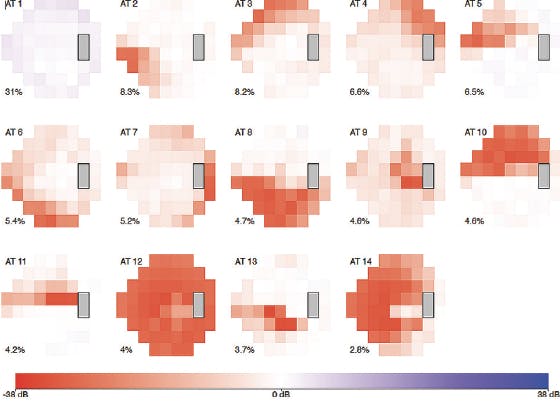
Figure. The 14-composite visual field loss patterns referred to as archetypes in cases of incident POAG (n = 2,564 eyes), depicted in right-eye format. For each pattern, the archetype number appears at the top left, and the average decomposition weight percentage appears at the bottom left. The heat map refers to relative retinal sensitivity compared to age-matched controls on the total deviation plot in decibels. Reprinted with permission from the Association for Research in Vision and Ophthalmology.
RESULTS
Our study was designed to capture the earliest visual field defect that defined POAG, a disease with generally slow progression. Although all participants were health professionals with access to medical care, we found that 339 of 2,564 eyes had dominant weighting coefficients for one of the advanced loss patterns (13.2%), which was remarkable and speaks to the insidious nature of POAG. Black patients made up only 1.4% of the study cohort; nonetheless, they were at a nearly twofold increased risk of developing peripheral loss patterns, and they had more than a sixfold increased risk of developing advanced loss compared with non-Hispanic White patients. These results were from our multivariable modeling, in which we controlled for a range of potential confounders, such as socioeconomic status, number of eye exams, and diet.
We used a statistical method (the Firth penalized likelihood method)6 that produces accurate effect estimates for the much smaller sample size among minority participants. Then we applied a statistical test (the global contrast test)7 that compared the magnitude of the risk estimates for early and advanced loss patterns in Black patients versus non-Hispanic White patients. This test unequivocally showed that the difference in estimates (sixfold vs twofold for Black patients vs non-Hispanic White patients) was highly statistically significant (P = .0002).
Overall, Black patients with POAG were younger at diagnosis than non-Hispanic White patients (64.5 ±8.4 years vs 67.0 ±9.4 years) and had worse mean deviations (-7.6 ±6.6 dB vs -5.0 ±4.6 dB). These differences were not dramatic but were consistent with our main finding. Our ability to perform comprehensive IOP profiling on our cohort was incomplete, but maximum IOP in the eye with the most compromised visual field loss before or at diagnosis was slightly higher in Black patients (23.2 ±5.2 mm Hg) than in non-Hispanic White patients (22.8 ±5.0 mm Hg).
We also studied Asian and Hispanic White patients who made up approximately 1% of each cohort. Asian patients had a 1.85-fold increased risk of the early glaucoma patterns versus non-Hispanic White patients, but they did not have a statistically increased risk for advanced loss patterns. Hispanic White patients were at increased risk for the superior paracentral loss pattern compared with non-Hispanic White patients; the number of cases in this category was small, however, and the confidence interval was wide (odds ratio = 4.6; 95% confidence interval, 2.0–12.10).
Black health professionals presented with more advanced visual field loss than non-Hispanic White health professionals for myriad potential reasons. These include previously unrecognized environmental, genetic, and social factors as well as the physiological stress related to repeated marginalization and discrimination, a concept known as weathering. Regardless, there is an urgent need to search for glaucoma in Black patients at an earlier age than non-Hispanic White patients.8 We realize that this statement is at odds with the recent US Preventive Services Task Force conclusion that direct evidence on glaucoma screening is limited,9 and we recognize that our study was not a screening study. Nevertheless, one study that screened for glaucoma in younger Black patients suggested that the burden of glaucoma among Black individuals aged 20 to 40 years is considerable.10
CONCLUSION
If glaucoma develops earlier in Black patients than in non-Hispanic White patients, it stands to reason that Black patients may be more likely to experience blindness because current treatment slows but does not halt the disease. Given that both family history and Black race are risk factors for POAG, we believe that ophthalmologists who treat middle-aged Black patients with advanced POAG should communicate the elevated risk and highly recommend glaucoma screening for their children aged 20 to 40 years. This seems like a logical step toward earlier diagnosis and treatment that may help to avert advanced vision loss in this high-risk population.
Authors' note: The research discussed in this article was supported by grants from the National Eye Institute, The Glaucoma Foundation, and Research to Prevent Blindness (New York City).
1. Tielsch JM, Sommer A, Katz J, Royall RM, Quigley HA, Javitt J. Racial variations in the prevalence of primary open-angle glaucoma. The Baltimore Eye Survey. JAMA. 1991;266(3):369-374.
2. Sommer A, Tielsch JM, Katz J, et al. Racial differences in the cause-specific prevalence of blindness in east Baltimore. N Engl J Med. 1991;325(20):1412-1417.
3. Kang JH, Wang M, Frueh L, et al. Cohort study of race/ethnicity and incident primary open-angle glaucoma characterized by autonomously determined visual field loss patterns. Transl Vis Sci Technol. 2022;11(7):21.
4. Wang M, Shen LQ, Pasquale LR, et al. An artificial intelligence approach to detect visual field progression in glaucoma based on spatial pattern analysis. Invest Ophthalmol Vis Sci. 2019;60(1):365-375.
5. Doshi H, Solli E, Elze T, Pasquale LR, Wall M, Kupersmith MJ. Unsupervised machine learning shows change in visual field loss in the Idiopathic Intracranial Hypertension Treatment Trial. Ophthalmology. 2022;129(8):903-911.
6. Greenland S, Mansournia MA. Penalization, bias reduction, and default priors in logistic and related categorical and survival regressions. Stat Med. 2015;34(23):3133-3143.
7. Wang M, Spiegelman D, Kuchiba A, et al. Statistical methods for studying disease subtype heterogeneity. Stat Med. 2016;35(5):782-800.
8. Greenidge KC, Dweck M. Glaucoma in the black population: a problem of blindness. J Natl Med Assoc. 1988;80(12):1305-1309.
9. Chou R, Selph S, Blazina I, et al. Screening for glaucoma in adults: updated evidence report and systematic review for the US Preventive Services Task Force. JAMA. 2022;327(20):1998-2012.
10. Bokman CL, Pasquale LR, Parrish RK 2nd, Lee RK. Glaucoma screening in the Haitian Afro-Caribbean population of South Florida. PLoS One. 2014;9(12):e115942.