The United Nations established strategies to reduce greenhouse gas (GHG) emissions, but human-induced global warming continues to threaten global health.1 The health care sector accounts for 4.4% of global emissions.2 In the United States, the health care sector’s climate footprint amounts to about 10% of total GHG emissions.3
As surgical technique and instrumentation evolve to become more efficient, the environmental burden may grow.4 The carbon footprint from the OR alone is an estimated 3,000 to 5,000 tons of CO2 per year.5 The amount of medical waste, moreover, increased dramatically during the COVID-19 pandemic owing to the increased use of personal protective equipment.6
Ophthalmology is no exception to these trends.7 The popularity of single-use equipment and devices as a means of lowering the risk of infection and reducing postoperative complications has produced an explosion of medical waste. Growing awareness of the problem is spurring initiatives to reuse or resterilize as much equipment and medication as possible.8
SURGICAL WASTE TODAY
Surgical waste can accumulate quickly and is often collected before the surgical day concludes (Figure A).
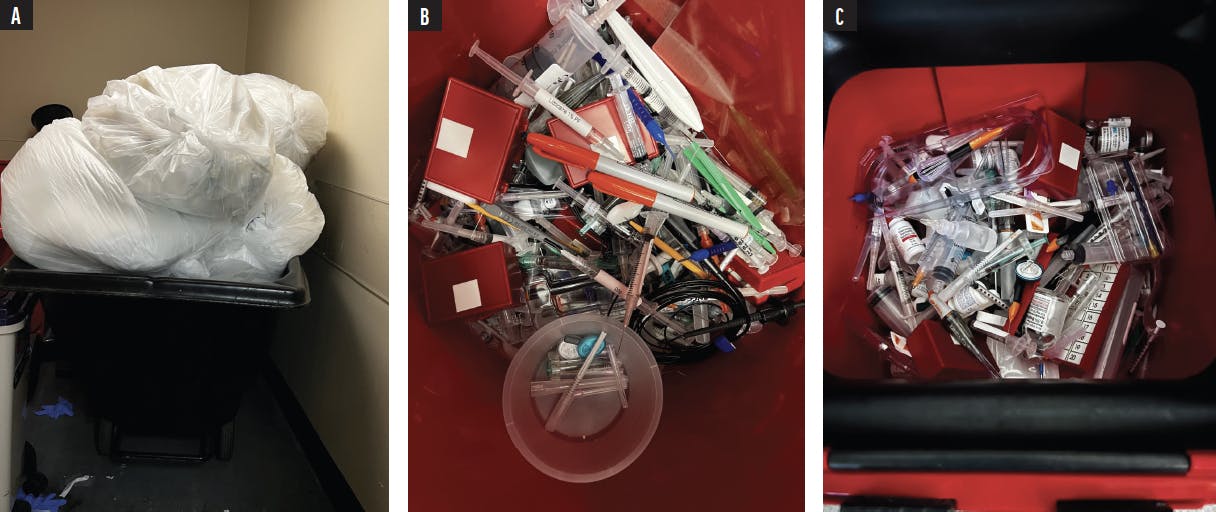
Figure. Surgical waste accruing before noon on a routine surgery day (A). Marking pens, bottles of balanced salt solution, needle containers, and unfinished drug bottles are common objects in ophthalmology ORs (B, C).
Some medical equipment, including syringes, needles, tips, and empty IOL cartridges, is designed for single use. Gonioscopy lenses and applanation tonometer prisms used to be reusable, but nearly all of those currently manufactured are disposable, increasing plastic waste and health care costs.9 Some disposable gonioscopy lenses have been investigated to see if they cause any deleterious effects or influence patient outcomes when compared to those that are reusable.10 It was concluded that there are no differences in efficacy in reducing IOP when disposable or reusable lenses are used, suggesting that reusable lenses may be an environmentally friendly option.
Many commonly used tools can be reused but are not. For example, marking pens may be used repeatedly but are often disposed of after making a single mark (Figure B). Needle containers can hold up to 20 needles but are disposed of after each surgical case, as are partially filled containers of dilating drops and balanced salt solution (Figure C).
The amount of surgical waste is greater in the United States than in some other countries. In one study, approximately 1 kg more waste was generated per trabeculectomy at an eye care facility in Baltimore compared to one in India.11 This is interesting because India has far fewer regulations governing the use and disposability of surgical equipment. Moreover, the rate of endophthalmitis reported following phacoemulsification was lower in India than in the United States (0.01% vs 0.04%).12
STRATEGIES AND RECOMMENDATIONS
No. 1: Analyze the waste. One strategy for reducing OR waste and ophthalmology’s carbon footprint is to separate waste from recyclable material.13
No. 2: Reconsider regulations. Eye care providers, health care administrators, and manufacturers can also reevaluate the benefits and drawbacks of strict regulations on products for which the risks of contamination are not well studied. The theoretical adverse effects of reusing eye drops, gonioscopy lenses, and tonometer prisms are not equivalent to the measurable financial and environmental burden of the waste produced.14 Efforts at reducing environmental costs without sacrificing surgical technique and increasing postoperative complications have shown great promise in several countries, creating an opportunity for a shift in others, including the United States.11
No. 3: Improve education. Studies have found that trainee surgeons generate almost 25% more waste than experienced surgeons. Efforts to reduce GHG emissions could be augmented through waste reduction education starting at the trainee level.15
No. 4: Conduct research to inform action. There is a dearth of research on the environmental impact of surgical waste in ophthalmology. Studies should be designed to trial different approaches to waste reduction.
1. Working Group II. Climate change 2022: impacts, adaptation, and vulnerability. summary for policymakers. IPCC. Accessed December 22, 2022. www.ipcc.ch/report/ar6/wg2/
2. Lenzen M, Malik A, Li M, et al. The environmental footprint of health care: a global assessment. Lancet Planet Health. 2020;4(7):e271-e279.
3. Eckelman MJ, Sherman J. Environmental impacts of the U.S. health care system and effects on public health. PLoS One. 2016;11(6):e0157014.
4. Pradere B, Mallet R, de La Taille A, et al; Sustainability Task Force of the French Association of Urology. Climate-smart actions in the operating theatre for improving sustainability practices: a systematic review. Eur Urol. Published online February 9, 2022. doi: 10.1016/j.eururo.2022.01.027
5. MacNeill AJ, Lillywhite R, Brown CJ. The impact of surgery on global climate: a carbon footprinting study of operating theatres in three health systems. Lancet Planet Health. 2017;1(9):e381-e388.
6. Sarkodie SA, Owusu PA. Impact of COVID-19 pandemic on waste management. Environ Dev Sustain. 2021;23(5):7951-7960.
7. Palmer DJ, Robin AL, McCabe CM, Chang DF; Ophthalmic Instrument Cleaning and Sterilization Task Force. Reducing topical drug waste in ophthalmic surgery: multisociety position paper. J Cataract Refract Surg. 2022;48(9):1073-1077.
8. Roach L. Support grows for minimizing OR waste. EyeNet Magazine. September 2020. Accessed January 8, 2023. https://www.aao.org/eyenet/article/support-grows-for-minimizing-or-waste
9. Park EA, LaMattina KC. Economic and environmental impact of single-use plastics at a large ophthalmology outpatient service. J Glaucoma. 2020;29(12):1179-1183.
10. Oydanich M, Kass W, Khouri AS. Laser induced damage to disposable gonioscopy lenses during selective laser trabeculoplasty. J Glaucoma. 2022;31(7):e46-e48.
11. Namburar S, Pillai M, Varghese G, Thiel C, Robin AL. Waste generated during glaucoma surgery: a comparison of two global facilities. Am J Ophthalmol Case Rep. 2018;12:87-90.
12. Pershing S, Lum F, Hsu S, et al. Endophthalmitis after cataract surgery in the United States: a report from the Intelligent Research in Sight Registry, 2013-2017. Ophthalmology. 2020;127(2):151-158.
13. Buchan JC, Thiel CL, Steyn A, et al. Addressing the environmental sustainability of eye health-care delivery: a scoping review. Lancet Planet Health. 2022;6(6):e524-e534.
14. Tauber J, Chinwuba I, Kleyn D, Rothschild M, Kahn J, Thiel CL. Quantification of the cost and potential environmental effects of unused pharmaceutical products in cataract surgery. JAMA Ophthalmol. 2019;137(10):1156-1163.
15. Khor HG, Cho I, Lee KRCK, Chieng LL. Waste production from phacoemulsification surgery. J Cataract Refract Surg. 2020;46(2):215-221.