All medical school applicants share a common goal: acceptance into their program(s) of choice. The modifiable difference between those who are accepted and those who are not is the process behind each application’s preparation (not to minimize other nonmodifiable, and sometimes unfair, factors). If an applicant ignored the goal (eg, the result) and focused only on the system (eg, the process that leads to the result), would it change the outcome?
James Clear, author of the book Atomic Habits, maintains that “results have very little to do with the goals we set and nearly everything to do with the systems we follow.”1 As a surgeon, I am sometimes kept up at night by the complications I encounter. I also witness ophthalmology trainees beating themselves up about complications—sometimes to a point at which they have difficulty continuing to operate. In response, many trainees come to me to discuss their results; instead, it may be more productive for us to evaluate any shortcomings in the overall surgical process. Ongoing sloppy surgery with a near miss is worse than precise surgery with an occasional poor outcome.
This article explores the importance of habit forming over goal setting and shares a few basic tenets of this concept as it relates to surgery and surgical training.
No. 1: Achieving a goal is only a momentary change; goals restrict satisfaction.
Within the University of Toronto’s ophthalmology residency program, changes in the system have allowed trainees to perform a high volume of cataract surgery. It was not the goal but rather the system update that affected this atomic change. Surgeons were incentivized to teach: case numbers were tracked by surgeons and trainees, and operating time was linked to teaching volume. Structured time was dedicated to surgical simulation, and overall higher surgical exposure in a longitudinal fashion was provided. Over time, these incremental changes led to a new culture and identity for the residency program. This year, each graduate had performed more than 1,200 cataract surgeries.
No. 2: Surgical case numbers are easily measured but not overly important.
Trainees sometimes feel downtrodden when their surgical case numbers are lower than their peers’—for example, when they start their surgical training with a low-volume rotation. Others triumphantly share their high milestone numbers. Neither goal-oriented concept benefits these trainees. The former is distracted by goal achievement that does not relate to their own systems and processes. The latter is at risk of lacking motivation to improve. What happens when you cross the finish line? You stop. Clear refers to this as the yo-yo effect.
Surgery is not about winning the game; it is about building systems to play the game better. The goal of doing x number of cataracts during training may help a trainee plan for progress, but it does not help them make progress. Smaller, perhaps more nebulous, measures of a trainee’s performance are more important to me. How many times did they hesitate or ask for the wrong instrument? How often did they overfill the eye with OVD? What did they do when the posterior capsule ruptured? How did they manage iris prolapse? Further, did some part of the prescribed process (or lack thereof) contribute to an undesirable result?
No. 3: Habits lead us to act without thinking—harness this for good!
One of our fellowship preceptors allows a trainee to perform a glaucoma surgery only if they can first articulate every step of the procedure. Preparation and a systems-based approach may seem overly prescribed and basic. How can a surgeon improve if they just follow memorized steps? Is that not the role a technician versus a surgeon? Ultimately, however, the automization of processes frees the mind for improvement, creativity, and the methodical management of complications.
Habits do not restrict freedom; they create it. As Clear notes, “The ultimate purpose of habits is to solve the problems of life with little energy and effort as possible.”1 Regrettably, breaking muscle memory for bad habits is as hard as developing good habits. Attendings may find it easier to influence trainees with less experience, as they have yet to adopt any suboptimal habits into their surgical identities.
No. 4: Habit forming requires small, incremental changes in decision-making.
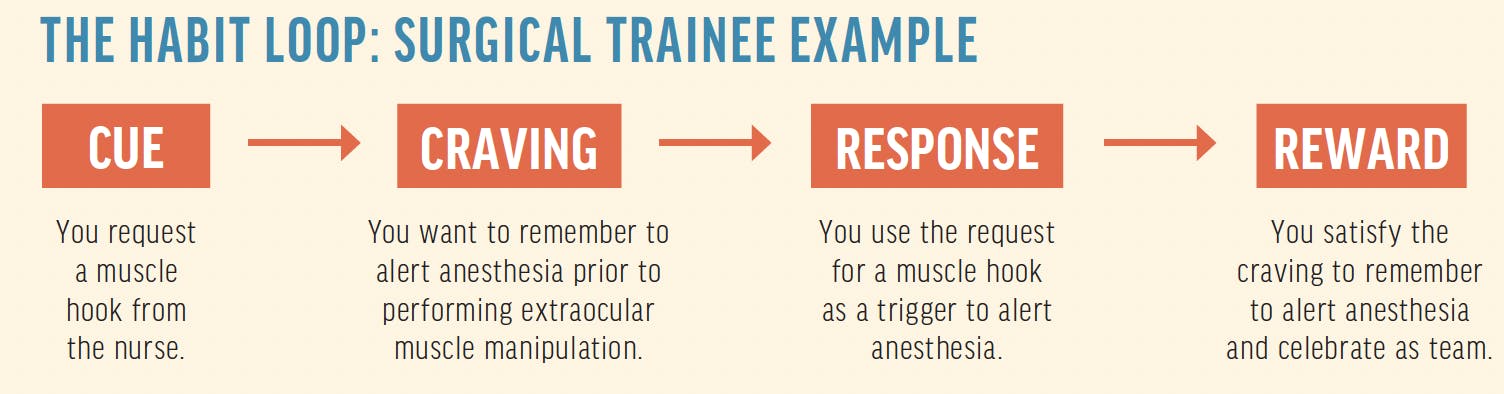
Clear articulates a feedback loop for developing habits that involves four steps: (1) cue, (2) craving, (3) response, and (4) reward.
It is important for surgeons to become aware of any poor surgical habits they possess and then to develop a cue that allows them to consistently make small decisions to improve their actions. For example, I previously worked with a trainee who consistently forgot to alert anesthesia when we were about to manipulate the extraocular muscles during implantation of a Baerveldt glaucoma implant (Johnson & Johnson Vision). Our surgical instrumentation often leads to profound bradycardia and discomfort. The problem was obvious, but the habit was ingrained.
The strategy is to create an environment in which it is difficult to repeat a bad habit, then habit stack. Prepare and practice utilizing a good habit or cue (in this case, requesting the muscle hook from the nurse), and then stack the new habit on top (using this as a cue to notify anesthesia). Recruit the scrub nurse to help: “If I don’t alert anesthesia when I ask for the muscle hook, please remind me.” Inform anesthesia about your process change and employ their help as well. Consider a self-imposed penalty for missing a stacked cue, perhaps as an agreement with the surgical teacher. Then celebrate small new cravings and responses together. “If a behavior can get us approval, respect, and praise, we find it attractive,” explains Clear.1
SUMMARY
It is natural for surgeons and surgeons-in-training to focus on achieving surgical goals. However, by doing so, we may overemphasize the importance of achieving outcomes and underestimate the value of making atom-by-atom improvements on a consistent basis. I encourage my colleagues and trainees to try to stop setting goals and start changing their identity-based habits. It is this commitment to the process that will ultimately lead to progress.
1. Clear J. Atomic Habits. New York: Avery; 2018.
Acknowledgements: The author would like to thank Iqbal Ike K. Ahmed, MD, FRCSC; Devesh Varma, MD, FRCSC; and Sherif El-Defrawy, MD, for content related to this article.