CASE PRESENTATION
A 72-year-old woman presents for routine follow-up glaucoma care. The patient reports difficulty with her vision in both eyes and ocular irritation. She has a longstanding history of glaucoma that is more severe in the right eye.
The patient wears soft contact lenses. She is used to monovision, with her right eye targeted for distance. She underwent uneventful implantation of an Ahmed Glaucoma Valve (AGV; New World Medical) in the right eye 3 years ago to address an IOP of 25 mm Hg on maximally tolerated medical therapy, which consisted of a fixed combination of brimonidine tartrate and timolol maleate (Combigan, Allergan) and bimatoprost ophthalmic solution (Lumigan, Allergan). After surgery, the IOP was in the low teens, but it recently began to rise. She is currently administering both medications bilaterally.
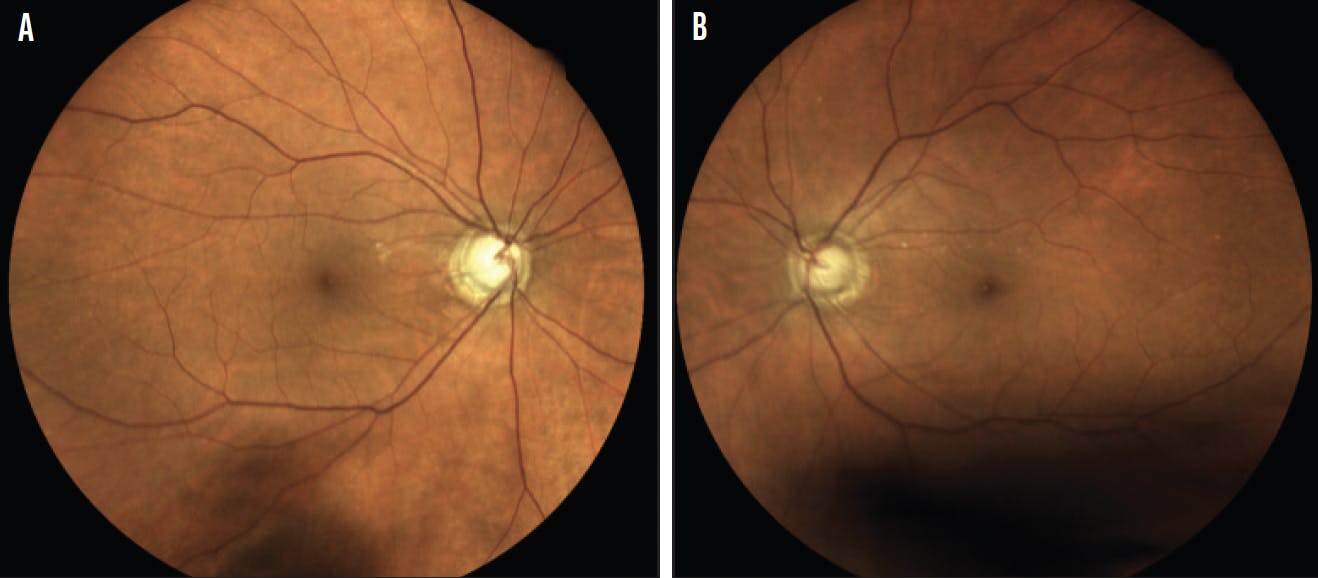
On examination, the patient’s BCVA is 20/30 OU and decreases to 20/50 OU with medium glare testing. The IOP is 16 mm Hg OD and 17 mm Hg OS. Gonioscopy shows open angles to grade 4 and a superior-temporal, well-placed tube in the right eye. A slit-lamp examination reveals a 1+ to 2+ nuclear sclerotic cataract with cortical vacuoles in each eye. A mild reduction in tear film production and mild conjunctival injection are evident bilaterally. The tube in the right eye is well covered. A fundus examination is unremarkable aside from optic nerve cupping that is greater in the right eye (Figure 1).
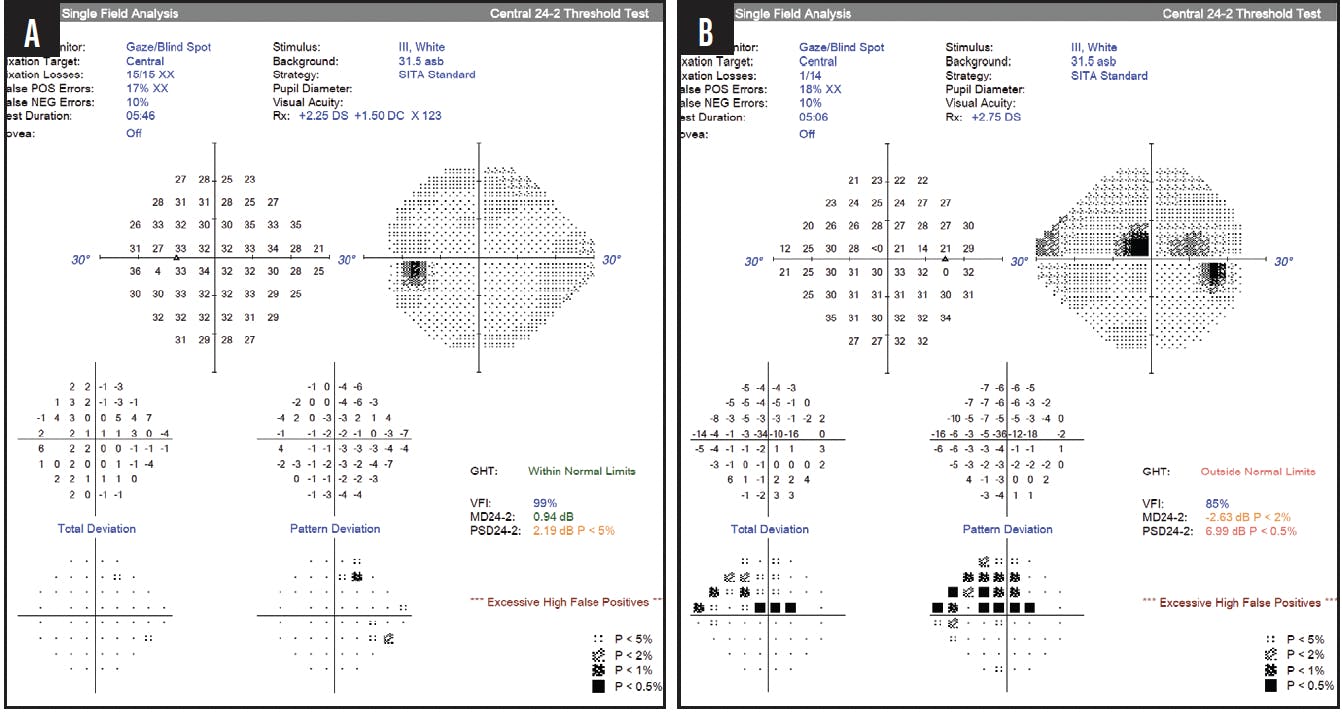
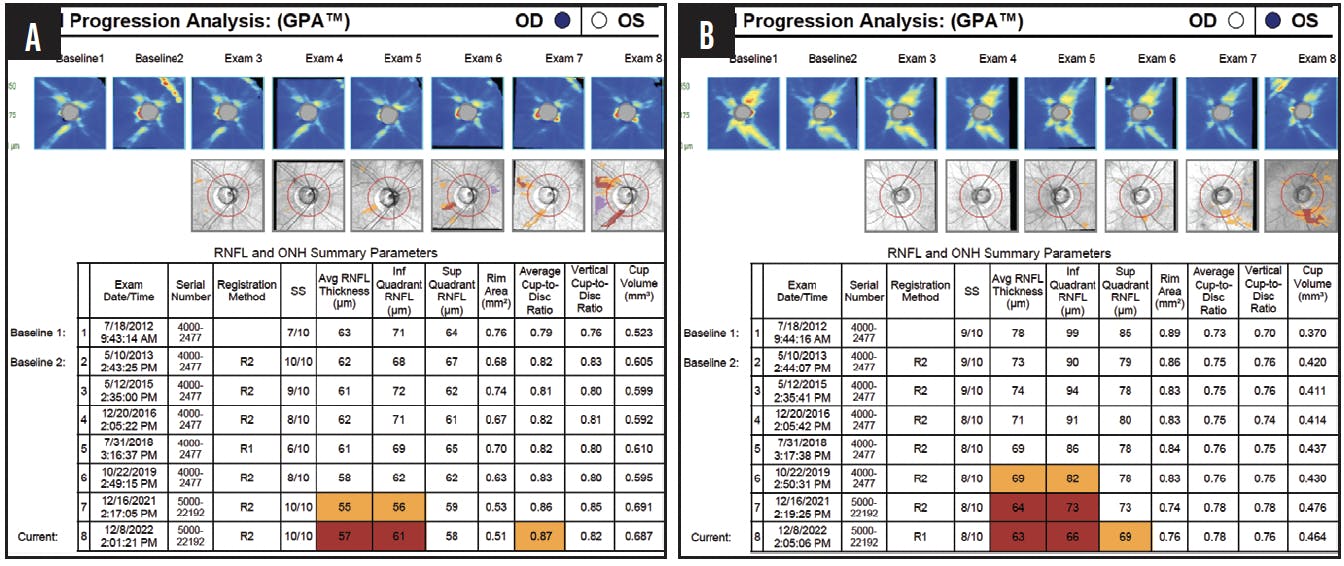
Humphrey visual field testing (Carl Zeiss Meditec) shows superior paracentral changes in the right eye and an overall normal field in the left eye, but the tests have poor reliability (Figure 2). OCT imaging reveals cupping and thinning of the retinal nerve fiber layer that is worse in the right eye. The structural damage recently progressed (Figure 3).
The patient is unhappy with her vision, IOP, and medical regimen. She has high expectations for her vision after surgery and expresses a strong desire not to wear glasses. She says, moreover, that a friend of hers recently had “dropless” cataract surgery and asks if she can avoid administering drops postoperatively.
How would you address the patient’s request for improved vision and spectacle independence? How would you improve her IOP control and reduce her medication burden?
—Case prepared by Jacob Brubaker, MD
JOSEPH F. PANARELLI, MD
The patient must be educated on her disease and how it can affect her quality of vision. Although glaucomatous progression has been slow thus far, there continue to be changes to the optic disc in each eye, and I would not be surprised to see a paracentral scotoma develop in the left eye in the near future. Visual field testing with a 10-2 strategy may already show changes.
If the patient has tolerated monovision, I would stick with that strategy and target a plano result in the dominant eye and -1.75 D in the contralateral eye. In my experience, patients tend to be happier with mini-monovision because it better addresses their needs. Before recommending this strategy, however, I would want more information on where this patient likes to read most of the time.
An extended depth of focus (EDOF) IOL is an option. A slight undercorrection of the left eye to attain more near vision could be considered. In my experience, patients need time to adjust to EDOF lenses and may not be happy with their vision in the early postoperative period. An EDOF lens would not be my preference here but should be discussed.
It is important to emphasize to the patient that she may become more aware of the scotoma in her right eye after the cataract is removed. I have heard many patients say postoperatively that a scotoma was “not there” before cataract surgery.
I would recommend a nasal goniotomy to reduce IOP and the patient’s medication burden in the left eye. I would perform phacoemulsification alone on the right eye. I have found that the procedure sometimes lowers IOP reasonably well—although not predictably—following primary tube shunt placement. If the IOP reduction is insufficient, I would then perform transscleral cyclophotocoagulation (half treatment in the inferior quadrant). Filtration surgery on the left eye may be required in the future if further disease progression and central visual field loss occur.
NATHAN M. RADCLIFFE, MD
Better IOP control and a reduction in the number of medications required would be beneficial. The patient tolerates monovision and desires a plano prescription in the right eye and near vision in the left eye.
The right eye has an encapsulated AGV. My preference would be to revise the AGV capsule by excising Tenon and scar tissue, applying mitomycin C, and primarily closing the conjunctiva with a running, locking polyglactin (Vicryl, Ethicon) suture. At the same sitting, I would remove the cataract and perform endoscopic cyclophotocoagulation (ECP) or micropulse transscleral therapy. A monofocal IOL with a plano target would be implanted. Astigmatism correction with a toric IOL or keratotomy (laser or manual) could be offered if needed.
The left eye requires a different approach. Cataract extraction and a MIGS procedure targeting the trabecular meshwork would be performed. An appropriate amount of myopia—guided by the patient’s monovision trial and history—would be the refractive goal.
I have performed dropless cataract surgery on most of my glaucoma and traditional cataract patients for 10 years. I would therefore offer this patient intravitreal triamcinolone acetonide 15 mg/mL and moxifloxacin 1 mg/mL (Tri-Moxi+ PF, ImprimisRx; off-label indication). With a 30-gauge needle, 0.2 mL of the product would be injected into the anterior vitreous, and another 0.2 mL would be injected superiorly into the sub-Tenon space. In my experience, this approach may be safely performed in glaucomatous eyes with an excellent success rate.
This case perfectly illustrates the need for tailored glaucoma therapy. By my estimate, however, mastery of at least seven surgical cataract and glaucoma approaches and techniques is required to serve the patient well. Thankfully, resources such as Glaucoma Today are available to help ophthalmologists learn them.
MANJOOL SHAH, MD
The volume of aqueous around the shunt seton in the right eye would be assessed with B-scan ultrasonography. I would expect the amount of fluid flowing to the plate to be adequate given the significant pressure reduction achieved by the combination of the tube shunt and topical medications. If this expectation proves accurate, I would recommend cataract surgery combined with ECP. The latter procedure is essentially surgical aqueous suppression. When combined with a robust outflow procedure such as a preexisting drainage device, ECP may be sufficient to reduce the medication burden greatly. In eyes with significant intrinsic outflow dysfunction, the added value of Schlemm canal–based surgery may be limited.
The patient would be counseled that her central field defect is a contraindication for many diffractive and EDOF IOLs because they may reduce contrast sensitivity and visual quality. My preference would be a monofocal plus lens such as a Tecnis Eyhance (Johnson & Johnson Vision) or enVista (model MX60E, Bausch + Lomb) to maximize her visual range without sacrificing contrast.
The left eye has relatively mild glaucoma, and outflow dysfunction appears to be less severe than in the right eye. Cataract extraction with a Schlemm canal microstent would therefore be appropriate. To augment the effect of the device, I would consider performing canaloplasty at the same time to deliver maximal treatment of the conventional outflow system. Given the intact central visual field, a trifocal or EDOF IOL could be considered to increase the likelihood of spectacle independence.
SARAH H. VAN TASSEL, MD
The patient has progressing glaucoma and progressive expectations. Her refractive goals are largely reasonable, particularly given the outstanding tolerance of monovision she has demonstrated. At the time of cataract extraction, I would seek to maintain distance vision in the right eye and reading vision in the left eye, mimicking her current contact lens targets. It is important to note that the visual field defect in the right eye threatens fixation. Some of my patients have lost their love of monovision in the setting of functional progression. I would explain this to the patient as well as her possible need for occasion-specific spectacles in the future.
My preference would be to place a Hydrus Microstent (Alcon) at the time of cataract extraction in the left eye. I expect this combination to substantially reduce and possibly eliminate the need for topical medication. Selective laser trabeculoplasty and/or placement of a bimatoprost implant (Durysta, Allergan) could be performed to supplement the results of the surgery in the future if necessary.
For the right eye, I favor ciliary body ablation as the next step and recommend ECP, given the plans for concurrent cataract surgery. I would advise the patient that some IOP-lowering drops may be required postoperatively but that the aim is to simplify the regimen. I generally find prostaglandin analogues and angle procedures have low efficacy in eyes that have received a tube shunt.
I do not have access to intracameral antibiotics and prefer the titratability of topical antiinflammatory medications following both ECP and angle surgery. I hope this compromise is acceptable to the patient.
WHAT I DID: JACOB BRUBAKER, MD
The patient had specific expectations regarding her care. We discussed her options in detail and the limitations posed by her glaucoma. I reminded the patient that glaucoma is a lifelong disease and any surgery carries risks and limitations. I then noted that more options are available today than in the past, which often allows me to cater to even the most discerning patients. We discussed possible IOLs, including standard monofocal lenses, EDOF IOLs, and the Light Adjustable Lens (LAL; RxSight). Given her current use of monovision and desire for perfection, I recommended the LAL.
Next, we discussed options for glaucoma management. The IOP in her right eye was not controlled medically despite the presence of an AGV. The iStent Infinite (Glaukos) has been studied in individuals with refractory glaucoma similar to this patient, although in a standalone setting.1 I thought the device could reduce IOP and provide the quick visual recovery required to allow light adjustment treatment of the LAL 3 weeks postoperatively.
To address the patient’s desire for dropless cataract surgery, placement of a dexamethasone ophthalmic insert 0.4 mg (Dextenza, Ocular Therapeutix) and an intracameral injection of moxifloxacin were planned.
Uneventful surgery was performed on the right eye, followed by the left eye 1 week later. The IOP remained in the low teens in each eye during the initial weeks following surgery. At the 1-week postoperative visit, the patient’s drug regimen was switched from a fixed combination of brimonidine tartrate and timolol maleate administered twice a day to timolol administered once a day, and therapy with bimatoprost ophthalmic solution was continued in both eyes.
Light adjustment treatment was performed 3 weeks after the patient’s last surgery (Figure 4). The goal was to optimize distance vision in the right eye and target -1.00 D in the left eye. After the adjustments and lock-in treatment of the LAL, her UCVA was 20/20 OD and 20/20 and J2 OS.
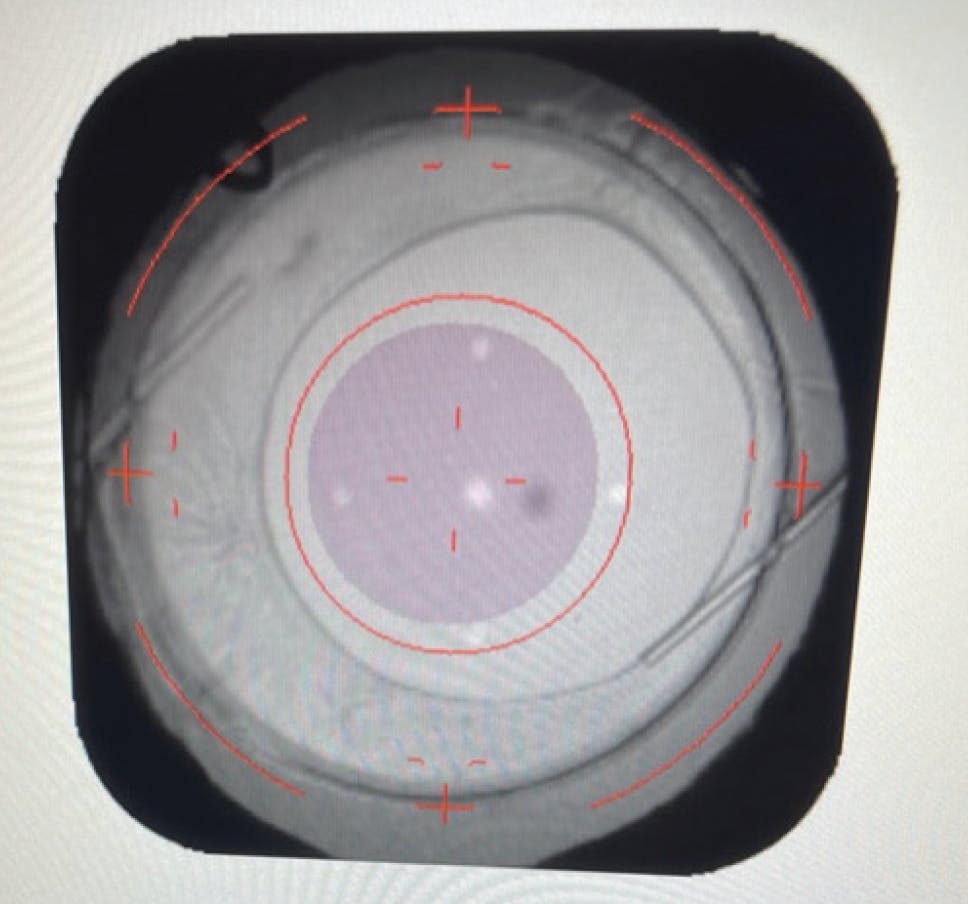
Figure 4. Photograph of the Light Delivery Device (RxSight) interface showing the LAL and tip of the Ahmed tube before light adjustment treatment of the right eye.
The patient’s medical regimen was reduced to timolol and bimatoprost ophthalmic solution. At her 3-month follow-up visit, her IOP was 11 mm Hg OD and 12 mm Hg OS. The patient was thrilled, and I was grateful we were able to meet her expectations while achieving better control of her glaucoma.
1. Sarkisian SR Jr, Grover DS, Gallardo MJ, et al; iStent infinite Study Group. Effectiveness and safety of iStent Infinite Trabecular Micro-Bypass for uncontrolled glaucoma. J Glaucoma. 2023;32(1):9-18.