The COVID-19 pandemic forced us to shift our perspective on many things, and surgical education was no exception. The closure of ORs led to reduced resident case numbers, while social distancing led to a reduced number of teaching interactions. Traditional methods for independently practicing microsurgical skills include large time commitments for accessing areas with microscopes and setting up supplies. With limited time for self-care and limited control over their schedules, residents are already near burnout, and, therefore, independent skill practice can fall by the wayside.
In an effort to refocus surgical education in these changing times, we at the University of Iowa implemented an initiative to provide ophthalmology residents with a mobile microsurgical kit. The purpose of this kit is to allow residents the opportunity to practice surgical skills at home by providing access to equipment and reducing the time commitment that practice requires.
AT-HOME CORNEAL SUTURING KIT COMPONENTS
- Tabletop microscope (eg, Labomed) with a beam splitter attachment for use with a smartphone
- Eye model (eg, Basic Suture eye [PS-016] with Stemi eye holder [PS-020s], both Phillips Studio)
- Keratome
- 10-0 nylon sutures
- Single-use instruments (eg, Malosa single-use instruments [BVI Medical]), including toothed Bonn forceps, straight tying forceps, angled tying forceps, a needle driver, and Westcott scissors
The mobile microsurgical kit that we created currently focuses on corneal suturing (see At-Home Corneal Suturing Kit Components), but it could be adapted for capsulorhexis creation or other steps of cataract surgery. Our kit includes a tabletop microscope by Labomed with a beam splitter attachment for use with an iPhone (Apple). This attachment holds the iPhone and aligns the camera for video recording or virtual teaching instruction through video calls. The eye model we selected for the kit is the Basic Suture eye (PS-016, Phillips Studio) with the Stemi eye holder (PS-020s, Phillips Studio). The kit also contains a keratome, 10-0 nylon sutures, and Malosa single-use instruments (BVI Medical), including toothed Bonn forceps, straight tying forceps, angled tying forceps, a needle driver, and Westcott scissors.
AT-HOME CORNEAL SUTURING IN ACTION
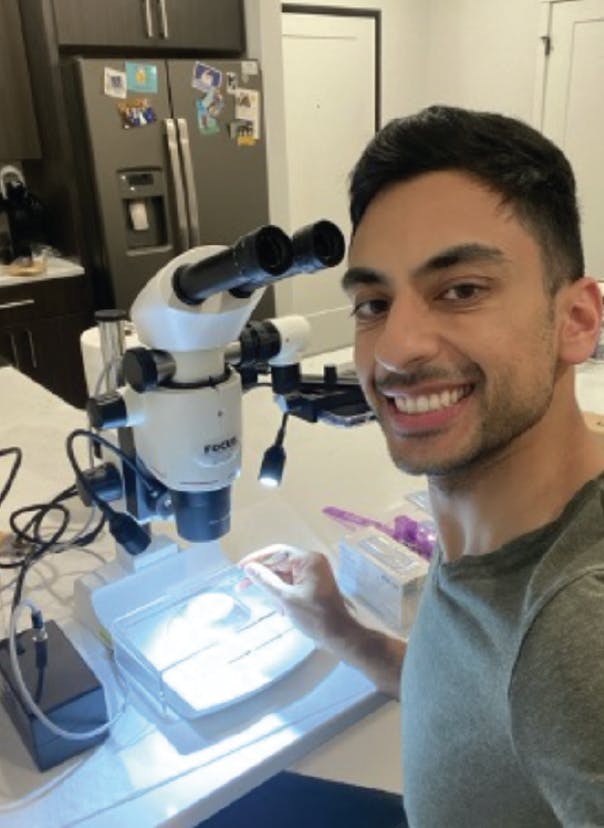
“With dedicated faculty members such as Dr. Haugsdal guiding us in simulation, we now have the ability to develop solid surgical fundamentals from home—an incredible way to build confidence before encountering the ‘real deal’ in the OR. Putting in the time to practice the kinetic skills of corneal suturing helps me to recognize the delicacy of the movements needed for safe, effective microsurgery. Not only is it crucial to put in the time to develop these skills, but it’s also fun, too!”
—Bilal S. Ahmed, MD
Resident, Department of Ophthalmology and Visual Sciences,
University of Iowa, Iowa City, Iowa
We believe that the key components of this initiative are mobile equipment for at-home practice, quick and easy setup, and the ability for virtual instruction (see At-Home Corneal Suturing in Action). All of these components are important as they allow for easy, efficient, and effective practice with the goal of improving skill development.