JOHN P. BERDAHL, MD
GT: What do you consider to be the greatest threat(s) to innovation in glaucoma today? How has this changed over the course of your career?
Dr. Berdahl: In my experience, one of the greatest threats to innovation is inertia among colleagues. It is apparent that many glaucoma therapies over time did not pan out and advance the profession. On one hand, as scientists, physicians must look at the evidence and determine whether it supports a treatment. On the other, someone must generate that evidence in the first place and try to set a new standard of care. It is difficult to balance these two requirements, so the standards of care often stay in place longer than they should.
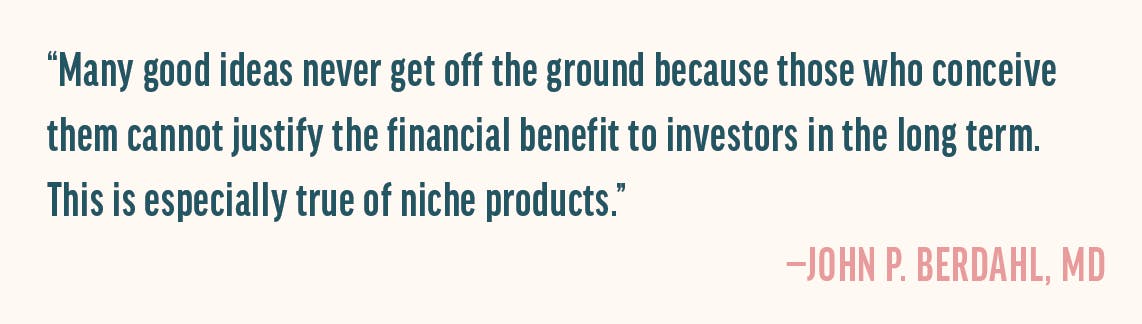
Another threat is the difficulty of achieving the proper ecosystem for innovation. The only technologies that truly succeed provide fair value to the patient, fair value to the payer, fair value to the doctor, and fair value to the manufacturer—and it is very difficult to check all those boxes. In the current environment, the path to innovation is lined with funding barriers, regulatory barriers, and reimbursement barriers. The effort and cost directed toward overcoming these obstacles is enormous, and the return on investment on the back end must justify all the risk taken up front, knowing that many of these products will not pan out. Many good ideas never get off the ground because those who conceive them cannot justify the financial benefit to investors in the long term. This is especially true of niche products.
GT: What can physicians do to help combat some of the current threats to innovation?
Dr. Berdahl: Physicians should look at the arc of innovation. Lipitor (atorvastatin, Viatris) now costs $3 for a monthly supply; however, to get to this point of affordability, the drug had to go through a period in which it was a high-priced, branded medication in an effort to support the innovation in the first place. Physicians can zoom out and see how the greater good is served over decades, in addition to being able to compare the cost and benefit of an innovation with the potential to help the patients we see daily.
Physicians can also advocate for fair reimbursement. It often does not benefit us individually to spend time advocating for reimbursement or understanding the regulatory process. However, it is critical to the collective, and we must all be willing to do things that are not just in our personal interest.
GT: What has been the greatest lesson you have learned about innovating in glaucoma?
Dr. Berdahl: Innovating is exhilarating, harrowing, and potentially devastating. If we knew how high the mountain was, we might never start climbing it. But we only get one swing at this life, and we should try to do things that actually make a dent.
GT: The path of an innovation is often long and bumpy. What advice would you give to those who are just starting out on this journey?
Dr. Berdahl: First, surround yourself with the best possible people, specifically wonderful people with wonderful skillsets. Often when we start out on a journey, we do not know exactly how it will go; however, if we get in the car with the right people, the ride will have been worth it, no matter the destination.
Second, keep going. Entrepreneurship is not like clinical practice, in which we are well trained with good data to make the decisions we face every day. Entrepreneurship mandates making gray decision after gray decision and maintaining self-motivation throughout. Doctors—those who took an oath to patients and have insight into the true unmet needs in their care—must be intimately involved with the innovation process.
REAY H. BROWN, MD
GT: What do you consider to be the greatest threat(s) to innovation in glaucoma today? How has this changed over the course of your career?
Dr. Brown: Many obstacles to innovation exist. The first is having a great idea—not half of an idea, but a nearly complete idea that can be produced and used in the human eye. In 1994, I patented a transcorneal drainage device. This was probably less than half of a great idea. Several companies have tried to develop this technology without success. Ray Kurzweil, a famous inventor and Google's Director of Engineering, likens innovation to a surfer catching a wave: The timing must be right. A new device usually requires many supporting technologies that may not be advanced enough at the time. So, good ideas may fail. Charles Kelman, MD, invented phaco technology in the late 60s, but it took more than 2 decades for it to reach widespread use. I still believe that the transcorneal drainage device is a great idea, but the other supporting factors are not in place.
A second obstacle is industry support. It is extremely hard to find funding for new ideas. This was practically impossible 20 years ago, when few if any companies had divisions devoted to glaucoma surgery. This began to change after Glaukos received FDA approval for the iStent in 2012. My wife, Dr. Mary Lynch, and I developed a precursor to the iStent—the EyePass—but it was abandoned in 2007, in the middle of our phase 3 FDA clinical trial, due to a lack of funding. Our goal was to develop a device that could replace trabeculectomy. Therefore, we targeted refractory glaucoma patients who were going blind—an extremely small market. Glaukos had a vastly different and more successful strategy. The company targeted patients with mild to moderate glaucoma who were undergoing cataract surgery. This approach greatly increased the market for surgery and created the MIGS opportunity. Now there is much greater interest in MIGS devices and device alternatives such as goniotomy and canaloplasty. Today, opportunities for innovation in glaucoma are more abundant.
Third, the FDA is a major challenge and a serious consideration. With the EyePass, the FDA required us to conduct a blind-eye study. This was a discouraging decision, especially because we were trying to treat eyes with glaucoma—an incurable, blinding disease with no good surgical option. The blind-eye study was essentially a terminal blow to a small company trying to develop the first MIGS device. The FDA no longer requires blind-eye studies for MIGS devices, but its barriers are still exceedingly high.
GT: What has been the greatest lesson you have learned about innovating in glaucoma?
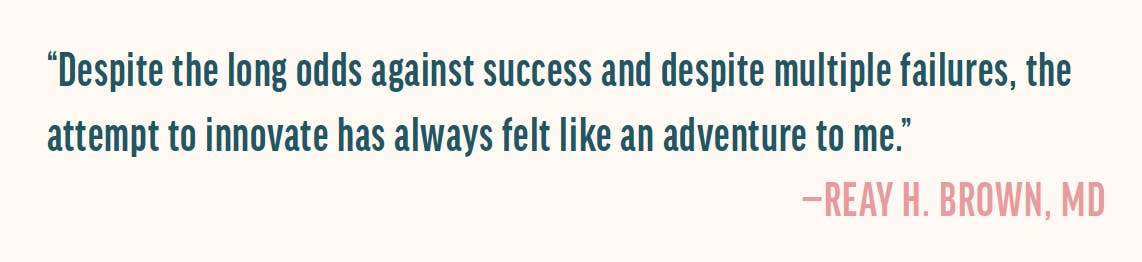
Dr. Brown: It is difficult and rare to turn an idea into a device that helps people. But, despite the long odds against success and despite multiple failures, the attempt to innovate has always felt like an adventure to me. It has been an end in itself. Each project I have worked on centered around an idea that I thought would solve the glaucoma surgical problem. I was delusional, but it probably helped me to never give up. As I look back, my career was like an investment portfolio. I never stopped being an active clinician and surgeon; I never quit my “day job.” My day-to-day clinical activities were like an index fund in my investment portfolio. The innovation was where I took risk, but the risk was mainly in my own time.
Today, it may not be possible or even desirable for physicians to attempt independent innovation. Now, most highly skilled and inventive glaucoma surgeons understandably enjoy being a part of innovation in many areas and working with many device companies. For all but a few inventors, the multiple-company approach also financially outperforms trying to invent something and then “selling” it to industry. For me, working with multiple companies (even if they had existed at that time) was not possible, as establishing these relationships requires signing contracts that give the companies the rights to an invention. Despite these contractual issues, a few remarkably successful outliers have been able to navigate complex relationships with universities and multiple companies and still perform innovative technological development.
GT: The path of an innovation is often long and bumpy. What advice would you give to those who are just starting out on this journey?
Dr. Brown: Passion and determination are required to overcome the inevitable resistance to innovation. The sentiments of Mother Teresa are relevant here. If you try to innovate, most of the time you will fail. You will be criticized, ignored, have your ideas stolen, and watch as others succeed. You will have companies reject you and be punched in the nose by the FDA. Do it anyway.
VANESSA VERA, MD
GT: What do you consider to be the greatest threat(s) to innovation in glaucoma today? How has this changed over the course of your career?
Dr. Vera: In my opinion, the biggest threat to innovation is focusing too much on reimbursement during the early innovation startup phases. The incentive to chase reimbursement often leads to great ideas not being pursued when a lucrative reimbursement strategy is not present, or it may lead to a better idea being abandoned in favor of a more lucrative one. Working backward, with reimbursement as the main goal and the driver of innovation, creates a different mindset, with which developers focus on creating new products that would receive a “well-reimbursed” code. With this approach, a product that fills a gap or meets a real need for patients has less of a chance of being developed, and many good novel ideas are less likely to move forward.
In other cases, innovative startup companies may make their new devices and procedures artificially more complex to add reimbursable procedure steps and make their proposal more attractive to ophthalmologists and investors from a reimbursement perspective; at the same time, this allows the company to increase their device price and margins. This trend ultimately drives up costs for the overall health care system. It can also prohibit the development of competing ideas that would provide better patient outcomes with lower costs and less complex solutions. For example, startups with great innovations may struggle to find funding if they cannot present a good reimbursement strategy or if they cannot add a disposable.
When a good idea is presented to fulfill an unmet medical need or to improve an existing product, efforts should be made around getting the best outcomes via the simplest approach, ultimately by optimizing cost-effectiveness. When an effective solution is found to address a medical need, reimbursement should follow.
Unfortunately, there is no clear solution to this issue. Raising awareness is the first step toward opening discussions on this possibly misaligned incentive structure. More incentives and value to innovation that produces lower cost and effective glaucoma solutions may need to be created to counter this trend.
GT: What can physicians do to help combat some of the current threats to innovation?
Dr. Vera: Keep the best patient outcome as the primary objective, via the simplest approach. Patients come first, and physicians’ main objective should never be compromised. High cost and complexity do not equal better outcomes for patients.
Physicians with the opportunity to evaluate, test, and guide new developments should push, question, and challenge the technical aspects of startup products to achieve low-cost and low-complexity devices and procedures. If low-cost innovative procedures are created, they are also more easily scalable to address growing needs in ophthalmic care around the world.
GT: What has been the greatest lesson you have learned about innovating in glaucoma?
Dr. Vera: Many things come to mind when I look at the road behind.
- Just because something works does not mean that it cannot be improved.
- Even after a successful launch, do not stop improving a product, including through reductions in cost and complexity, to be able to reach more patients.
- Innovation can come from opposite approaches: a problem that needs a solution, or a solution to a problem that does not exist (yet).
- Involve outsiders as much as possible because they do not know what can’t be done.
- The best solutions are always the simplest, most obvious ones—those that make us think, “Why didn’t I think of that?”
GT: The path of an innovation is often long and bumpy What advice would you give to those who are just starting out on this journey?
Dr. Vera: Take a chance, pursue big and new ideas, and be prepared for failure! Try … fail. Try … fail. Try … fail. Repeat as necessary.
Every failure is an opportunity to learn and improve; in other words, every failure is a success in learning, which ultimately leads to overall success. Also, challenge everything—do not take no for an answer. Last, find good partners and team members. A good team will make it to the finish line.
L. JAY KATZ, MD
GT: What do you consider to be the greatest threat(s) to innovation in glaucoma today? How has this changed over the course of your career?
Dr. Katz: One of the greatest challenges is that, to satisfy the regulatory agencies, the required pivotal trials must be well designed to meet the scientific rigor for acceptance. Careful deliberation on the appropriate regulatory path [510(k) or premarket approval], adequate duration, and reasonable sample size for adequate statistical analysis is vital for success. Additionally, innovators must ensure that the path is not blocked by a previously filed patent.
Realistic assessment of any traditional path that may be challenged by an innovation must focus on the benefit-to-risk comparison. For example, the traditional path may be more effective, but the innovation may offer a safer, technically easier approach with reasonable effectiveness. Maintaining the status quo across a disease state is a major threat to progress. For patient care to improve, we must strive to address gaps in the care of disease and to safely adopt new approaches to diagnosis and treatment.
Overall access to a drug, device, or technology (at a macro level) is a major hurdle. A product may have unmatched efficacy, but that is futile if patients cannot access it. Reimbursement by third-party payers must be quickly established for adoption into clinical practice. Educating payers on the importance and value of an innovation will facilitate adoption in the real-world health care system. Value demonstrated by health economic outcomes research is quickly becoming the norm and a requirement by many payers.
Thought leaders in the medical community must be provided with strong scientific evidence of clinical value with the introduction of a new product. This may supplant or complement prior options. Alignment of certain physicians with bias toward certain companies or products raises the bar for acceptance of new technologies. Patients’ acceptance of and ability to pay for new technologies can also affect innovation.
GT: What can physicians do to help combat some of the current threats to innovation?
Dr. Katz: Physicians assume a de facto gatekeeper role in helping to educate third-party payers and patients on whether an innovation may lead to better health care, improve quality of life, and warrant introduction into the diagnostic or therapeutic realm. Keeping an open mind and being well informed about the advantages and disadvantages of any innovation will help in discerning the role of a new technology or therapy. Physicians must always be advocates for their patients and maintain the decision-maker role for which device or treatment to adopt.
Physicians can also be a part of the research efforts to evaluate a new product. Participating in clinical trials or independently reporting real-world experience with any innovation will aid in determining what role that product will assume.
Leaders who have teaching roles in residency or fellowship programs or serve as educators at meetings or through media should provide unbiased views, based on available data, and circumspect opinions on the merits of innovations in development.
GT: What has been the greatest lesson you have learned about innovating in glaucoma?
Dr. Katz: The road from creative thought to commercial application is often a complex journey with many key steps and players. Avoiding any snags in the process requires foresight, strong beliefs, good science, teamwork, and patience. One must truly believe that the introduction of an innovation is a difference maker that brings something worthwhile to the table. Tackling a traditional approach with a novel wrinkle is challenging; it often occurs after clearing considerable hurdles based on the observed merits of the drug, device, or procedure through familiarity in clinical practice. Acceleration of the process requires a multilevel effort with good people who have broad experience and a common goal, as well as peer-reviewed publications, defined reimbursement, and endorsement by clinical leaders and professional organizations.
GT: The path of an innovation is often long and bumpy. What advice would you give to those who are just starting out on this journey?
Dr. Katz: Understand the existing landscape of medical care with demarcation of unmet needs and analyze where an innovation fits; is there a practical place that affords better care that will be adopted by the health care community? Also, a good mentor who can offer sound guidance, along with a strong, capable, and committed team, can make a world of difference.