Glaucoma treatment has evolved over time and become increasingly dependent on implanted devices to manage IOP and improve outcomes. Many available devices create alternative outflow pathways that provide a safe, controlled aqueous outlet that maintains effectiveness over time. Although a wide range of glaucoma devices exists, trade-offs between safety, effectiveness, and longevity come with each technology. VisiPlate (Avisi Technologies) is a novel drainage device designed to overcome many of the challenges and trade-offs associated with current glaucoma surgical treatments.
VisiPlate is an ultrathin, multichannel, nonfibrotic aqueous shunt. It shunts aqueous humor from the anterior chamber through a network of open microchannels to the subconjunctival space. The VisiPlate design represents a unique approach to lowering IOP; numerous microchannels in the device enable slow and controlled outflow and provide a multitude of pathways for redundancy. Slow outflow can create a diffuse, low-lying bleb that avoids tension and results in greater patient comfort than an elevated bleb. Additionally, a controlled reduction of IOP minimizes the risk of early suprachoroidal hemorrhage.
VisiPlate’s thin profile is designed to limit peridevice flow and provide greater comfort and better aesthetics for the patient, with less risk of microtraumas from eyelid movement. Additionally, the nonfibrotic nature of the device minimizes foreign body response and has the potential to be effective without antifibrotic agents.
This article reviews the design, technology, and developmental progress of VisiPlate.
DEVICE SPECIFICATIONS
VisiPlate features a nanoscale alumina plate that is conformally coated with Parylene C. Alumina is highly biocompatible, with many uses in the medical field including in orbital, dental, and orthopedic implants. Parylene C is a US Pharmacopoeia Class VI polymer that has been widely used for more than 4 decades in FDA-cleared implantable devices such as cochlear implants, cardiac assist devices, stents, and needles. VisiPlate’s metamaterial is approximately 5 µm thick and is corrugated into a pattern of networked microchannels, forming a hexagonal honeycomb (Figure 1). The technology features the world’s thinnest freestanding material (ie, it can support its own weight). The alumina core and hexagonal, isotropic microstructure increase the material’s flexural strength to up to 1,000 times that of a planar film of the same scale.1 At the same time, the composite structure is flexible and allows the device to conform to the curvature of the globe.
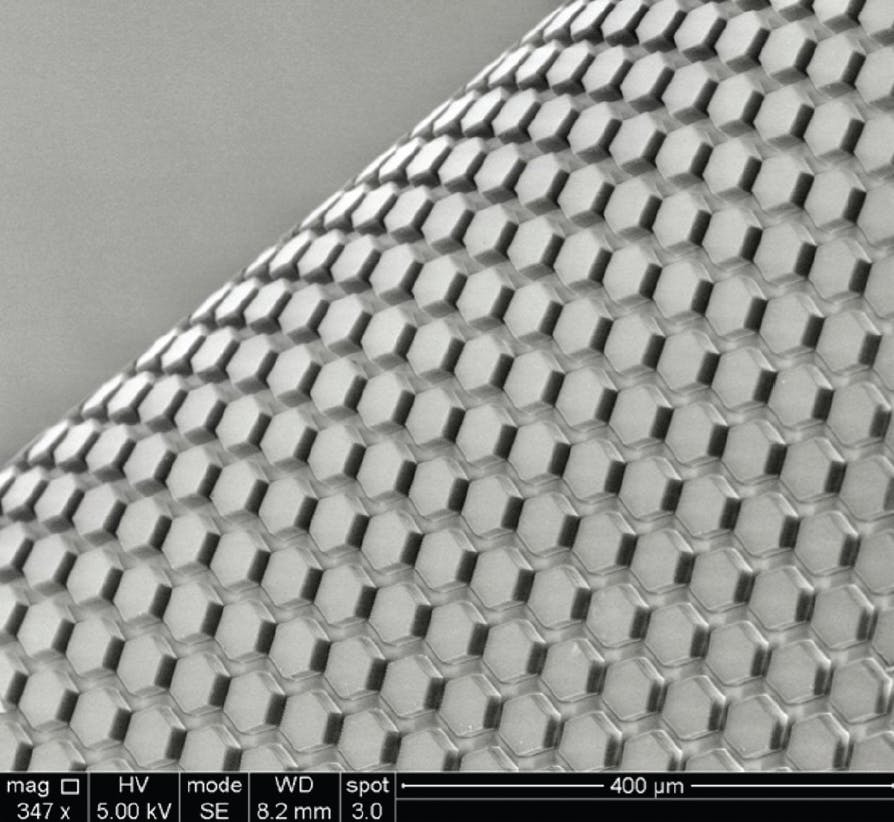
A version of VisiPlate being evaluated in early feasibility trials is approximately 5 mm wide and 8 mm long. A distinct feature of the device is that it drains aqueous humor across the implant through a network of highly tunable rectangular microchannels rather than through a large single-lumen tube. The microchannels regulate outflow and resistance using principles of the Hagen-Poiseuille equation. The multichannel design provides several potential advantages over a tubular design by minimizing the risk of postoperative hypotony, avoiding peridevice flow, and diffusing aqueous in all directions in the subconjunctival space to form and sustain a low-lying bleb. The surface area of the device aids in its ability to physically maintain a drainage space over time.
SURGICAL TECHNIQUE
Although the VisiPlate surgical technique is still evolving, the implantation is designed to be simple, without the need for patch grafts and gonioscopes. The current procedure contains six steps and uses an ab externo approach and standard surgical tools. The use of topical anesthetic and antifibrotic agents depends on surgeon preference. In brief, a peritomy is made at the limbus in a superior quadrant. A clean scleral surface is prepared using blunt dissection. A self-sealing scleral tunnel is constructed using a standard keratome. The device is inserted into the anterior chamber through the scleral tunnel. Once the device is in the anterior chamber, it can be visualized through the cornea. The device is secured to the sclera. After a watertight closure of the conjunctiva, a bleb will form.2
The unique material properties of VisiPlate provide the strength necessary for the thin device to withstand standard surgical handling and suturing. VisiPlate implantation is simpler than a trabeculectomy (ie, no scleral flaps dissection, sclerostomy, peripheral iridectomy, or suture adjustments), requires less tissue dissection than tube procedures, and does not require the use of a patch graft to prevent conjunctival erosions. Moreover, the VisiPlate procedure does not require intraoperative gonioscopy. This surgical technique will continue to be refined in future clinical trials.
CURRENT EVIDENCE
VisiPlate is undergoing early feasibility testing and has been evaluated in multiple long-term (3–6 month) studies using New Zealand white rabbit eyes. In this rabbit model, VisiPlate has been shown to be well tolerated and to reduce IOP.3 The tip of the VisiPlate is positioned in the anterior chamber (Figure 2), where it facilitates aqueous flow through the network of hexagonal microchannels into a low-lying bleb. The bleb has been confirmed with a postoperative injection of fluorescein dye into the anterior chamber, which revealed dispersion to the subconjunctival space (Figure 3). The company continues to validate the performance of VisiPlate in rabbit models, and testing has shown healthy bleb development even without the use of an antifibrotic agent such as mitomycin C.
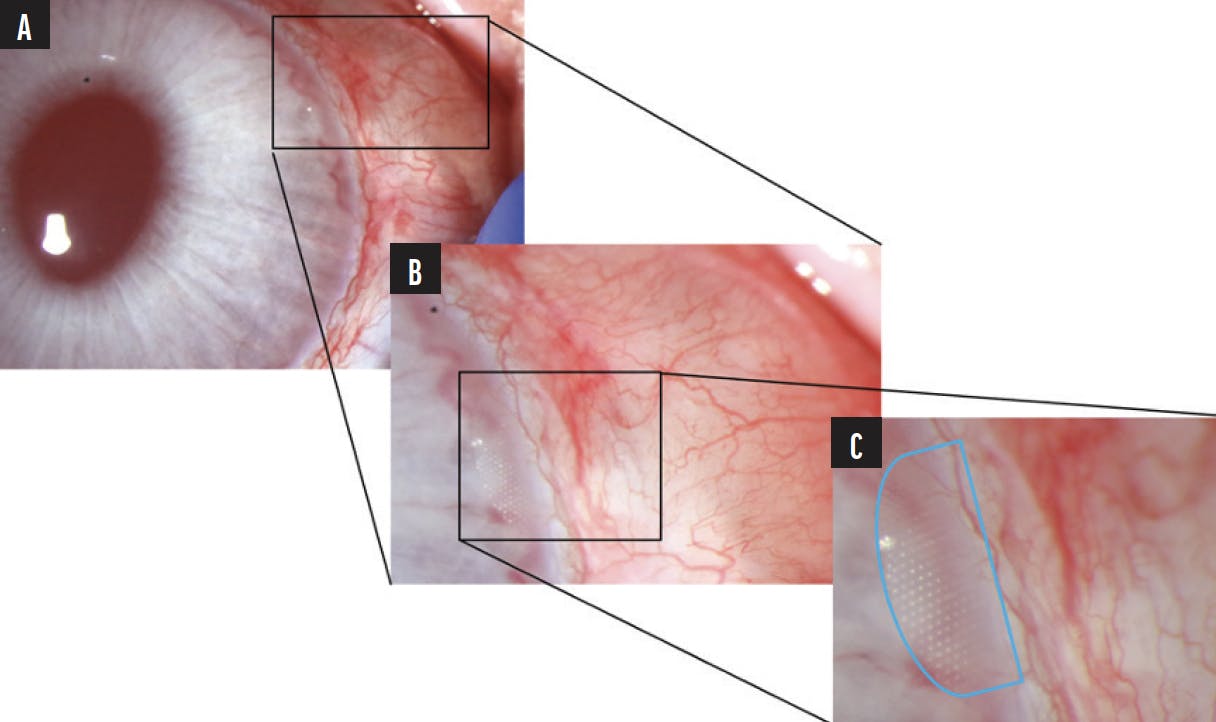
Figure 2. A depiction of VisiPlate in a New Zealand white rabbit model with progressive magnification. A low-lying bleb developed at day 90 without mitomycin C (A). The semitransparent tip of the VisiPlate is visible within the anterior chamber (B). The VisiPlate tip with visible hexagonal microchannels is outlined in blue (C).
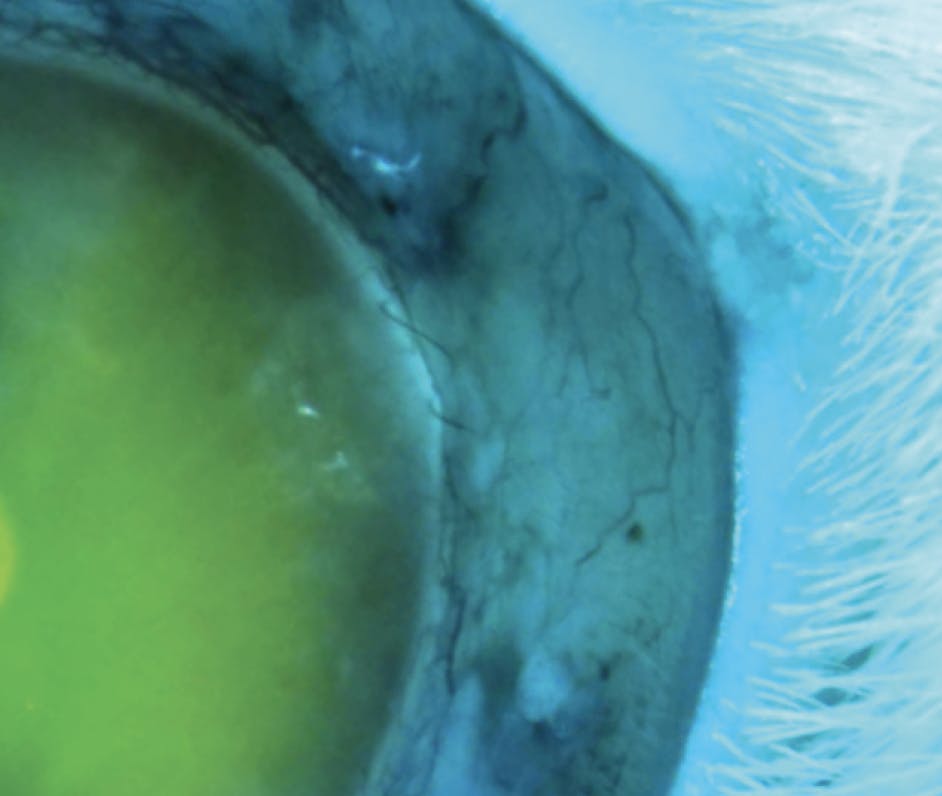
Figure 3. An injection of fluorescein dye into the anterior chamber of an implanted New Zealand white rabbit on postoperative day 21 ±3 shows the device facilitated dispersion of aqueous humor from the anterior chamber into the subconjunctival bleb.
CONCLUSION
VisiPlate is a clearly differentiated and innovative device for the surgical treatment of glaucoma. Its ultrathin, multichannel design with nonfibrotic materials has the potential to build a shallow, diffuse, and effective bleb that can maintain lower IOP—perhaps even without mitomycin C. Its broadly distributed outflow profile is designed to provide smooth and controlled IOP reduction while lowering the risk of hypotony, suprachoroidal hemorrhage, and anterior chamber shallowing, leading to greater surgeon and patient satisfaction. The developmental progress to date is promising, and VisiPlate is a device to watch in the coming years.
1. Davami K, Zhao L, Lu E, et al. Ultralight shape-recovering plate mechanical metamaterials. Nat Commun. 2015;6:10019.
2. Miller-Ellis E. Avisi VisiPlate. Presented at: the AAO Annual Meeting; September 30-October 3, 2022; Chicago.
3. Kao BW, Meer E, Barbolt TA, et al. Biocompatibility and feasibility of VisiPlate, a novel ultrathin, multichannel glaucoma drainage device. J Mater Sci: Mater Med. 2021;32:141.