CASE PRESENTATION
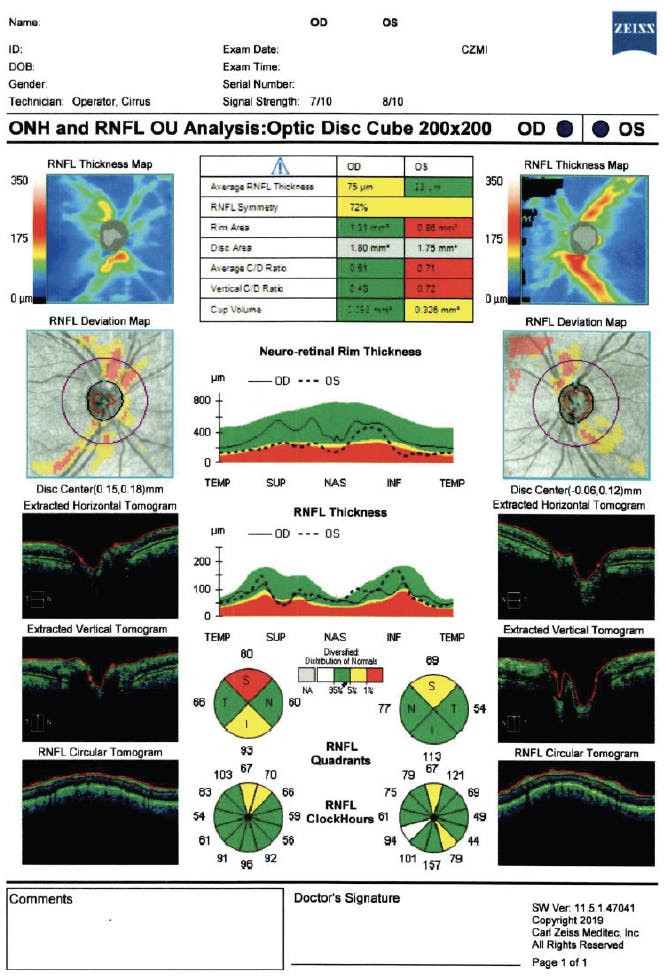
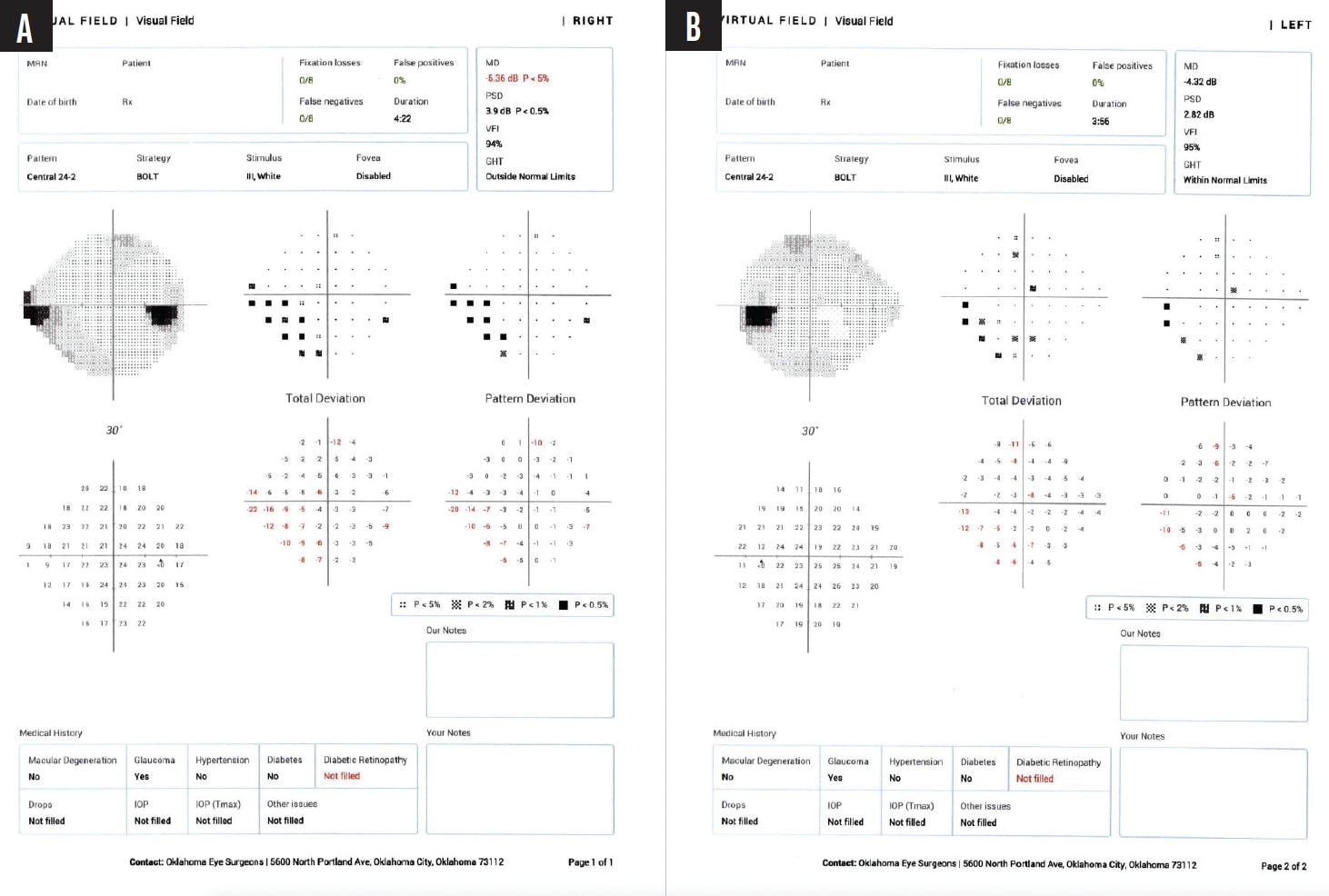
A 42-year-old woman is referred by her optometrist for a consultation for laser peripheral iridotomy (LPI) to treat narrow-angle glaucoma. On presentation, the patient’s IOP is 39 mm Hg OD and 25 mm Hg OS. The angle is grade 0 on gonioscopy and opens to a scleral spur on indentation gonioscopy. No peripheral anterior synechiae are present. Her BCVA is 20/20 OU with a refraction of +1.50 D for distance and an add of +1.25 D sphere. OCT imaging and visual field tests are shown in Figures 1 and 2.
An LPI is performed on each eye. Afterward, the IOP is 26 mm Hg OD and 18 mm Hg OS.
How would you proceed?
—Case prepared by Steven R. Sarkisian Jr, MD
EVA DEVIENCE, MD
I would check the patency of the LPIs. If repeat gonioscopy shows an open angle in the left eye, the IOP is on target, and optic nerve function is relatively preserved, close observation may be reasonable. In the right eye, if the angle is open but the IOP remains elevated, treatment is required. Given the patient’s young age, her high-risk characteristics, and the degree of optic neuropathy at baseline, the options include medical therapy and laser trabeculoplasty. I would discuss the risks and benefits of each with the patient.
She would be monitored closely. Visual field testing, OCT imaging, and optic nerve photography would be repeated every 3 to 4 months.
ABAYOMI FABUNMI, MD
Each eye appears to have appositional angle closure and evidence of optic nerve damage. Visual field testing suggests moderate impairment on the right and mild defects on the left.
I would reevaluate the angles for residual narrowing. Persistent appositional closure may indicate a secondary mechanism such as a malpositioned ciliary body, nanophthalmos, or lens-induced closure. Even with appropriate deepening of the angle, trabecular meshwork dysfunction from prolonged iridocorneal contact—if discounted—could lead to preventable retinal nerve fiber layer loss.
The risks and benefits of a lensectomy would be discussed with the patient. An understanding of her visual needs and expectations is essential to proper lens selection and surgical decision-making. Although phacoemulsification and long-term topical therapy are a reasonable strategy, the patient might benefit from angle surgery at the time of cataract extraction. The next step would be to choose an intervention that can safely establish a bypass of the trabecular meshwork. My preference would be ab interno canaloplasty or microbypass stenting. A generous amount of an OVD would be instilled during lens disassembly at the iris plane to safeguard the endothelium and maintain a pristine view of the angle.
The patient’s IOP would be managed with a fixed-combination drug such as netarsudil 0.02%/latanoprost ophthalmic solution 0.005% (Rocklatan, Alcon) or dorzolamide hydrochloride-timolol maleate (Cosopt, Mundipharma Ophthalmology Products) until she can undergo surgery.
BRIAN SHAFER, MD
Based on the case presentation and test results, the patient has appositional angle closure in both eyes, and the degree of glaucomatous damage is greater in the right versus left eye. The LPIs reduced the IOP in each eye, but it is still elevated in the right eye. This is of particular concern because mild to moderate visual field loss is evident in that eye. An IOP of 26 mm Hg, however, is not an emergency. Time is on our side.
The first step is to determine the status of the angle. No information on race or ethnicity is included in the case presentation. In the Chinese population, approximately two-thirds of patients continue to have appositional angle closure despite a patent LPI.1 Both static and dynamic gonioscopy would be performed in a dark room to evaluate if there is a component of appositional angle closure in the patient’s right eye. Performing a provocative test with either pupillary dilation or dark room adaptation can show if the IOP increases with mydriasis.
If a component of angle closure remains, the lens should be extracted to create more space and deepen the angle in this hyperopic eye. If the angle is truly open, the diagnosis is mixed-mechanism glaucoma. In this situation, I would perform selective laser trabeculoplasty (SLT) and monitor the patient’s response. If SLT is unsuccessful, topical therapy would be initiated and titrated to achieve an IOP below 21 mm Hg.
In short, the patient has some time. Figuring out the true status of the angle is critical to determining the next steps.
WHAT I DID: STEVEN R. SARKISIAN JR, MD
After LPI, the angles in the right and left eyes were grades 1 to 2 and 2 to 3, respectively. At the first follow-up visit after LPI, the patient reported that treatment had worked well immediately postoperatively and she had been able to work at a computer without glasses for a few hours. By dinnertime, however, her vision was blurry again.
I explained that laser treatment was meant to lower her IOP by opening the angle and that it had been pilocarpine treatment that had improved her vision. I then asked, “How did the drops we gave you before laser treatment feel?” She replied that she had experienced no pain or headache after administering pilocarpine. We discussed her presbyopia and her desire not to wear reading glasses. I prescribed pilocarpine 1% to be administered in both eyes twice daily or more, if she wanted, based on the clarity of her reading vision. I asked her to call me if she experienced visual flashes, floaters, or vision loss or if she wished to discontinue the pilocarpine because of pain.
The patient returned 2 weeks later. Her IOP was 16 mm Hg OD and 12 mm Hg OS. Her UCVA was 20/20 distance and J2 near OU. She was asymptomatic and content with her reading vision.
A refractive lensectomy or clear lens exchange could have opened the angle in each eye further. The patient’s low refractive error, however, made pilocarpine a safe and equally effective treatment. If further IOP lowering becomes necessary, SLT would be an excellent option. With the angle in each eye now fully open, however, trabecular outflow is adequate.
1. Yan YJ, Wu LL, Wang X, Xiao GG. Appositional angle closure in Chinese with primary angle closure and primary angle closure glaucoma after laser peripheral iridotomy. Invest Ophthalmol Vis Sci. 2014;55(12):8506-8512.
_1754918026.png?auto=compress,format)