Up to 20% of patients undergoing cataract surgery are estimated to have some form of glaucoma.1 When discussing options for cataract surgery with these individuals, it is imperative to identify their goals and expectations and then decide whether they can be met with the technologies available. Reaching this determination requires consideration of multiple factors.
Arguably most important to consider are the severity and stability of the patient’s glaucoma. Anatomic factors to note include pupil size, which at the extremes can affect surgical outcomes, and zonular support, which is an issue primarily in patients with pseudoexfoliation syndrome. Long-term topical glaucoma therapy can cause ocular surface disease, which may affect refractive stability. It is also important to remember that some patients may ultimately require refractive surgery to meet their goals.
With all this in mind, a range of advanced technology options for cataract surgery can and should be evaluated for patients with glaucoma.
ADVANCED TECHNOLOGY IOLS
An important consideration with advanced technology IOLs—particularly diffractive lenses—is their effect on contrast sensitivity, the visual function that allows a patient to differentiate between the luminance of an object and its background. A reduction in contrast sensitivity may cause patients visual problems even if their visual acuity is normal. Most presbyopia-correcting IOLs decrease contrast sensitivity by splitting the light that reaches the retina for distance vision. It is worth noting that the defocus created with monovision can also reduce contrast sensitivity,2 so this correction strategy may not necessarily be a better option for reducing spectacle dependence in the glaucoma population.
Multifocal IOLs
Data on the potential of multifocal IOLs in glaucomatous eyes are limited; the sample sizes of most studies are small.3 A prospective study published in 2000 found that the implantation of an early multifocal IOL (Array lens) in glaucomatous eyes was beneficial and visual disturbances were not as disruptive as previously thought.4 A small study published the following year assessed the visual function of patients with preperimetric and perimetric glaucoma who received multifocal IOLs.5 The nonglaucomatous eyes had statistically better monocular distance visual acuity (including in low-contrast settings) than glaucomatous eyes. The patients with glaucoma also reported greater difficulty driving at night.
Multifocal IOL technology can have an impact on glaucoma testing. In one study, patients who received diffractive multifocal IOLs experienced clinically relevant reductions in visual sensitivity as measured by standard automated perimetry.6 Another study demonstrated wavy horizontal artifacts on OCT in patients with diffractive multifocal IOLs.7
Extended Depth of Focus IOLs
Extended depth of focus (EDOF) IOLs extend patients’ range of vision into the intermediate range but provide less near vision than a true multifocal IOL.
The Tecnis Symfony (Johnson & Johnson Vision) is a diffractive EDOF IOL that provides an elongated focal zone as opposed to the multiple distant focal points of a classic multifocal IOL. A meta-analysis showed an increased risk of contrast sensitivity loss and halos with this EDOF IOL compared with monofocal lenses but better contrast sensitivity compared with multifocal lenses.8 Similarly, a comparative analysis showed no significant difference in contrast sensitivity between the Tecnis monofocal (Johnson & Johnson Vision) and the Tecnis Symfony.9 The Symfony may therefore be an appropriate choice for patients with underlying conditions such as glaucoma that affect contrast sensitivity. Halos and glare are potential concerns with the Symfony because of its diffractive design.
The AcrySof IQ Vivity (Alcon) features wavefront-shaping technology and nondiffractive optics. The visual disturbance profile of this IOL has been found to be similar to that of a monofocal IOL.10 Reductions in mesopic contrast sensitivity have been observed with monocular but not binocular testing. With fewer associated visual disturbances than a multifocal IOL, the Vivity may have a greater role in patients with comorbidities such as glaucoma, but its impact on contrast sensitivity requires further study.
Studies reporting the use of EDOF IOLs in glaucomatous eyes are extremely limited but in general have demonstrated good visual outcomes.11,12
Monofocal IOLs
Monofocal IOLs are widely accepted for use in patients with moderate to severe glaucoma. These lenses do not split light and pose no concerns regarding contrast sensitivity loss or photic phenomena seen with diffractive lens technology. The aspheric design inherent to most modern monofocal IOLs has been shown to increase mesopic contrast sensitivity, which is beneficial in glaucomatous eyes.
Several enhanced monofocal IOL options are available, including the Tecnis Eyhance (Johnson & Johnson Vision) and the RayOne EMV (Rayner). These lenses do not meet the criteria of a true EDOF IOL, but they can improve uncorrected intermediate visual acuity in most patients and are worth considering for those with glaucoma.
The Light Adjustable Lens (RxSight) is another monofocal option. Because its power can be adjusted postoperatively, this lens can be useful for addressing the lack of refractive predictability frequently seen in glaucomatous eyes, particularly those with extreme axial lengths.
LASER CATARACT SURGERY
In general, laser cataract surgery is considered safe in the glaucoma population. Studies using various testing modalities have shown disease stability after laser cataract surgery.13-15 Similar efficacy and refractive outcomes have been demonstrated when laser cataract surgery was combined with MIGS.16
Laser cataract surgery has been shown to have an impact on IOP. During docking of a femtosecond laser, IOP may rise about 10 to 16 mm Hg above baseline for 30 to 90 seconds.17 However, IOP can also increase up to 60 mm Hg during standard cataract surgery and between 70 and 90 mm Hg during LASIK flap creation.
A nonrandomized prospective study compared IOP changes in glaucomatous versus nonglaucomatous eyes at different stages of laser cataract surgery.18 IOP was measured at four time points with rebound tonometry. The mean change in IOP from baseline to vacuum-on did not differ significantly between groups. The same was seen after the vacuum was undocked. The mean change in IOP after treatment was significantly higher in glaucomatous eyes versus healthy controls, but this difference was not observed at any other time point.
Laser cataract surgery offers unique benefits in certain subsets of glaucomatous eyes, particularly those with narrow angles and shallow anterior chambers. The lens pretreatment option allows less ultrasound energy to be delivered to the corneal endothelium. Additionally, the ability to reduce manipulation, complete the capsulotomy with less zonular stress, and adjust the capsulotomy size to the pupillary margin can be beneficial in patients with pseudoexfoliation. Before surgery, it is wise to explain to patients that, owing to certain conditions that are more common in glaucomatous eyes (ie, small pupils), they may not be able to benefit from all capabilities of laser cataract surgery.
Some unique challenges with laser cataract surgery in glaucoma patients also exist. The presence of a bleb may make docking the laser more difficult, and associated bleb leaks have been reported. Patients with thin-walled blebs therefore may not be good candidates for laser cataract surgery.
Similarly, in patients with tube shunts, the ability to dock the laser may be impeded by the patch graft, and erosion over the tube can occur. Capsulotomy creation may have to be performed manually in eyes with long tube shunts. Subconjunctival hemorrhage could influence the success of subconjunctival MIGS procedures and negatively affect a previously well-functioning bleb. Pseudoexfoliation can be a double-edged sword; a small pupil may make it impossible to pretreat the lens. Cortical removal can also be more challenging, which may place additional stress on the zonules.
CONCLUSION
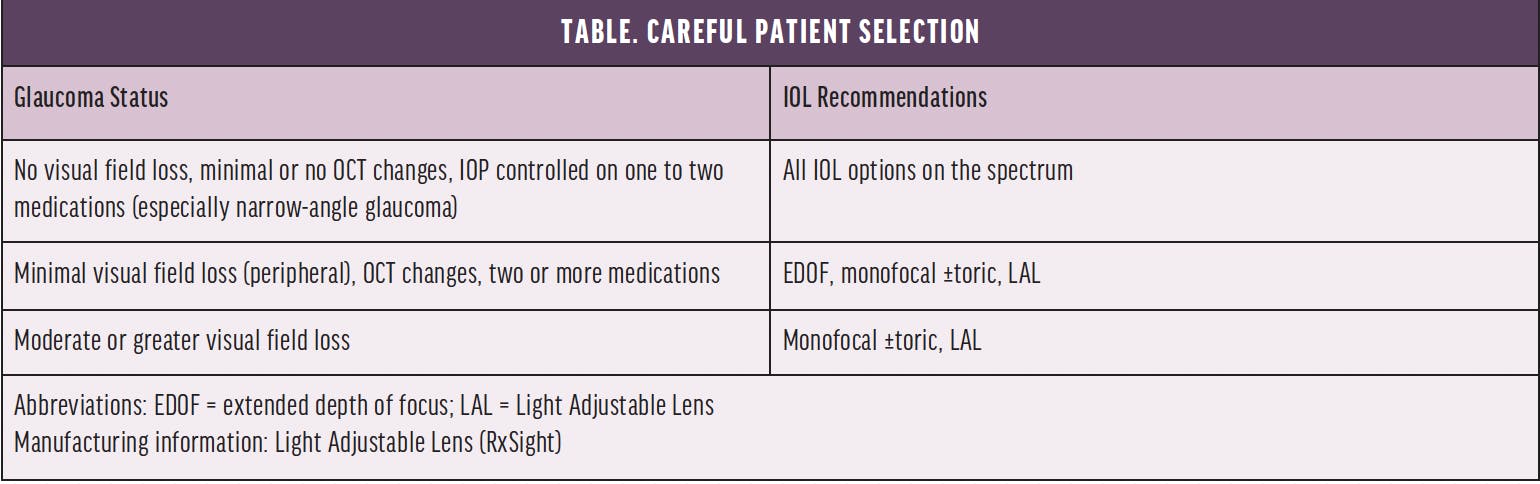
Patients with glaucoma deserve access to advanced technology that can help meet their goals. However, patient selection is paramount. In general, I stratify these patients into different categories based primarily on the severity and stability of their disease (Table). Aggressive treatment of dry eye can be beneficial, and there may be a role for the bimatoprost intracameral implant (Durysta, Allergan) or selective laser trabeculoplasty before preoperative measurements are obtained and an IOL is selected. Adding MIGS procedures to cataract surgery has been shown to be refraction-neutral19,20 and can reduce the medication burden and its contribution to ocular surface disease.
The greatest challenge presented by glaucomatous eyes is an inability to predict if they will experience disease progression. Ultimately, a well-informed patient with reasonable expectations is likely to be satisfied with the results of cataract surgery.
1. Shah M, Law G, Ahmed IK. Glaucoma and cataract surgery: two roads merging into one. Curr Opin Ophthalmol. 2016;27(1):51-57.
2. Radhakrishnan H, Pardhan S, Calver RI, O’Leary DJ. Effect of positive and negative defocus on contrast sensitivity in myopes and non-myopes. Vision Res. 2004;44(16):1869-1878.
3. Kumar BV, Philips RP, Prasad S. Multifocal intraocular lenses in the setting of glaucoma. Curr Opin Ophthalmol. 2007;18(1):62-66.
4. Kamanth GG, Prasad S, Danson A, Phillips RP. Visual outcome with the Array multifocal intraocular lens in patients with concurrent eye disease. J Cataract Refract Surg. 2000;26(4):576-581.
5. Sanchez-Sanchez C, Rementeria-Capelo LA, Puerto B, et al. Visual function and patient satisfaction with multifocal intraocular lenses in patients with glaucoma and dry age-related macular degeneration. J Ophthalmol. 2021;2021:1-8.
6. Aychoua N, Junoy Montolio FG, Jansonius NM. Influence of multifocal intraocular lenses on standard automated perimetry test results. JAMA Ophthalmol. 2013;131(4):481-485.
7. Inoue M, Bissen-Miyajima H, Yoshino M, Suzuki T. Wavy horizontal artifacts on optical coherence tomography line-scanning images caused by diffractive multifocal intraocular lenses. J Cataract Refract Surg. 2009;35(7):1239-1243.
8. Liu J, Yi D, Wang Y. Efficacy and safety of extended depth of focus intraocular lenses in cataract surgery: a systematic review and meta-analysis. BMC Ophthalmol. 2019;19:198.
9. Pedrotti E, Carones F, Aiello F, et al. Comparative analysis of visual outcomes with 4 intraocular lenses: monofocal, multifocal, and extended range of vision. J Cataract Refract Surg. 2018;44(2):156-167.
10. AcrySof IQ Vivity extended vision intraocular lenses (IOLs) models: DFT015, DFT315, DFT415, DFT515. FDA. Accessed July 1, 2021. www.accessdata.fda.gov/cdrh_docs/pdf/P930014S126C.pdf
11. Bissen-Miyajima H, Ota Y, Yuki K, Minami K. Implantation of diffractive extended depth-of-focus intraocular lenses in normal tension glaucoma eyes: a case series. Am J Ophthalmol Case Rep. 2022;29:101792.
12. Takahashi M, Yamashiro C, Yoshimoto T, et al. Influence of extended depth of focus intraocular lenses on visual field sensitivity. PLoS One. 2020;15:e0237728.
13. Salimi A, Qi SR, Harasymowycz P. Femtosecond laser-assisted cataract surgery in patients with prior glaucoma surgery. J Glaucoma. 2022;31(7):547-556.
14. Geyer O, Ben-Shaul O, Lux C, et al. Effect of femtosecond laser cataract surgery on peripapillary retinal nerve fiber layer thickness. J Glaucoma. 2022;21(5):340-345.
15. Alvarez-Ascencio D, Prado-Larrea C, Jimenez-Roman J, Castañeda-Diez R. Long-term visual field changes after femtosecond laser-assisted cataract surgery in glaucoma patients, case series. Am J Ophthalmol Case Rep. 2021;23:101163.
16. Hillman L. A perspective on FLACS and glaucoma. EyeWorld. October 2022. Accessed November 30, 2023. www.eyeworld.org/2022/a-perspective-on-flacs-and-glaucoma
17. Schultz T, Conrad-Hengerer I, Hengerer FH, Dick BH. Intraocular pressure variation during femtosecond laser-assisted cataract surgery using a fluid-filled interface. J Cataract Refract Surg. 2013;39(1):22-27.
18. Darian-Smith E, Howie AR, Abell RG, et al. Intraocular pressure during femtosecond laser pretreatment: comparison of glaucomatous eyes and nonglaucomatous eyes. J Cataract Refract Surg. 2015;41(2):272-277.
19. Brown RH, Zhong L, Bozeman CW, Lynch MG. Toric intraocular lens outcomes in patients with glaucoma. J Refract Surg. 2015;31(6):366-372.
20. Zabriskie N. IOL selection considerations in glaucoma patients. Glaucoma Today. May/June 2014. Accessed November 30, 2023. https://glaucomatoday.com/articles/2014-may-june/iol-selection-considerations-in-glaucoma-patients