February 2022 marked the division of life in Ukraine into two periods: before the start of war and after it. Since this turning point, our lives have changed radically, and a number of new challenges have complicated the management of glaucoma. This article reviews the key recommendations for managing glaucoma and the modifications needed to address current problems with care in Ukraine.
From 2017 to 2022, the Ukrainian Glaucoma Society cooperated with the European Glaucoma Society (EGS) to translate the 4th and 5th editions of the EGS’ Terminology and Guidelines for Glaucoma into Ukrainian to enable ophthalmologists here to apply this information to their practice.1-4 One of us (Z.V.), as the Ukrainian Glaucoma Society President, was included as an author of the 5th edition of the guidelines.
In 2023, a group of glaucoma experts from the Ministry of Health of Ukraine composed the Ukrainian document Standards of Glaucoma Medical Care.5,6 This document is based on the 5th edition of the EGS guidelines for glaucoma care and provides Ukrainian ophthalmologists with access to the most up-to-date information. By following these recommendations, ophthalmologists in Ukraine can keep pace with ophthalmologists all over the world and optimize the well-being of Ukrainian patients with glaucoma.
KEY RECOMMENDATIONS FOR CARE
In the 5th edition of the EGS’ Terminology and Guidelines for Glaucoma, the main tenets of glaucoma care include the following:
- Quality of life is a central goal of care for patients with or at risk of developing glaucoma;
- A diagnosis may be made on the basis of standard automated perimetry, tonometry, gonioscopy, and ophthalmoscopy examinations;
- Digital methods are effective for monitoring glaucoma but not for revealing and establishing disease in a patient;
- Prostaglandin analogues are the leader among first-line therapies for the treatment of glaucoma;
- The presence of dry eye disease and allergy is a deciding factor in the prescription of preservative-free drops;
- The presence of ocular hypertension is a suitable reason to prescribe a glaucoma therapy due to the high risk of transformation into primary open-angle glaucoma;
- Selective laser trabeculoplasty may be a first-line treatment for advanced-stage and refractory cases of glaucoma; and
- Trabeculectomy is the gold standard of surgical treatment, and glaucoma drainage devices remain an alternative method.
PROBLEMS WITH GLAUCOMA CARE IN UKRAINE
Since the beginning of Russian aggression in 2022, war and martial law in Ukraine have drastically changed the lives of the people in our country. In this uniquely challenging setting, a number of significant problems have affected the physical and psychological status of our people, both with and without glaucoma.
As members of the Ukrainian Glaucoma Society, we conducted a primary analysis of the challenges associated with managing glaucoma in war and wartime conditions between February 2022 and March 2023. Preliminary data were obtained through the analysis of general information from our ophthalmologists and patient survey data. A number of primary and secondary problems with glaucoma care were identified as a result.
Primary Problems
Wartime conditions have caused serious damage to the health care system and the ability to diagnose and monitor glaucoma. The primary problems associated with providing glaucoma care to patients in Ukraine include the destruction of houses, external or internal resettlement (7.5 million and 2.8 million individuals, respectively), a deficiency in or absence of ophthalmologists and available medications, and a deficiency in or absence of eye departments for IOP control, eye examinations, and surgery.
Secondary Problems
People in wartime Ukraine are under constant stress, which significantly changes their personal priorities and causes a serious shift in attitude toward their overall health and specific conditions. All of these factors have impeded the timely diagnosis, treatment, and follow-up care of glaucoma. As a result, a significant increase in the number of individuals with advanced glaucoma has been observed.
THE NEED FOR UPDATEd RECOMMENDATIONS according to the situation
Given these challenges, it is necessary to adjust recommendations for glaucoma management according to the ability to provide examination, treatment, follow-up care, and so on.
The following are examples of adjustments that Ukrainian ophthalmologists can make to improve glaucoma care in wartime.
- Methods of tonometry. Ophthalmologists can consider the use of alternative technologies for measuring IOP, such as the iCare Home rebound tonometer (Icare USA) or transpalpebral tonometry.
- Treatment goal. The goal of therapy should be to achieve the target IOP as quickly as possible.
- Decision-making for therapy. In an unstable health care system with limited or no access to first-line therapies to reduce IOP by 25% to 30%, drugs of different classes or fixed-combination therapies can be recommended as an alternative.
- Management of drug-resistant IOP. In these cases, ophthalmologists can proceed with combined therapy or fixed-combination therapy of available drugs or perform selective laser trabeculoplasty.
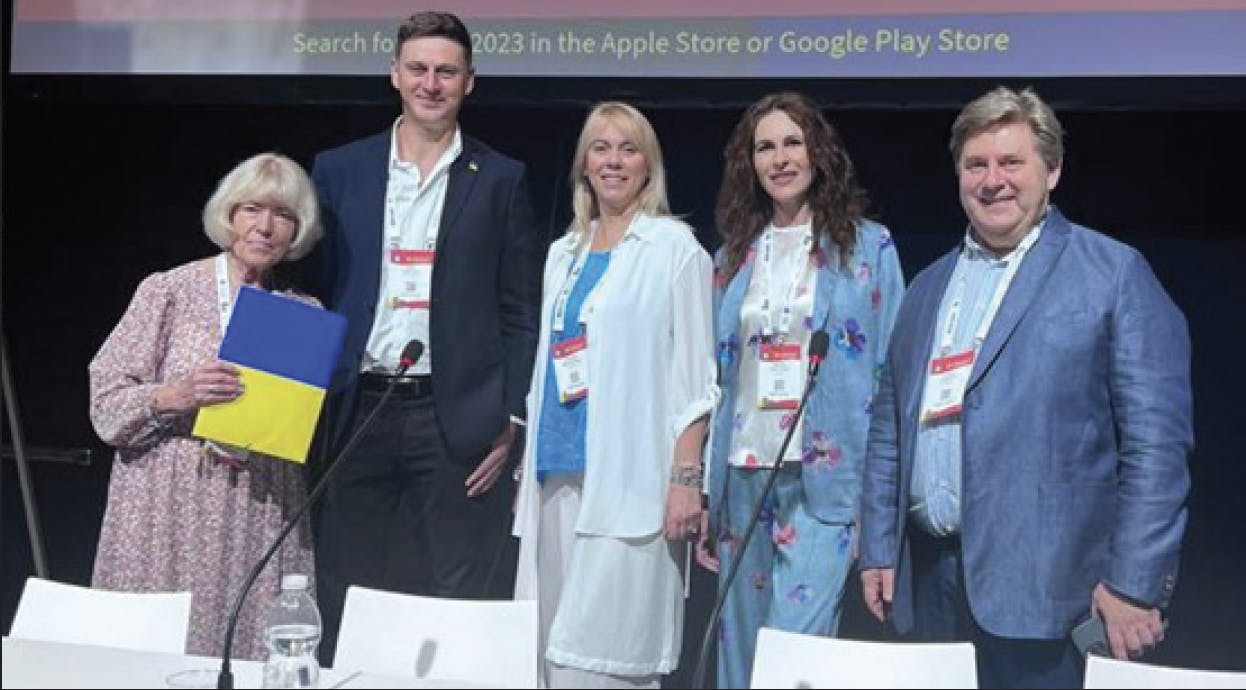
Figure. Drs. Zoya Veselovska (Veselovskaya), Vasyl Shevchyk, Natalia Malachkova, Marina Karliichuk, and Valerii Serdiuk during the Ukrainian Glaucoma Society symposium at the 2023 World Glaucoma Congress in Rome.
CONCLUSION
Adapting to the realities of wartime is a great challenge. Ukrainian ophthalmologists are faced with significant problems, and it is necessary to update modern recommendations in accordance with the current circumstances. Thanks to significant assistance from European and international organizations such as the EGS, ESCRS, and others, Ukrainian ophthalmic and social services are gradually stabilizing to improve the diagnosis and management of patients with glaucoma.
Ukrainian ophthalmologists’ active participation in international conferences and forums helps to support their emotional state in a stressful work environment. The Ukrainian Glaucoma Society symposium, which took place during the 2023 World Glaucoma Congress in Rome, was a great success (Figure) and, for us, served as a much-needed respite and valuable exchange of scientific information. Our relationships with the global ophthalmology community help us to better support our patients and their loved ones and, in turn, motivates them to keep a regular treatment schedule in such a difficult time.
1. European Glaucoma Society. Terminology and Guidelines for Glaucoma. 4th ed. Savona, Italy: PubliComm; 2014:195.
2. European Glaucoma Society. Terminology and Guidelines for Glaucoma. 5th ed. Savona, Italy: PubliComm; 2020:169.
3. European Glaucoma Society. Teрмінологія та Настанова з глаукоми. [Terminology and Guidelines for Glaucoma.] 4th ed. Savona, Italy: PubliComm; 2020:195.
4. European Glaucoma Society. Teрмінологія та Настанова з глаукоми. [Terminology and Guidelines for Glaucoma.] 5th ed. Savona, Italy: PubliComm; 2021:169.
5. Ministry of Health of Ukraine. Про затвердження Стандарту медичної допомоги «Глаукома» [About the approval of the Standards of Glaucoma Medical Care]. www.moz.gov.ua. Doc. No. 959; May 26, 2023. https://moz.gov.ua/article/ministry-mandates/nakaz-moz-ukraini-vid-26052023--959-pro-zatverdzhennja-standartu-medichnoi-dopomogi-glaukoma. Accessed December 18, 2023.
6. Veselovska ZF, Harasymowycz P, Yalvac I, et al. Standards of glaucoma medical care. J.ophthalmol.(Ukraine).2022;4:75-81.