CASE PRESENTATION
A 58-year-old man is referred for a glaucoma evaluation. The patient’s BCVA is 20/20 OU. Corneal pachymetry readings are 591 µm OD and 592 µm OS. IOP measurements with Goldmann applanation tonometry are 27 mm Hg OD and 29 mm Hg OS. The crystalline lenses are clear, and the anterior segment of each eye is unremarkable. Gonioscopy of each eye is grade 4 with 1+ pigment of the trabecular meshwork and no sign of angle recession. He has newly diagnosed, untreated, asymptomatic primary open-angle glaucoma (POAG) and no other significant findings or history. The results of OCT imaging and visual field testing are shown in Figures 1 and 2, respectively.
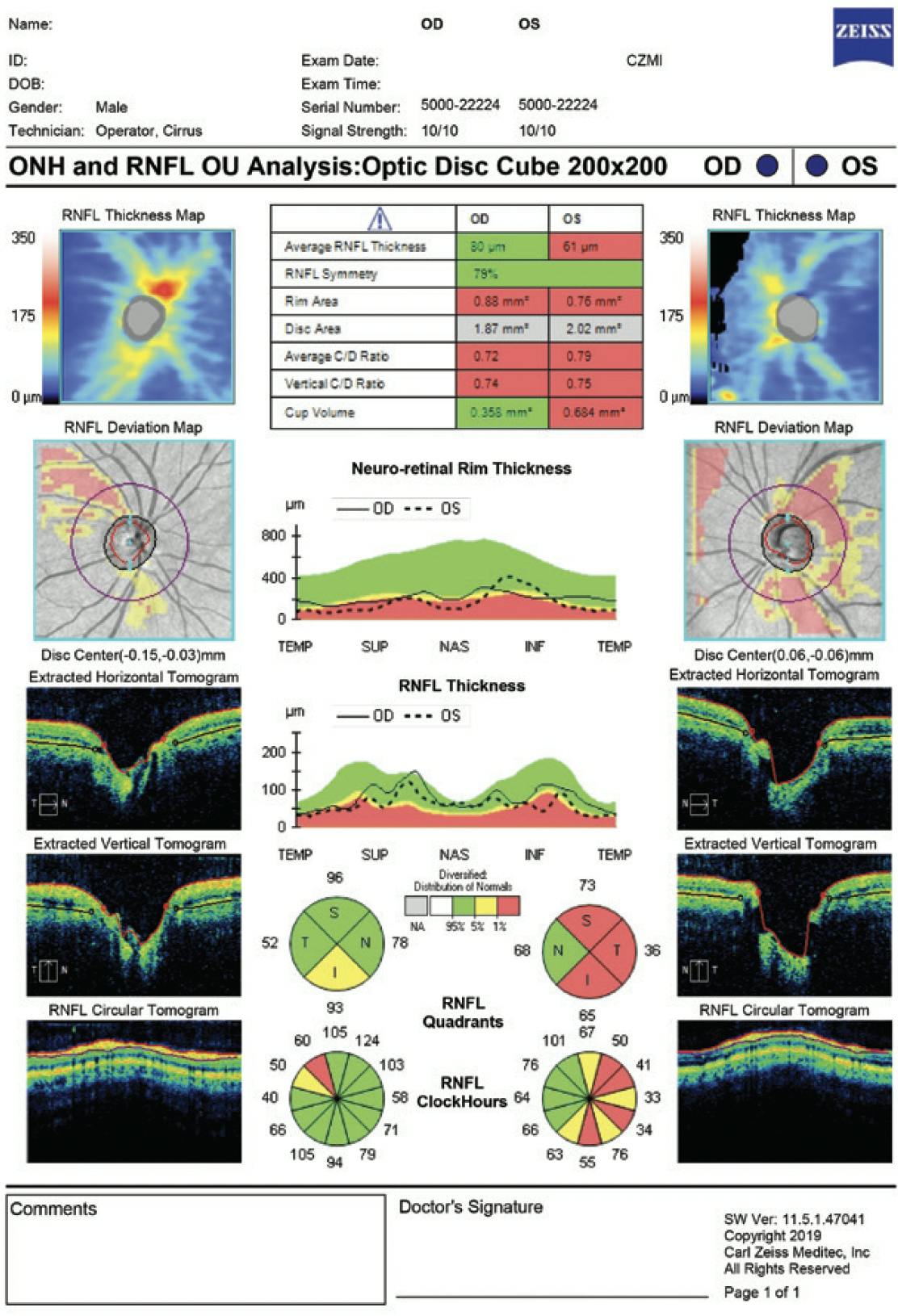
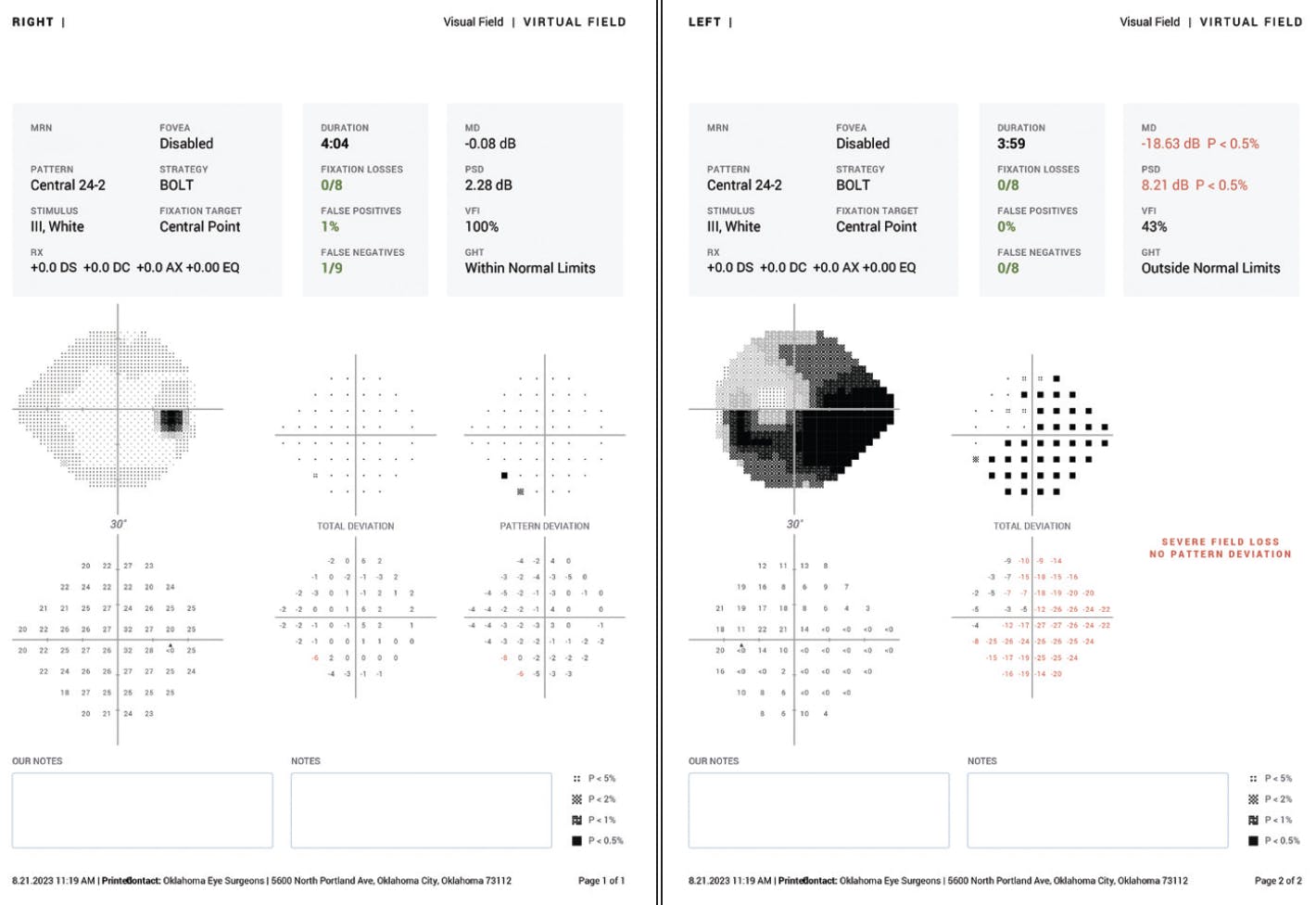
The patient refuses to begin topical medical therapy. How would you proceed?
—Case prepared by Steven R. Sarkisian Jr, MD
DAN EISENBERG, MD
Given the IOP readings, early glaucomatous damage in the right eye, and advanced damage in the left eye, the initial target pressures would be in the high and midteens in the right and left eyes, respectively, even though the corneas are somewhat thick. The patient has a greater than 70% chance of blindness in his lifetime with the traditional treatment progression of medication, laser therapy, and incisional surgery.1 Based on my experience in the original US trial of the iStent (Glaukos), I think the placement of microstents that bypass the trabecular meshwork is the only form of treatment that could provide him with 20+ years of functional vision. Sadly, there is little evidence that the vision in the left eye can be saved.2 Surgery would therefore be performed on the right eye first to retain the greatest amount of vision possible.
iStent Infinite stents (Glaukos) would be placed in the temporal quadrant of the right eye to save the nasal quadrant for future intervention. It would be helpful to remove the crystalline lens as soon as possible. At that time, my preference would be to perform cataract surgery combined with the implantation of a Hydrus Microstent (Alcon).
An Ahmed Glaucoma Valve (AGV; New World Medical) would be placed in the inferonasal quadrant of the left eye via the double-tunnel method, and 20 µg of mitomycin C would be injected into the same quadrant.
In short, I would expect the chronology of surgery to be as follows:
1. Temporal iStent Infinite placement in the right eye;
2. AGV implantation in the left eye;
3. Cataract surgery combined with Hydrus implantation in the right eye,
4. Cataract surgery combined with implantation of a Hydrus Microstent or suprachoroidal bypass in the left eye; and
5. Stent placement in the remaining quadrants of the right eye as needed.
REGINE PAPPAS, MD
The patient is a candidate for several options that do not require the daily administration of eye drops. That said, my first step would be to determine why he refuses topical therapy. Perhaps the reason is financial. Maybe he hopes to manage his disease in a one-and-done fashion with a standalone procedure. Whatever his motivation, I would emphasize to him that preventing blindness will require a lifelong approach.
The corneal pachymetry readings are above average. The optic nerve findings are asymmetric, with the left eye exhibiting moderate to severe disease.
Selective laser trabeculoplasty (SLT) would be the most feasible alternative to drop therapy. I would discuss this option with the patient and cite findings from the Laser in Glaucoma and Ocular Hypertension (LIGHT) trial.3 Another viable strategy would be to place a bimatoprost implant (Durysta, Allergan). If the patient is amenable to surgery, I would offer a standalone MIGS procedure such as the iStent Infinite or goniotomy with the Streamline Surgical System (New World Medical) or the Omni Surgical System (Sight Sciences) for the right eye. To lower IOP further, MIGS could be combined with transscleral laser therapy using the MicroPulse P3 delivery device (Iridex). A combined procedure such as goniotomy with the Omni Surgical System and ab externo placement of a Xen Gel Stent (Allergan) with primary needling would be performed in the left eye.
TONY REALINI, MD, MPH
The patient appears to have early POAG in the right eye and advanced POAG in the left eye. Reasonable initial target IOPs would be in the high teens for the right eye and midteens for the left eye, representing reductions of approximately 30% and 50%, respectively.
I would encourage the patient to undergo primary SLT in both eyes. SLT alone is likely to achieve the target IOP in the right eye but not the left. The procedure should, however, reduce the number of medications required to hit the target IOP in the left eye. This patient was uninterested in medications as a first-line option, but most patients who are resistant to using medications become less resistant when faced with surgery as the alternative. Fewer medications generally mean fewer side effects, better patient adherence, and a lower risk of disease progression over time. If additional medical therapy is required, the laterality of the indication would dictate my recommendations. A prostaglandin analogue would be my first choice if both eyes require medical therapy after SLT. If only the left eye requires medical therapy, I would opt for a beta blocker. I try to avoid unilateral therapy with a prostaglandin analogue because cosmetic side effects tend to be more obvious—and thus have a greater adverse impact—in this situation. The beta blocker would be dosed once daily in the morning. After approximately 1 month of treatment, IOP would be assessed at 8 am at 24-hour trough. If necessary, the dosing frequency could be increased to twice daily. If the target IOP is still not achieved, then the medication would be replaced with a fixed combination of a beta blocker and carbonic anhydrase inhibitor or adrenergic agonist administered twice daily.
WHAT I DID: STEVEN R. SARKISIAN JR, MD
As the panelists eloquently state, the patient had mild glaucoma in the right eye and severe glaucoma in the left. Given the imminent loss of vision in the left eye, I convinced him to begin medical therapy with a fixed combination of timolol 0.5%, brimonidine tartrate 0.1%, and dorzolamide 2% (OSRX) as a temporizing measure with a pledge to halt the medication after laser therapy and the implantation of a sustained-release bimatoprost implant. The patient was scheduled for bilateral SLT procedures 1 week after the initial visit and placement of a bimatoprost implant in the left eye 2 weeks later.
After 1 week of medical therapy, the IOP had decreased to 14 mm Hg OD and 18 mm Hg OS. Topical therapy was halted in the right eye. SLT was performed on both eyes.
Two weeks later, a bimatoprost implant was placed in the left eye, and topical medical therapy was discontinued.
Six weeks after SLT and 1 month after placement of the bimatoprost implant, the patient’s unmedicated IOP was 15 mm Hg OD and 13 mm Hg OS.
I agree that primary surgery with the iStent Infinite or Omni Surgical System in the right eye and a Xen Gel Stent or an AGV in the left eye would have been reasonable alternatives.
1. Peters D, Bengtsson B, Heijl A. Lifetime risk of blindness in open-angle glaucoma. Am J Ophthalmol. 2013;156(4):724-730.
2. Oliver JE, Hattenhauer MG, Herman D, et al. Blindness and glaucoma: a comparison of patients progressing to blindness from glaucoma with patients maintaining vision. Am J Ophthalmol. 2002;133(6):764-772.
3. Gazzard G, Konstantakopoulou E, Garway-Heath D, et al; LiGHT Trial Study Group. Laser in Glaucoma and Ocular Hypertension (LiGHT) trial: six-year results of primary selective laser trabeculoplasty versus eye drops for the treatment of glaucoma and ocular hypertension. Ophthalmology. 2023;130(2):139-151.
_1754918026.png?auto=compress,format)