In October, WPS Government Health Administrators, a Medicare Administrative Contractor, published a local coverage determination (LCD) for MIGS that, once effective, would deem several procedures investigational. The LCD essentially cited a lack of evidence indicating that these procedures are superior to trabeculectomy and tube shunt surgery. Enclosed here are a few patient and caregiver perspectives that highlight the life-changing benefits of some of the treatments that the LCD threatens to restrict.
“Now that he is through the recovery phase of the surgery, he is definitely singing a different tune.”
—L.D., Patient Wife and Supporter; St. Louis
Editor’s note: L.D. is the wife and supporter of a 47-year-old patient with glaucoma. GT spoke to her about her husband’s experience with the disease and what it would mean for him not to have had access to a treatment like gonioscopy-assisted transluminal trabeculotomy (GATT).
A note from Arsham Sheybani, MD
“Given this patient’s age and IOP on maximum tolerated medical therapy, I found it likely that his disease was in the realm of juvenile-onset open-angle glaucoma. After reviewing a range of options, we decided to proceed with GATT to treat the disease mechanistically rather than target a specific IOP. I preferred to avoid the higher risk of complications associated with trabeculectomy and tube shunt surgery in this young patient. Glaucoma is a long disease, and the use of GATT does not eliminate future treatment options.”
GT: What was your husband’s experience before treatment?
L.D.: “We never even discovered that my husband had glaucoma until 2017. That was his first time coming to the United States [from Haiti]. He had no symptoms; I was just like, ‘We’re in the States. We should probably get you an eye exam.' We had an eye exam done at Walmart, and that was when we were told his pressures were high. They recommended that we go to an ophthalmologist. We had one at our church, and he started [my husband] on drops.
But his pressures were so high—around 36 mm Hg—and the optic nerve was already 90% damaged at this point. [The ophthalmologist] was worried about waiting any longer for more extreme treatment, so he did a laser [treatment]. That did help bring the pressures down, but my husband still had to be on two drops in each eye. We couldn’t afford the better drops, the ones that might cause fewer side effects. Even with the laser—it did bring the pressures down, but to keep them [at that] level, he had to be on the two drops. Then there was [a pressure] spike in his right eye. That’s the eye he had [GATT] on with Dr. Sheybani.”
GT: What has his experience been like after treatment?
L.D.: “So far, he has only been on one drop in [the treated] eye. We have a follow-up a week from today to see if the pressure has stayed down while only on one drop. We’re really hoping that was successful because then it at least gets him off one of the drops, which is very, very significant.
My husband is an extremely healthy man. He has no other health issues except for this glaucoma, so it’s really frustrating. And he is so young. It was a hard pill for my husband to swallow that his eyes were that damaged. Obviously, no one wants surgery, but he doesn’t want to lose his eyesight. Now that he is through the recovery phase of the surgery, he is definitely singing a different tune. He’s really glad he did it, especially if we have a good [postoperative] report.
We all know that glaucoma cannot be cured. It can only be treated. We’re closely monitoring the eye he did not have surgery on because, if the surgery is as successful as we think it has been, then he may someday need the other [treated]. [I’d] rather not battle insurance and [would] like for it to be covered.”
GT: If your husband could not get access to this care, how do you think he would feel?
L.D. “My husband is a benevolence pastor. If he could not drive [because of his vision], that would have a huge impact on him doing what he’s called to do.”
“I don’t know that everybody else is so lucky.” —C.R., Patient; Denver
Editor’s note: C.R. is a patient who underwent endocyclophotocoagulation (ECP) and phacoemulsification. GT spoke to her about her experience and what it would mean for her not to have had access to a treatment like ECP.
A note from Leonard K. Seibold, MD
“Preoperative IOP was in the midteens on timolol after laser peripheral iridotomy, but the patient's angle was still occludable and she was forming peripheral anterior synechiae. I chose to proceed with ECP because it can deepen the angle beyond what cataract surgery can by shrinking problematic, large ciliary processes. This effect, in addition to aqueous suppression, can yield profound improvements in the angle anatomy and IOP. Vision is now 20/20, and IOP is 12 mm Hg off medication in both eyes.”
GT: What was your experience like before treatment?
C.R.: “[My IOP] was off the charts. That’s how I ended up finding Dr. Seibold and going this route because I just had really high pressure. My left eye was up at 37 [mm Hg], and my eye doctor was … alarmed. Long story short, I found Dr. Seibold.
Then, when I went to see him and he did a round of tests, he said, ‘Your angles are very narrow and most likely you have a very big buildup of fluid that is preventing your fluid from moving properly. I want to prevent you from having [more damage] by doing this procedure.’ In my case, I was really lucky that I had this early warning. I don’t know that everybody else is so lucky. But he’s pretty optimistic based on the success [of the procedure] that I am going to be okay.”
GT: What has your experience been like after treatment?
C.R.: “[I was on drops after] surgery for 2 weeks, and then I saw [Dr. Seibold] after. He did … my left eye first, my right eye 2 weeks later, and he saw me religiously in between. I saw him about 3 or 4 weeks ago now. He [was] like, ‘I don’t need to see you for 6 more months.’ I was so lucky.”
GT: If you could not get access to this care, how would you feel?
C.R.: “… I know there are so many people that don’t have the privileges that I have. I can’t even imagine having somebody get glaucoma and possibly lose their vision because they didn’t have access. That would be awful, and that's why I want to try to help if I can.”
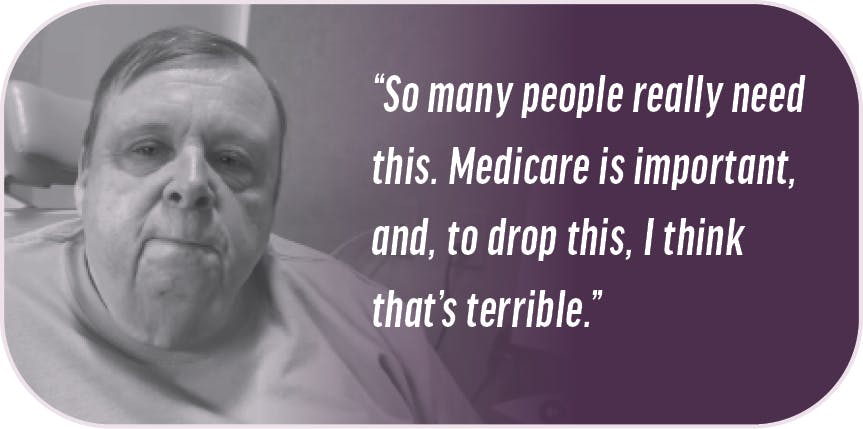
After 10 years on drops, a patient with moderate to severe glaucoma underwent cataract surgery and canaloplasty, performed by I. Paul Singh, MD. At 3 months postoperatively, the patient is seeing 20/20 on no medication, and IOPs are 12 mm Hg and 13 mm Hg. When describing what it’s like being off drops, he says, “It’s just fantastic to me. It really is.”
Click here to watch the full video.