Lowering IOP remains the only clinically acceptable method by which to slow glaucomatous progression. IOP is determined by the balance between aqueous humor production in the ciliary body and its egress through either the pressure-dependent conventional outflow pathway or the pressure-insensitive unconventional or uveoscleral outflow pathway. Addressing that balance has long been the focus of glaucoma treatment, yet current therapeutic approaches fail to target a key component, episcleral venous pressure (EVP), which can account for up to 50% of total IOP.
The quantitative importance of EVP is evident in the modified Goldmann equation,1 which mathematically describes the interplay of the four components of IOP (Figure): aqueous humor inflow rate (Q), uveoscleral outflow rate (U), conventional outflow facility (C), and EVP:
IOP = EVP + (Q-U)/C
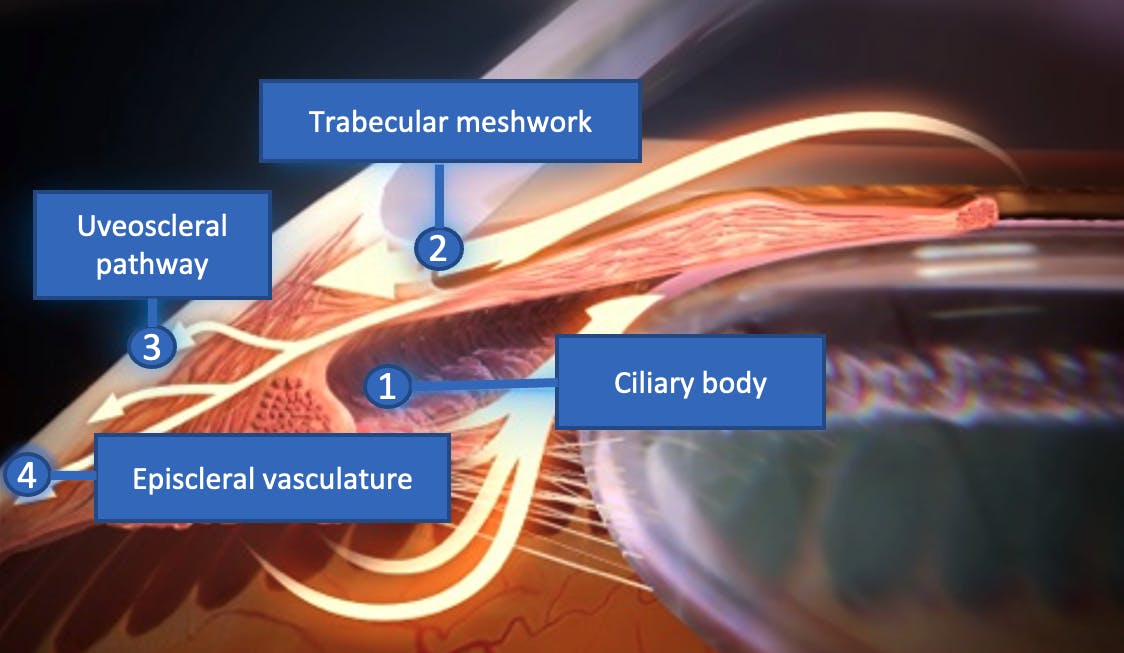
Figure. IOP is composed of four distinct components: aqueous humor inflow rate, uveoscleral outflow rate, conventional outflow facility, and EVP.
Until recently, research on IOP focused mainly on characterizing the conventional outflow pathway owing to its perceived importance in generating outflow resistance. At the outset of the 21st century, the general understanding of the conventional outflow pathway was that aqueous humor drained through the trabecular meshwork into Schlemm canal, then exited via collector channels and into aqueous veins that are integrated into the systemic venous system. In this model, elevated IOP is caused by outflow resistance generated at the interface between the trabecular meshwork juxtacanalicular (JCT) region and the inner wall cells of Schlemm canal.
Consequently, in the past 20-plus years, several products have been designed to reduce resistance at the JCT region or create a conduit to bypass this junction. These products include ocular hypotensive agents such as fixed combinations of dorzolamide 2% and timolol 0.5% (Cosopt, Mundipharma Ophthalmology Products), brimonidine 0.2% and timolol 0.5% (Combigan, Allergan), netarsudil 0.02% and latanoprost 0.005% (Rocklatan, Alcon); newer drugs such as netarsudil (Rhopressa, Alcon); and angle-based MIGS devices.
However, aqueous humor removal through the conventional outflow pathway is not passive. Rather, it is an active process that is highly regulated by the trabecular meshwork, ciliary muscle, and Schlemm canal and coordinated with the ocular pulse through functional nerve junctions in a nonuniform, segmental pattern. Moreover, although treatment strategies have been effective in lowering IOP from elevated to normal levels (14–16 mm Hg), they often cannot reduce IOP further (eg, to 10–12 mm Hg), even if used in combination, because of the back pressure from the episcleral venous system.
UNDERSTANDING THE SITES OF OUTFLOW RESISTANCE
Improving treatment options for glaucoma requires fully understanding the sites of outflow resistance in the conventional outflow pathway. Rosenquist et al demonstrated that up to 50% of outflow resistance in normal eyes and 70% of outflow resistance in glaucomatous eyes occurred at the JCT/Schlemm canal inner wall. They concluded, however, that 30% to 50% of outflow resistance remained distal to this region.2 Likewise, Schuman et al found that 35% of out- flow resistance existed in the distal outflow region following excimer laser removal of a portion of the sclera and the outer wall of Schlemm canal.3
Although these data were available in the latter half of the 20th century, it was not until the past decade that the field came to appreciate that outflow resistance exists beyond Schlemm canal in the distal outflow pathway and episcleral vasculature. One reason is that studies of nitric oxide showed that vasodilation of the distal vasculature within the conventional outflow pathway improved fluid flow and ultimately reduced IOP.4,5 These studies established the distal outflow pathway as a viable clinical target for lowering IOP in patients with glaucoma. Unfortunately, among the currently available antiglaucoma drugs, only netarsudil has been shown to have an indirect effect on EVP, with a modest decrease of approximately 10%.6
It is now understood that resistance within the distal outflow region is responsible for at least some of the 8 to 10 mm Hg attributed to EVP in normal eyes and higher EVPs (≥ 12 mm Hg) in eyes with primary open-angle glaucoma or normal-tension glaucoma (NTG).7 A drug that directly and specifically targets the distal outflow region and lowers EVP would be a significant therapeutic tool. It would “lower the floor” for IOP and work additively with all current glaucoma treatment options.
My laboratory recently developed a novel ocular hypotensive agent called cromakalim prodrug 1 (CKLP1) that belongs to the class of ATP-sensitive potassium channel openers. CKLP1 lowers IOP directly by targeting the distal outflow pathway and EVP.8,9 Working with Qlaris Bio, a clinical-stage biotech company, we have modified CKLP1 into an investigative compound, QLS-111. We have shown that, like CKLP1, QLS-111 independently lowers IOP by modulating the episcleral vasculature, most likely by relaxing smooth muscle and causing moderate vasodilation of distal outflow vessels beyond Schlemm canal through the activation of specific ATP-sensitive potassium channels. In preclinical studies, this class of compounds has also been shown to work in an additive manner with prostaglandin analogues, aqueous humor suppressants, and Rho kinase inhibitors.8
CONCLUSION
Elucidating the role of the distal outflow pathway in generating resistance significantly enhances clinicians’ understanding of IOP regulation. This information is particularly important to the treatment of patients with ocular hypertension, primary open-angle glaucoma, secondary glaucomas, and glaucomas driven by EVP, such as Sturge-Weber syndrome. It will also be valuable for patients with NTG because current treatment options are geared toward lowering their baseline pressure, which is often set by their EVP.
It should be noted that there are currently no approved, on-label, viable treatment options for NTG and Sturge-Weber syndrome. Developing drugs that modify the distal outflow region and EVP is thus the next frontier in managing IOP-driven pathologies with greater efficacy. In the not-too-distant future, novel EVP-targeting agents, whether administered singly or in combination with other therapies, may rise to the challenge.
1. Brubaker RF. Goldmann’s equation and clinical measures of aqueous dynam- ics. Exp Eye Res. 2004;78(3):633-637.
2. Rosenquist R, Epstein D, Melamed S, Johnson M, Grant WM. Outflow resistance of enucleated human eyes at two different perfusion pressures and different extents of trabeculotomy. Curr Eye Res. 1989;8:1233-1240.
3. Schuman JS, Chang W, Wang N, de Kater AW, Allingham RR. Excimer laser effects on outflow facility and outflow pathway morphology. Invest Ophthalmol Vis Sci. 1999;40(8):1676-1680.
4. Chang JYH, Stamer WD, Bertrand J, et al. Role of nitric oxide in murine conven- tional outflow physiology. Am J Physiol Cell Physiol. 2015;309(4):C205-C214.
5. McDonnell F, Dismuke WM, Overby DR, Stamer WD. Pharmacological regula- tion of outflow resistance distal to Schlemm’s canal. Am J Physiol Cell Physiol. 2018;315(1):C44-C51.
6. Kazemi A, McLaren JW, Kopczynski CC, Heah TG, Novack GD, Sit AJ. The effects of netarsudil ophthalmic solution on aqueous humor dynamics in a randomized study in humans. J Ocul Pharmacol Ther. 2018;34(5):380-386.
7. Selbach JM, Posielek K, Steuhl KP, Kremmer S. Episcleral venous pressure in untreated primary open-angle and normal-tension glaucoma. Ophthalmologica. 2005;219:357-361.
8. Roy Chowdhury U, Rinkoski TA, Bahler CK, et al. Effect of cromakalim prodrug 1 (CKLP1) on aqueous humor dynamics and feasibility of combination therapy with existing ocular hypotensive agents. Invest Ophthalmol Vis Sci. 2017;58(13):5731-5742.
9. Roy Chowdhury U, Millar JC, Holman BH, et al. Effect of ATP-sensitive potas- sium channel openers on intraocular pressure in ocular hypertensive animal models. Invest Ophthalmol Vis Sci. 2022;63(2):15.